During our stay, together with philosopher and friend #Leonardo Caffo#, we sketched out a kind of constellation of Kyiv’s art scene – mapping the city through artists, intellectuals, researchers, curators, cultural workers and poets who have stayed behind. The constellation, which is necessarily incomplete, was created through visits and interviews – always the same ten questions to everyone. Simple questions about daily life, care and an uncertain future. We sought to avoid ‘distancing’ the violence they experience. Ukrainian artists are not monuments, but individuals with stories that transcend the national and historical frameworks they are often forced into.
OOZ Kharkiv is the name of the research project we have in mind – based on the interviews and field notes. An exhibition will also be curated in collaboration with the Yermilov Centre in Kharkiv, as well as a publication. If #Europe relates to Ukrainian art through the lens of #war – and reduces artists to fixed symbols – the OOZ Kharkiv project attempts to reverse this logic and shift the focus to the people and their stories: not from the war, but through it.
Below are a number of things I did not know about war before this trip. Reflections I had not arrived at. The Italian philosopher #Giorgio Agamben# writes in Infancy and History (1978): ‘Experience is not something we have, but something that happens to us.’ What follows are concrete insights, born of my emotional, political and professional response.
Things I didn’t know – art and weapons
In #Kyiv, cultural life is flourishing despite the war. Every week, new exhibitions, performances and bookshops open, and magazines are published. Some say it feels like the ‘new Berlin’. But the difference is radical: here, art is not a leisure activity – it is military activity. It is part of a widespread resistance movement in line with the immediate needs of society. Art does not represent the war: it intersects with it, transforming it into care and fundraising. Many artists have been recruited to the front lines. By selling their works, others finance ammunition, equipment and medicine. Artistic practice becomes a form of survival logistics.
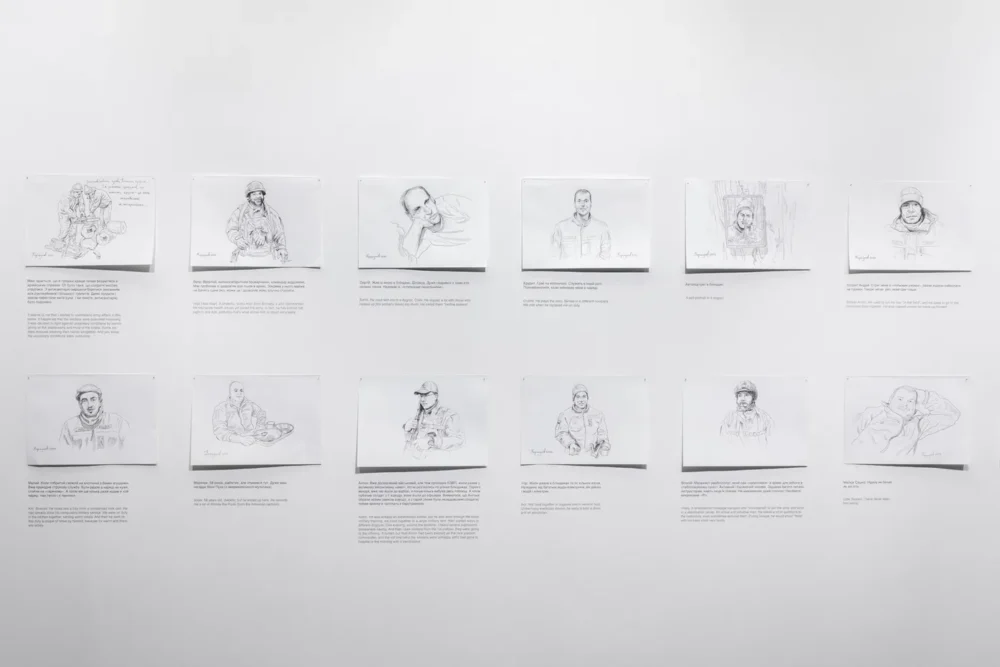
In Dust Cures by #Yevhen Korshunov#, presented at the Pinchuk Art Centre, this dual connection between art and life is shown in its rawest form. The faces drawn on the walls are from the graves of war comrades, with their distinctive features, stories and ways of remaining human – while dust, rats and damp fill every room here. The work moves between discomfort and deep intimacy, offering a multifaceted image of the soldier – not an abstract figure, but a face, a voice, a body that has coughed alongside a hundred others every morning in the freezing cold. Here, art does not idealise. It documents and disarms, bringing human micro-histories to the surface, previously buried under the rhetoric of war.
Bringing human micro-histories to the surface, previously buried under the rhetoric of war.
Dreams that resist
But art in Ukraine is not just testimony: it is active reconstruction. Theatre of Hopes and Expectations, by the Prykarpattya Theatre collective (including Yarema Malashchuk and Roman Khimei), is a clear example. The space was originally built as a temporary pavilion in Düsseldorf from discarded theatre sets and housed exhibitions, concerts and discussions. It was later dismantled and transported to Ukraine, where it became a home for the displaced Honchar family from the Kyiv region. A powerful gesture: transforming art into a place of refuge, an aesthetic object into an infrastructure of solidarity.
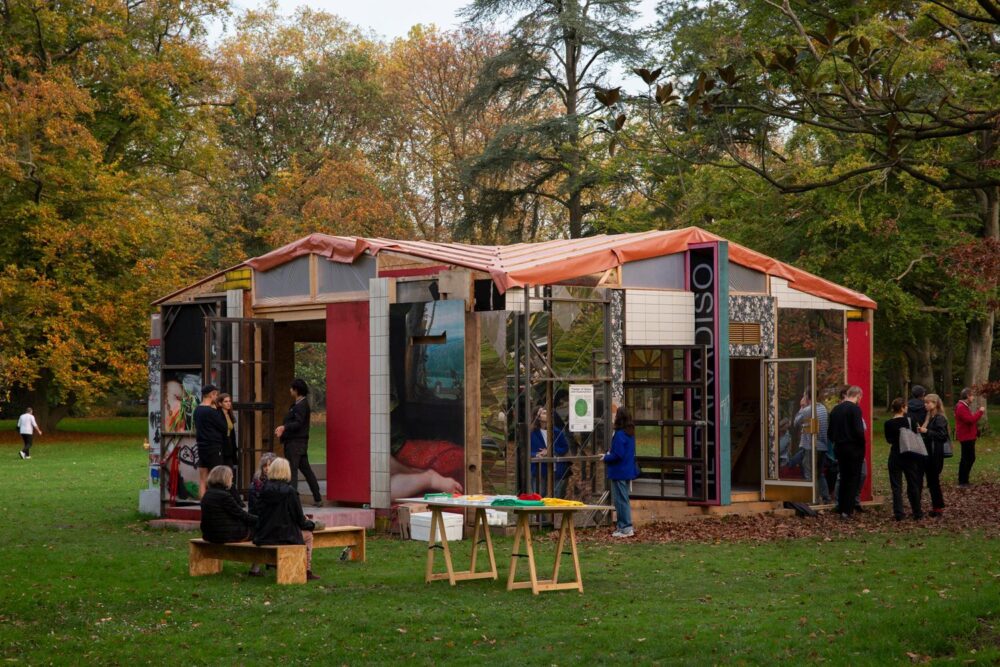
A space for voices, memories, bodies, dreams that resist.
These projects do not ask war to stay away from art, but allow art to be permeated by it – so that it can be transformed. In this context, the artist is neither commentator nor observer: they create bonds, networks, tell small stories and are a means of cohesion. In Ukraine today, making art is creating space – literally. A space for voices, memories, bodies, dreams that resist. And this is perhaps the most important role of art in times of war: not only to give form to pain, but to create the conditions for future peace, rooted in care, listening and rebuilding together.
What if they bombed your cultural heritage?
When trying to imagine war from the outside, it can be helpful to think about #cultural heritage#. How would you feel, for example, if your cultural heritage was bombed? If they destroyed your favourite statue, the dome of a church or your beloved museum? Imagine that almost every day, the history stored in the places that shape your identity is in danger.
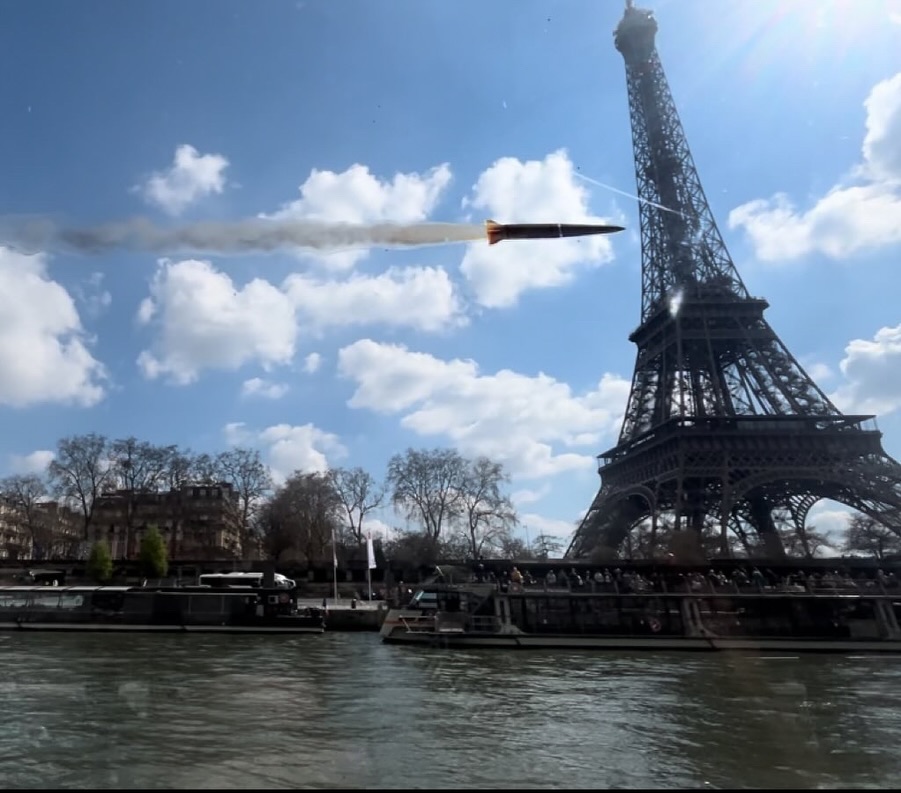
In Russian Rocket (2022), Ukrainian artist #Zhanna Kadyrova# performs a simple but striking gesture: she sticks a sticker with a Russian missile on the window of a bus, tram, train or ferry.
Imagine that the missile suddenly flies over your city. Your streets. Your schools. Your museums. The sticker becomes a visual parasite that adapts to any urban context and pollutes it. War – which is usually distant – appears in the windows of our lives and gives the impression of the same brutality that exists in Ukraine.
Russian Rocket is mobile and participatory, and can be placed anywhere in the world. The vehicle is the frame – the landscape is the backdrop. It is a tool for emotional displacement, democratic in its reach: anyone can participate, use the stickers, photograph it, share it. Art goes viral not by strategy, but by necessity: to show what is hidden, repressed, off-screen. At a time when war is filtered by algorithms and geopolitics, Russian Rocket reminds us that nowhere is truly safe when under attack. And it is on the glass that separates us from the missile – that window that has become a threshold – that the ethics of vision play out: are you a spectator or a target?
To bomb a museum is to bomb memories. Attacking a museum, a library, a theatre or a church is destroying what gives meaning, roots and history to a community. Defending them is protecting a common language, a common heritage and the basis for reconciliation.
Attacking a museum, library, theatre or church is destroying what gives meaning.
That is why #Odessa, in the midst of war, was declared a #UNESCO site – thanks in part to Italy’s diplomatic efforts: protecting cultural heritage is a political act, a moral resistance to violence. Cultural heritage in war is never ‘collateral’ – it is strategic, symbolic. The same is true of activating this in peacebuilding practices.
The theft of over 173,000 objects was no accident: it was identity erasure.
The artwork Explosions Near the Museum by #Yarema Malashchuk# and #Roman Khimei# tells the story of the Kherson Local History Museum, which was looted by Russian troops in October 2022, just before they withdrew. With actual bombings in the background – she filmed less than two kilometres from the front line – the museum was emptied of its treasures. The theft of over 173,000 objects was no accident: it was identity erasure, an attempt to rewrite history through looting. They are not just attacking people. They attack the ability to tell stories, to recognise oneself, to exist in time. It is a war against memory.
It was identity erasure, an attempt to rewrite history through looting.
That is why protecting cultural heritage is not neutral. It builds the symbolic and moral foundations for peace. ‘Since wars begin in the minds of men, it is in the minds of men that the defences of peace must be constructed,’ states the introduction to the UNESCO declaration. Protecting cultural heritage means preserving the possibility of imagining a future.
The role of sound
If you try to imagine war from outside your home country, think about the sounds you hear every day: traffic, birdsong, church bells – these say something about the relationship we have with sound in the place where we are.
The sound of war is an intrusion into people’s physical and emotional space.
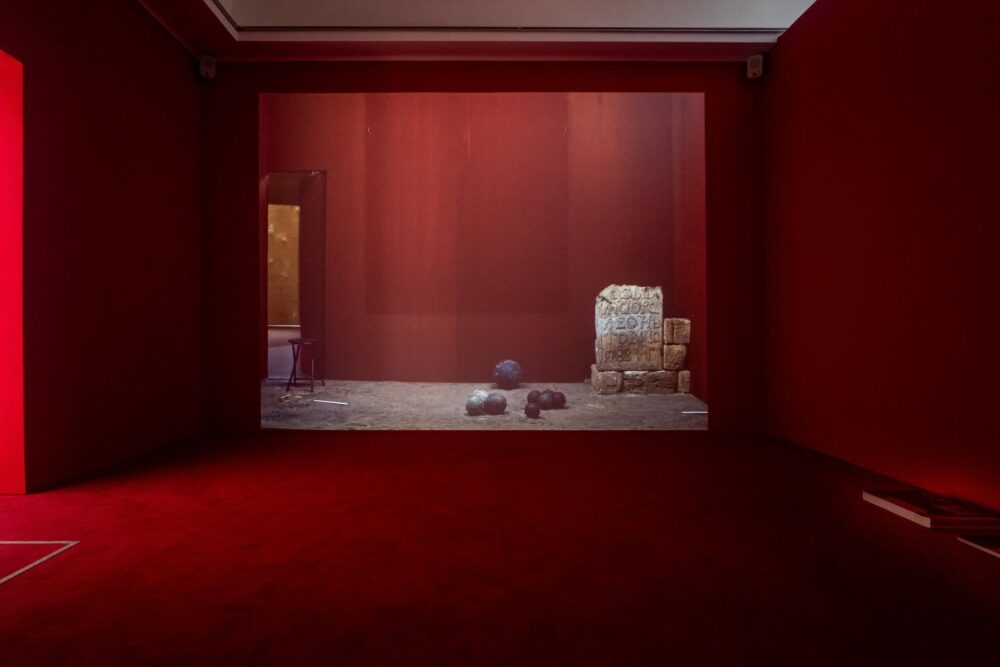
Two Ukrainian artists I deeply admire, #Nikita Kadan# and the collective #Open Group#, explore through their works Tryvoha (‘Sirens and the Mast’) and Repeat After Me II the sonic (auditory) colonisation of war in Ukraine’s everyday cultural atmosphere. The sound of war is an intrusion into people’s physical and emotional space. In Tryvoha, installed in a church in Ypres in 2023, Kadan built a circular structure of transparent fabric and light steel that invites the audience inside. It is a fragile, inviting, almost liturgical space. But inside, you are struck by a sharp, piercing sound: the air raid siren – the signal that in Ukraine means ‘imminent danger’. In Repeat After Me II, presented at the #Venice Biennale# in 2024, the Open Group brings the war into a military karaoke setting. Ukrainian refugees – civilians, not soldiers – recite the sounds of the bombs that hit them. The audience is invited to do the same. To learn the grammar of conflict, a sound language for survival. Karaoke – usually a playful, social tool – becomes a traumatic device.
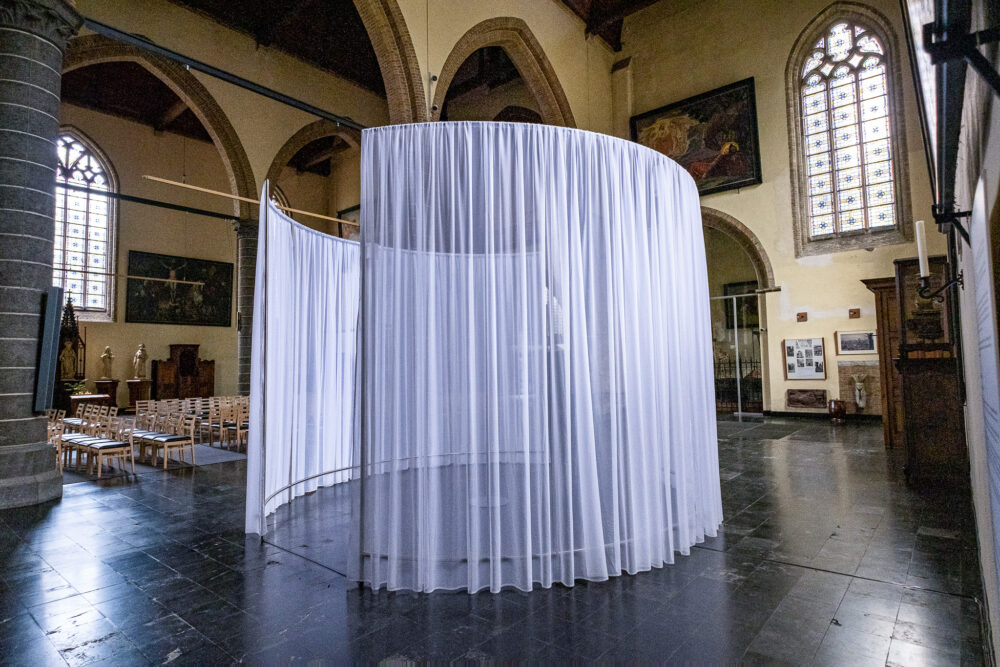
The works of Kadan and Open Group both show that sound is never neutral. In war, sound is power – it is a control system, a threshold for panic. But it can also become a tool for resistance.
It is a control system, a threshold for panic.
In Tryvoha and Repeat After Me II, listening is never passive – it is a political act, an action. Those who listen participate. Those who listen allow themselves to be moved. In this context, sound operates on the border between personal experience and collective #trauma, between auditory memory and possible futures. In all cases, sound acts as a bridge between what is happening elsewhere and what is happening here, between those who have experienced war and those who can only imagine it.
A cultural rights movement
After sixteen hours on the bus and seven hours at the border between Ukraine and #Poland, Leonardo and I arrived home safely. This journey taught us that this war is also our war.
What is being defended in Ukraine is also a threat to my peaceful Sunday in the park at home in Malta.
Russia feels far away, but as I walked through Kyiv on a sunny day, I rediscovered what it means to be European. On the edge of Europe, we find more Europe than I ever imagined – respect for gender, freedom of thought, a queer scene, musical experimentation and political debate. The Russian empire does not fear #NATO – nor does it fear a cultural and collective rights movement. As #Tiziano Terzani# wrote in Letters from Kabul: ‘It is time to stand up; it is time to take a stand for the values we believe in.’
After this trip, I am convinced: as European cultural workers, it is our responsibility to take a stand. The Ukrainian resistance movement is defending a cultural vision. We are called upon to help protect it. It is time to make peace.