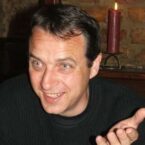
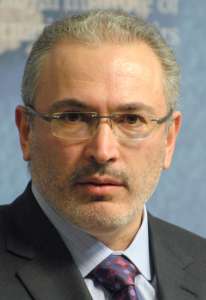
Mikhail Khodorkovsky has had a lot of time to think about how a new, democratic, socially compassionate, and enlightened #Russia could emerge after the eventual collapse of Putin’s autocracy.
He spent ten years in prison in Russia on trumped-up charges of #tax evasion# and other economic crimes. His real ‘crime’ was voicing open opposition to the loss of liberties in Russia under #Putin. It has now been ten years since Putin permitted his release, and Khodorkovsky – who was granted a last chance to see his mother before she died as a result of Putin’s decision – has lived in London since (although he has close ties with Switzerland too, where his wife Inn and two of his children live.)
Freed of the full-time duties of running a major Russian oil company (Yukos, which he lost control and ownership of when he was imprisoned), the brilliant young businessman who graduated from Moscow’s prestigious Mendeleev University of Chemical Technology in the mid-1980s devotes much of his time to supporting the Russian opposition movement and key figures within it. A fervent opponent of Russia’s war against #Ukraine (which he, like many in the Russian opposition, considers dates back to 2014 and the seizure of Crimea), he finally put his thoughts together in a systematic way in 2022 in a Russian language book. The English translation (by Stephen Dalziel) – How to Slay a Dragon: Building a New Russia After Putin – has now been published by Polity, a British publisher with offices in the UK and the US.
A new Russia
How to Slay a Dragon is a somewhat ponderous book, written with few references outside Khodorkovsky’s own experience; it wears its intellectual mantel lightly. A prescription for how Russia can move beyond Putin, shake off centuries of #despotism, and create a fair and democratic parliamentary #democracy to replace the corrupt old ways of its presidential (or Tsarist) system, there is little particularly new or radical about it.
Addressed to the Russian opposition and people who want better for their country than war, #autocracy and #corruption, like the armchair philosophers Khodorkovsky occasionally criticises in its 225 pages, the book sets out a plan of action without ever defining who might implement it and how.
For a still-wealthy man who made his money by taking control of streams of natural resource rents sold dirt cheap under Yeltin’s loans for shares scheme in the early 1990s, Khodorkovsky is magnanimous in suggesting that social equality could be achieved by returning the proceeds of oil, gas and other of Russia’s abundant natural resources to the people by paying monies directly into pension and social investment accounts for every citizen. Ideas elaborated in a text «Turn to the Left» that Khodorkovsky wrote in prison resurface here.
Today’s Russia, under Putin, uses those resources for the arbitrary benefit of a small circle of people – «several hundred families» – who are close to, and support, Putin, Khodorkovsky writes.
Putin «divides up the profits from the sale of raw materials – oil, gas, metals, and timber – in a completely arbitrary fashion doing simply as it wishes and acting in the interests of a narrow circle of people. I believe that, in order for Russia to be a state that provides for its people – as is prescribed in the Constitution but doesn’t exist in reality – it’s vital that society be given back control over resource rent – that is, over the rent proceeds from the extraction and exploitation of the country’s natural resources.»
«Revolutionary violence… then you will be in good company with any dictator.»
Blueprint for reform
To reach this state of affairs and the parliamentary federal system based upon a separation of powers and regional city-based grassroots democracy, that he foresees #revolution is necessary, Khodorkovsky stresses. And it is here that he joins companies with other, earlier oligarchic exiles, such as the late #Boris Berezovsky#, in calling for the potential use of arms against Putin’s regime.
«Revolutionary violence is necessary,» he states.
«If you regard peaceful protest as meaning that you reject on principle any revolutionary violence (and that is how many people naively see it), then you will be in good company with any dictator. But doing battle with the dictatorship will be completely impossible.»
He finesses his argument, but it boils down to a call to arms for those in Russia prepared to take on Putin.
«…if the regime is prepared to open fire on its own people, then a demonstrative and early refusal by the opposition to use violence as a way of seizing power will be counterproductive….If you turn away completely from violence, then you turn away from revolution. In reality, not only is revolutionary violence legitimate, but historically, it has always and everywhere proved to be a source of the new legitimacy.»
These are «hard truths,» Khodorkovsky admits. «But they are the ABCs of revolutions – and they need to be learnt by heart. If, that is, you wish to be victorious.»
«Today’s Russia, under Putin, uses those resources for the arbitrary benefit of a small circle of people»
Post-Putin
The author is happier when he gets into the meat of his arguments about what direction a post-Putin Russia could take to achieve a new, open, and fair country that could take its place back among the international community (that is, once the war in Ukraine is over, and after a suitable period where the lessons learned from its disastrous imperial ambitions have time to sink it.) Here, he stresses that the war must end in some kind of decisive peace, lest it be left to fester.
Khodorkovsky spends the first half of the book outlining how Russia’s disparate opposition can learn from the mistakes of the past (avoiding a ‘Bolshevik’ model where if you aren’t with us, you are against us, in favour of a model that recognises if you aren’t against us, you are with us), how Lenin’s maxims on the seizure of power can be updated for the 21st century (seizing key controlling points of national informational and structural infrastructure), and how the opposition in exile can and should work with those brave souls who remain in Russia. He also looks at what to do with members of the Old Guard – arguing, just as Lenin did, that you cannot afford to dismiss the entire civil and judicial service as you will have no one left to run the country.
The second half of the book is devoted to how to build a new Russia, and here, Khodorkovsky draws upon the model of the ancient system of pre-Muscovy self-governing city-states for a vision of a 21st-century federal and parliamentary democracy that gives powers to the regions via a kind of German democratic model of «lands» – large cities that have powerful, elected mayor and governors who balance the power of Moscow.
He examines questions of economic, judicial, intellectual, social, and political justice, concluding that a central concept of mercy has long been lacking in the Russian polity and that this is essential to a new vision for Russia.
It is all stirring stuff for those who dream of a new kind of Russia after Putin, but one is always left with the nagging thought of just who will actually launch, conduct, carry, and implement this revolution and these reforms. Khodorkovsky offers no answer for that.