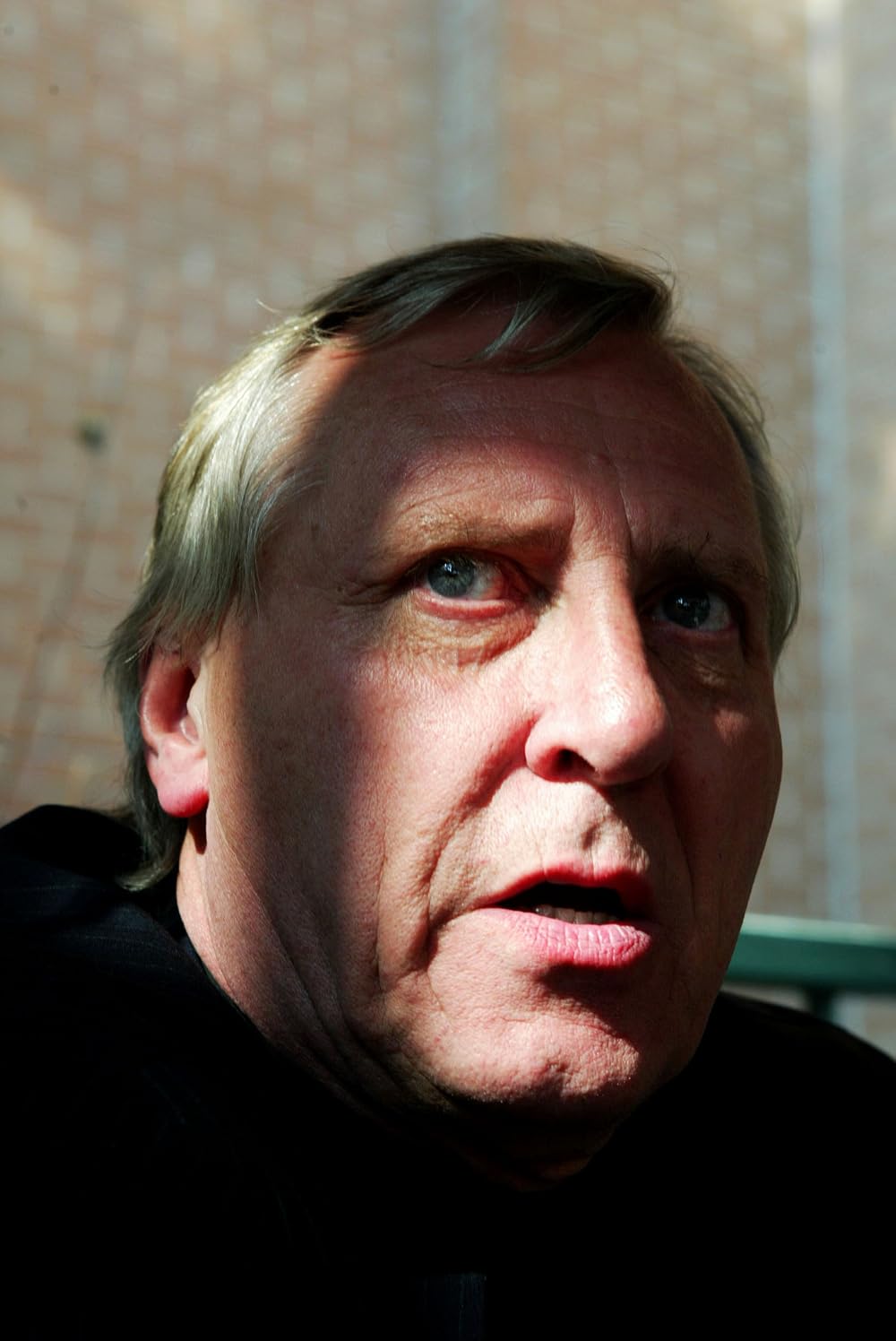
We meet him at the Kosmorama film festival in Trondheim. There is something irritating about the film director Peter Greenaway. To many, he comes across as a British snob, full of clichés. Such as the claim that ‘film is dead’. That ‘a pure film’ has not yet existed. That film remains illustrated text. Or that one should not adapt books for the screen.
The British filmmaker Greenaway was born in London and raised in a middle-class household. The star director visited Trondheim for barely a day – flying directly from Amsterdam, where he now lives.
Le Monde diplomatique has been granted 12 minutes for an interview. Somewhat reluctantly, I sit down opposite that arrogant, upturned face there on the sofa. In my notes, I have written something he said in 1997: ‘Film is an old technology. I think that over the last 30 years we have seen that film is dying. In a way, Jean-Luc Godard ruined everything […] he sounded the death knell because he took film apart, fragmented it, and made it highly self-conscious.”fotnoter“> (1)
Greenaway is known for confidently taking control of interviews, and the clichés come thick and fast. I ask for a more philosophical conversation, about what he actually means by ‘film is dead’. Greenaway replies, a glass of white wine in his hand:
– Film has not yet taken the visual seriously. I haven’t been to the cinema for the last 20 years. The last thing I saw was probably Blue Velvet by David Lynch. Film is extremely boring. The most interesting things rarely happen in film, but rather in the visual arts and literature.
– Perhaps you could explain a little more than just making a claim. Could you comment on the fact that Godard has been described as the man who deconstructed film?
– You need to read something other than Godard; he’s an old man. Focus on the present.
– But it’s you yourself who’ve referred to him before, hasn’t it?
– You sound like a student. Move on from him. Forget those intellectual textbooks.
GREENAWAY WAS once a director I enjoyed watching. In the 1980s, I discovered him through Zoo (1985), a film about decay – of insects, animals and humans alike. As philosophy students, we’d rush to the film club and the cinema to watch films like The Draughtsman’s Contract (1982), The Architect’s Stomach (1987), Drowning by Numbers (1988), or The Cook, the Thief, His Wife and Her Lover (1989), which shocked the audience at Oslo’s Gimle cinema. In the 1990s, Prospero’s Books (1991) was shown in cinemas whilst I was studying in New York – where half the audience walked out halfway through. But our professor of media theory showed clips from the film – whilst he himself lectured with the blinds drawn, his face tinged by the sun’s grid-like pattern. And we discussed it. Later came the enchanting The Pillow Book (1996) – in which Greenaway uses Japanese characters to attempt to unite text, body and image. But with 8½ Woman (1999), interest waned.
Here in Trondheim, Greenaway screened The Night Watch (2007), but also held a ‘masterclass’ for an audience of 400. We hear that the film has not achieved a sufficient degree of autonomy, that it fails to utilise its visual potential. He is repeating himself. For example, 14 years ago one could read in an interview: ‘The film has not yet existed. No one has yet made a film. The best we have seen has been a kind of illustrated literature or recorded theatre.’ (2)
In the 1960s, Greenaway was very much part of the French auteur milieu, according to himself. Young Peter spent three years trailing François Truffaut around Paris with his tape recorder in tow. Only to grow weary of him, describing him as ‘far too exhibitionist and far too French a director’. But do we not also grow weary of Greenaway after having laughed a few times, when he drags out his lecture half an hour too long? Is the 66-year-old too fond of his own show, standing there with his long pink scarf draped around his neck? Doesn’t he realise what clichés and assertions he is serving up with such panache in Trondheim’s largest cinema auditorium? ‘The most interesting films have all cost less than a million dollars.’ (That doesn’t apply to the majority of his own films, I reckon.); ‘Film has been around for 112 years, but has still not convinced visually.’ (Doesn’t he watch films?); ‘There are only two real themes in film: sex and death.’ (Oh really, are we that simple?) Nor did everyone in the auditorium agree with Greenaway’s doomsday prophecy regarding the history of cinema: ‘One could describe the period as three generations, with the grandfather [Eisenstein] who organised it all, the sons [de Sica, Fellini, up to Fassbinder’s death in 1976] who mainly maintained it all, and the grandchildren [Godard et al.] who threw it all overboard.’
Yet a couple of years ago, Greenaway wrote in Le Monde diplomatique about the revisionist filmmakers, noting that ‘Coppola, Kubrick and Scorsese championed the Fellini/Welles tradition, whilst Woody Allen, Wim Wenders and the Coen brothers championed the Godard tradition.’ (3) He also mentioned the post-revisionists “Tarantino, Stone and Scott”, who engage in interaction and pastiche. But didn’t he just say that he no longer watches films?
– Last year, the Coen brothers released the now Oscar-winning film based on Cormac McCarthy’s No Country for Old Men. What do you think of this film adaptation?
– I haven’t seen it.
WHAT DOES GREENAWAY actually mean when he says that film should take the visual seriously? At the very least, Greenaway explained 11 years ago that Alain Resnais, with Last Year at Marienbad (1961) (4), created the closest thing one could get to a film – that is, a work of art that could not be expressed in any other medium. Resnais’s masterpiece is described as ‘true cinematic intelligence. It is not a slave to the text. It is not a slave to a narrative. Rather, it deconstructs such phenomena and creates a product that is purely cinematic.’
A rather philosophical film. I shall therefore draw on a reference to Godard, who has stated that reality itself – and thus history – is most accessible through art, through the poetics of images. (5)
I am therefore expecting a more philosophical answer. The man is sitting 10 centimetres lower than me at the front of the sofa, but his head is tilted upwards enough that I feel he is looking down at me:
– Reality itself is far more real and inspiring. I can simply go out onto the street here in Trondheim, look around and be inspired. After all, my films are merely fiction.
Is the man being thoughtless, or simply not in the mood for reflection after Sunday’s many interviews? My notes also contain a quote from a Greenaway interview ten years ago: ‘For me, creation is trying to orchestrate the universe in order to understand what surrounds us. Even though, in order to achieve this, we resort to all manner of strategies and means, which ultimately prove completely unsuitable for keeping chaos at bay.”
The reality that surrounds us. Godard has previously reminded us that film images contain the joy of preservation, but that nothingness dwells right beside it. Whilst the images manage to deny nothingness, their transience constantly reminds us of it. That is why he defends the dignity of life in many of his approximately 80 films.
But what strategies has Greenaway himself employed to sustain reality?
– Are you seeking a deeper meaning with your aesthetic films?
– Meaning, what is that? A deeper meaning?
– Yes, something meaningful, something that gives meaning beyond the pleasure of the moment.
– What do you actually mean?
– Let’s say something that has consequences for us. Possible ethical and political aspects of being human.
– But everything is political, isn’t it! For example, the way you’re sitting here in front of me, the way you’ve had your hair cut, the fact that you’re unshaven, the clothes you’re wearing – and the way you express yourself through your questions.
– You’ve said before that ‘meaning is not the purpose of art’. Doesn’t it strike you that typically aesthetic film can be dismissed as too frivolous, merely as a game or various forms of play?
– My films and other projects give me the opportunity to play with language. For language is actually far more interesting than the content. The content always fades away quickly, and then all we have left is language. But that is more than enough.
To a large extent, more than enough.
GREENWAY’S LIST MANIA is well known. In contrast to the film’s usual dramatic narrative, he structured Zoo, for example, around the alphabet from A to Z; in The Cook, the Thief, His Wife & Her Lover, it was the seven colours of the rainbow; and in Drowning by Numbers, it was … well, take a guess.
– I have no particular desire to be polemical or didactic, or to have any ‘meaning’. I derive the greatest pleasure from works of art that depict an encyclopaedic and complex world.
Greenaway is not the first to do this. Greenaway’s ‘mentor’, Godard, was a master at using lists and categories – in contrast to the typical narrative film. The philosopher Gilles Deleuze describes him as Aristotelian; Godard’s films are syllogisms with ‘degrees of probability and logical paradoxes.’ (6) He creates lists or series marked by categories. Different genres are reflected in films with broken lines and an almost slalom-like progression through a sort of multilingual world. Godard influenced the Pop Art movement and, later, contemporary and video art by deconstructing cinematic language, as well as questioning the meaning(s) of images and what they represented. Through film, he reflected on the politics, production, self-reflexivity and subjectivity of the image. (7)
For example, Godard’s film Les carabiniers (1963) is not yet another film that glorifies or criticises war, but a cinematic exploration of the categories of war: air force, navy and infantry (air, water, land); concepts such as occupation and resistance; and emotions such as violence, absence, flight, surprise, noise and silence. This film also made use of colour codes, albeit not the entire rainbow as Greenaway did. For Godard, the aim was to ‘strip reality of its appearances in order to recreate raw reality […] To film is therefore to seize an event as a sign.’ (8)
Speaking of signs and lists: Greenaway’s The Tulse Luper Suitcases (2005) comprises 92 events with sub-scenes depicting Tulse Luper’s travels and 92 corresponding suitcases. The project consists, amongst other things, of several feature-length films totalling 7 hours. Uranium has the code 92 – the era is therefore linked to the deterrence of the atomic bomb, from Hiroshima to the fall of the Berlin Wall. Greenaway screened several excerpts in Trondheim: the work contains parallel narratives, collections of facts, stories (“History does not exist; there are only historians”), documentaries, replays and alternatives. The project is available online (160,000 hits daily), consists of interactive video games and 92 suitcase-sized DVDs, and is staged as an opera-like ‘total work of art’ with Greenaway himself as the DJ. The project is a navigational work – the narratives are merely appendages.
As early as 1991, in Prospero’s Books, Greenaway used an HD video inserted in the middle of the film footage – and, as mentioned, people walked out of the cinema. Today, many have become accustomed to the use of layers upon layers, windows, inset and frozen images on TV and computer screens. And more and more of the film industry has become post-production: computer-manipulated actors, digital backdrops, colour effects, and so on. As Greenaway said in Trondheim: ‘The actors will all disappear. We can recreate them from the tips of their toenails right up.’ He tells us that ‘young people go to the cinema less often […] my next film will be released on Second Life, where 64 million people have signed up.’ And that ‘interactive film is the future.’
– You’re clearly a technology optimist, but don’t we lose something with all this technology?
– But art has always made use of technology! Do you see this pencil I’m holding here? It’s technology just like anything else. It’s nothing new. New computer technology and virtual reality can take us out of the monotonous, passivising darkness of the cinema. For example, with three-dimensional IMAX or VR glasses, the edge of the screen moves beyond the periphery of your vision, so that you feel as though you’re right in the middle of the film.
I WON’T GIVE UP on delving into the content behind beautiful surfaces: in The Tulse Luper Suitcases, Greenaway explores meaningful themes well worth reflecting on: Tulse Luper is constantly taken prisoner and confined during his travels. Just like today’s asylum seekers. Metaphorically, some of the scenes can be interpreted as prisons: ‘the home as a prison’, ‘desert-like’ loneliness, the restlessness of travel, confinement within classical literature, or the suffocating claustrophobia of the bourgeoisie. And take, for example, suitcase no. 46, which contains 92 gold bars – all the gold belonging to the victims of the Third Reich …
– Would it be fair to say that you have a political message with Tulse Luper?
– We expect a film to, in one way or another, give us meaning or comfort us. That is simply not the purpose of art. All my films are experimental in one way or another – that’s how I take a risk. I believe it’s important to be provocative, whether intellectually or visually.
But I wonder how far Greenaway is willing to go, with his encyclopaedia or list-mania. Let me again use Godard to illustrate the problem. In the 1960s, he raised the possibility of making a film about a concentration camp: ‘The only real film that could have been made about it – which would have been unbearable, and therefore would never have been made – would have been the concentration camp filmed from the perspective of the torturer and the daily routine. Such as how to fit a two-metre-tall human body into a 50-centimetre coffin? How to load ten tonnes of arms and legs onto a three-tonne lorry? How to burn 100 women’s bodies with petrol worth 10? How do the secretaries produce typewritten lists of everything? The most horrific thing is not such scenes, but the camp’s utterly ordinary everyday life.” (9) In other words, evil as it can be banal.
Could Greenaway have made a film about the concentration camp – something akin to Drowning by Numbers set to Michael Nyman’s light-hearted score? No, I don’t think he would have dared.
– Isn’t one obliged to make use of the narrative if one is to convey a meaningful message?
– I believe that film has so much to offer beyond the constraints of narrative. A form of cinematic art has been created in which one speculates on allowing the audience to identify with the actor’s emotional and psychological expressions – one idolises the stars. This is an underestimation of the visual potential of the language of film, and is both limiting and reductive. One must move beyond the lazy, mimetic, passively observing eye. Rather than mimicking the world through reproduction, we should instead aspire to a ‘virtual unreality’ as the new cinematic art.
– In his book Thus Spoke Zarathustra, Nietzsche used the subtitle ‘A book for everyone and no one’. Is that how you perceive your own cinematic art – something for everyone, provided they can understand what you’re doing?
– I don’t want to sit in an ivory tower. Nor do I want to be a filmmaker for the underground. I want to make films for the widest possible audience. But, arrogantly enough, I want to make them my way.
So what did Greenaway actually mean by the cliché about the death of cinema? According to Carsten Juhl, ‘it becomes a problem for Peter Greenaway that he has no idea about the analytics and dialectics of aesthetic reflection.’ (10) My thoughts therefore turn once again to Godard when it comes to the death or zero point of cinema. Godard’s major film and television work, Histoire(s) du cinéma, is almost an elegy to what cinema has been. The underlying tone is sorrowful and melancholic throughout the work’s film chapters. At the same time, his message is that beauty and aesthetics save you from loneliness. This is particularly evident in the line ‘Do not harm yourself, we are all still here’, as we all, in a sense, dwell within the visual community of the cinematic universe. At the same time, Godard is timeless, provocative, and defends film as the great Art. Where Greenaway speaks in clichés or merely resorts to aesthetics, Godard raises the questions from his 1990s films – such as death and resurrection (Nouvelle vague, 1990), the visible and the invisible (Hélas pour moi, 1993), and the uncertain future of late-capitalist Europe (Allemagne neuf zéro, 1991).
Godard has not renounced his political will for change. He calls for the expression of thought through moving images. The inner turmoil, the turmoil of the heart and mind following the death of friendship in modern society – particularly relevant in our xenophobic, nationalist age. By ‘regaining one’s true identity, becoming dangerous to the thinker, transforming reality. […] it is only through creativity that humanity is truly authentic.’fotnoter“>11 Godard’s optimism regarding the cinematic universe’s potential to bring us closer to life and the world is a far cry from Greenaway’s more detached cultural-aesthetic withdrawal.
And yet. Both grapple with the dissolution of meaning in media society – one in the shadow of the other – with what the narrator in Chris Marker’s Sans Soleil (Without Sun, 1983) said: ‘The images have replaced my memory.’
Footnotes:
1 See salon.com, 6 June 1997
2 See Paris Transatlantic, November 1994. www.paristransatlantic.com/magazine/interviews/greenaway.html
3 See Peter Greenaway, ‘The Film: Four Tyrants’, Norwegian Le Monde diplomatique, May 2006.
4 See also Truls Lie, ‘The Legacy of the Auteurs’, Norwegian Le Monde diplomatique, September 2007.
5 See also Montage. On Film. Bonnier Essä, 2002.
6 See Gilles Deleuze, Cinéma 2, p. 185, Éditions de Minuit, Paris, 1985 (English trans. Athlone Press, 1989).
7 See also Gareth James and Florian Zeyfang, I Said I Love. That is the Promise. The Video Politics of Jean-Luc Godard, b_books, Berlin, 2003.
8 See Godard on Godard, Da Capo Press, 1972.
9 Ibid., p. 198. My translation. Note also Alain Resnais’s film Nuit et brouillard (1955) about the concentration camps of the Second World War, though here the inhuman brutality is depicted more as a phenomenon.
10 Carsten Juhl, Globalæstetik, p. 70, Copenhagen 2007. See ‘Sublim opprustning’, the Norwegian edition of Le Monde diplomatique, March 2008, p. 15.
11 See also Montage, p. 31