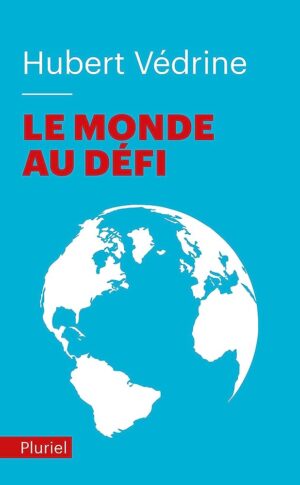
The author of this book, Hubert Védrine, is well-known in #Norway. In France, on the other hand, most people know who he is: Prime Minister and Socialist Védrine has been Minister of Education, Environment and Foreign Minister under both #Mitterrand and #Chirac. For the former, he was also secretary of state and spokesman during the last years of government. Védrine has led France’s #NATO cooperation, and under that, Sarkozy has been at the forefront of a state selection on France’s place in a globalised world. For five years, until the summer of 2016, he presented his foreign policy analysis weekly at RFI, Radio France International. In other words, both socialist and right-wing governments rely on Védrine’s professional competence.
A western concept
Hubert Védrine argues that we often and with great dedication refer to «the international community» without knowing what and who it is, what values apply there or what this society does. Even more than 70 years after the establishment of the #United Nations# and an expansion of the number of member states from 51 to 193, we cannot, without a doubt, assert that «the international community» corresponds to the United Nations; To that end, the organisation experiences too much internal disagreement and power struggle. Nor can we say that «the international community» consists of the multicultural elite of diplomats, international bureaucrats, and business and aid leaders; these are far too representative. Védrine asks whether «the international community» is the three billion Internet users or the several billion who follow the same sporting event directly on television – but even responds that these are just other forms of loose community. No, he says: The term is most often used about the value community we believe in the West is universal, where democracy, the individual and the free market are the least common multiple.
«the international community» is the three billion Internet users or the several billion who follow the same sporting event directly on television?
Does not exist
As long as these values are not shared by all countries worldwide, is it possible to talk about «the international community»? Hubert Védrine replies in the negative. He shows different attitudes different heads of state have to international issues and priorities at home, with examples from #Russia, #China and the #Middle East#, among others. He clearly demonstrates that a unified «international community» does not exist today – the world cannot even come together on a common time bill. He says: 2017 is 5777 for Jews and 1438 for Muslims. While most Europeans are becoming less and less religious – in France, 75 percent were practising #Catholics in 1945, while only 5 percent are today – we see a flourishing of the importance of religion elsewhere in the world. Religion’s place in politics differs widely from country to country in the «international community».
«The international community», as the term is used today, is just a phrase politicians dare when they don’t want to take responsibility. It refers to something undefined but still has great defining power – in Western favour. Védrine’s point is that «the international community» must be established as a global community of values for us to live and act together for the good of all humanity. The UN has not succeeded in this either the #G20, #BRICS or NATO. Even less the International Criminal Court in The Hague.
Humanity
What, then, can unite us in an international community? What values do we all have in common that can form the basis for global society and future cooperation? One of the answers that stand out is to ensure that the earth continues to be a liveable place for all of us. «We are not going to save the planet,» says Hubert, «because, like the planet, the planet is doing well. It is the human life we must save.» And then we have to change course. But not by reducing growth and prosperity, according to Védrine; rather, we must begin to think radically differently about how we live our lives; that is, we must think ecologically. This is difficult as long as our opinion leaders are mostly social scientists and humanists and do not understand science. Many of these claim that the environmental crisis is so urgent that we must stop doing most of what we appreciate – travelling on holiday by plane, taking a car to work, eating meat, and buying new electronics. But they are wrong: we must not stop doing any of this – it just has to be done in other ways. Consumers and producers must together take responsibility for producing/consuming more environmentally friendly, recycling and driving innovation. And a new element must be included in our national accounts: the (non-) use of nature and the #environment. This way of measuring value creation will reverse our attitudes and actions.
Ecology as common denominator
Le monde au défi is an easy-to-read book on difficult topics. Védrine roams around with names and events without source references in the best French essayistic case tradition. But for those of us who have been following politics since the Soviet dissolution in 1991, the references in the book arouse joy. In addition, when the author finishes the book with optimism on behalf of the earth’s environment, the book becomes even more commendable. There is only one thing to do: to establish «the international community» as a truly worldwide size, with all the countries of the globe in the numerator – and ecology in the denominator.