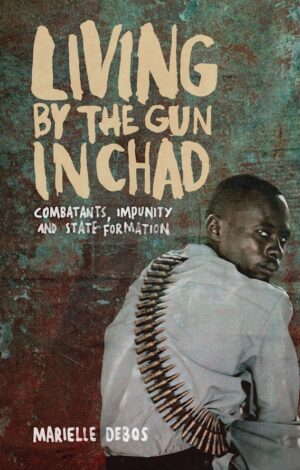
Political scientist Marielle Debos, a rising star in the French-academic African sphere, conducted fieldwork in #Chad for one and a half years to gather knowledge and inspiration for her book Living by the Gun in Chad (original title: Le métier des armes au Tchad). Although the book’s empirical data is drawn only from Chad, it contains numerous examples that are applicable to many other African countries.
Practice and theory
The author effectively utilises her experiences from the fieldwork. Each chapter begins with an event that the author herself witnessed during her stay in the African country. She uses these anecdotes as a perspective to understand how people think and assess their options in a country characterised by #authoritarian and unpredictable political decisions.
Gregory Mann, a professor of African studies at Columbia University, recently argued that relying on personal experiences when writing history is dangerous. He claims that it makes the writing eclectic and self-centred. On the contrary, I find this approach highly effective in Debos’ book. She does not fall into the trap of self-situation, nor does she risk placing excessive emphasis on random and personal experiences. Anyone who has travelled in #Francophone Africa will have had similar experiences at border crossings, bureaucratic meetings, or bus conversations as those referred to by Debos, but not everyone has reflected as clearly on what these experiences might mean. Not everyone manages to incorporate #political science# theories into their narratives in a way that allows events to be understood as how politics functions in so-called «failed states.»
Political ideology and religious affiliation have minimal significance in determining who one supports among the many political-military rebel leaders.
Favourite country
There is not much recent research on Chad. However, policy papers from military actors and aid organisations are abundant. Chad is the favourite country of #France and the #USA in the fight against #terrorism in the #Sahel. France has its largest African military base in the country, while the USA supports the Chadian army with weapons, training, and money. It is inconvenient to hear that there is never peace in the country, only «intervals between wars», as Debos puts it. It is uncomfortable for those who support the regime militarily or in humanitarian ways to be reminded that the formally democratic president is a clear dictator. Similarly, reminders that the population suffers under a corrupt, immensely wealthy elite that becomes richer and more violent every year. Nevertheless, such conditions do not seem to make a significant impression on our own Foreign Minister, who recently (February 24) persuaded Norway to allocate over 700 million kroner for emergency aid in Chad and the three other countries around Lake Chad for 2017 alone.
«Bigmen» and gains
The book’s first part, dedicated to Chad under French colonial rule and the first 50 years as an independent republic, is well-written and interesting for those not entirely familiar with post-colonial Francophone Africa. However, it is parts two and three that I find most intriguing. Here, Debos employs her own observations and interviews, as well as novels, archival material, films, and previous research, to answer the question of how one can gain and maintain power in Chad. And the answer, as the book title suggests, lies in the use of weapons.
Debos discusses why loyalty to wealthy, influential men («bigmen») in Chad is so fluid. She speaks of «fluid loyalties” and provides numerous examples showing that both the «bigmen» and their supporters among the population possess a significant degree of spatial, political, and social mobility. She demonstrates how the «big guys» constantly exploit changes in the power balance in the region to their advantage. Her reflections on how the peace agreement between Sudan and Chad in 2010 and Gaddafi’s death in 2011 completely altered the power dynamics in the region, leading regime opponents to suddenly become supporters, are very insightful. Political ideology and religious affiliation have minimal significance in determining who one supports among the many political-military rebel leaders. What matters is where one believes there is the greatest chance of gaining economic or social benefits.
Blurred boundaries
Marielle Debos actively uses this conclusion in the book’s final part, where she argues that there are blurred boundaries between soldiers and rebels, legal and illegal use of violence, and official and informal political decisions. Debos employs terms such as outsourcing and informalisation to understand how politics takes shape in Chad. She makes a complex and difficult political culture clear and understandable to readers while introducing theoretical concepts within Africanist political science.
However, I do not agree with her assertion that the Chadian state is weak. In this regard, she makes the same mistake as many other African experts: she does not differentiate between the state and the regime. The state refers to the official institutions, while the regime consists of those in power who misuse these institutions to govern and exercise political power. In the case of Chad, the state is virtually non-existent because the courts are biased, the police are highly violent, the newspapers are censored, the schools are controlled, and the #bureaucracy is corrupt. However, the regime is very strong; President Déby has full control over almost all economic and political sectors through his handpicked associates, often from his close family. The president has maintained this control continuously since coming to power in Chad through a coup d’état in December 1990.
I do not agree with her assertion that the Chadian state is weak.
Best in French
The translation by #Andrew Brown# from French to English is good, but I recommend the original edition for those fluent in French. The French language is much closer to Chad’s slang and everyday language, including wordplay that is often impossible to translate. One simply feels more at home in the capital, #N’Djamena, in the French edition, even though the English edition extends up to the presidential election last year, in which President Déby was reelected for the sixth time.