First seen by Modern Times Review at MOLDOX in Chișinău (WP 66th Festival dei Popoli in Italy – Special Jury Mention), where it won the inaugural Green Vine trophy, and later presented at One World Romania, Olga Lucovnicova’s Last Letters From My Grandma begins with a box of letters from the director’s Russian grandmother. Within them, a story of Soviet memory, family fracture, migration, silence, and the war in Ukraine pressing against private history emerges.
As Melita Zajc wrote for Modern Times Review, the film links Moldova, the southern Urals, and Spain into an «eye-opening journey» through realities in which the Soviet Union remains alive, both as nostalgia and as a source of suffering. Her film insists on the distinction that political reflex often collapses.
When you first received the letters, did you see them as more of a micro-archive of your family history? Or did you already sense they belonged to a larger historical conversation?
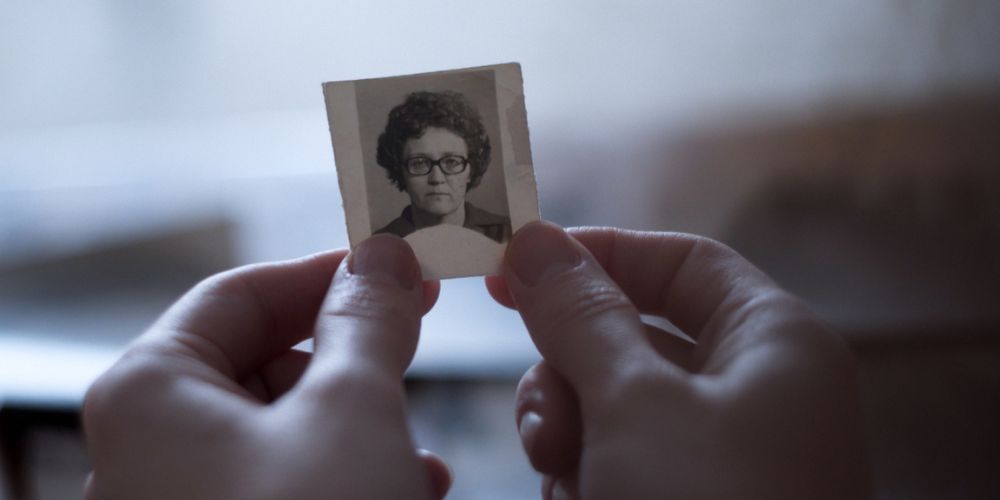
My grandmother was always present in my life through my father’s stories, but they were very fragmentary. There was always this box in our house that moved with us. This box was only accessible to my father. At some point, he felt it was the right time to give it to me, but he never wanted to open it with me and read these letters together.
It was difficult to sort them on the timeline and understand the context, because I was born after my grandmother passed away. But knowing her story in the Urals, I knew that, on the one hand, it’s a story of ordinary Soviet people that we usually don’t hear in history books, on television, or in broader contexts. But at the same time, her story was, in a way, unique, because we don’t hear about the peripheries of the Soviet Union.
She’s from such a city, which is on the very edge of the Russian Federation, on the border with Bashkiria. It’s not Moscow. It’s not St. Petersburg. It’s a different Russia, rarely portrayed on screen.
When I started reading these letters, I felt a personal connection to them, not only because she’s my grandmother. For me, these were letters written by a woman who had a very difficult life, who believed in the Soviet Union and in communism, but in the one portrayed in cinemas, on television, and in official publications, not the one she was living through.
It was the unique voice of a woman who lived in a reality that, on one hand, was quite progressive. She was born in 1938, and when she was 22, in the 60s, she had her first son, my father. The maternity leave was only two months before you gave birth and two months after, and then you returned to work at the same level as men. At the same time, in many European countries, married women faced legal and social barriers to working, and in some places, husbands could still decide whether their wives were allowed to work. So she had to deal with these realities of the Soviet Union, which were sometimes very controversial.
At the same time, her end was quite tragic. Because it was, I was questioning myself: what is the reason? Is it due to Soviet realities? Is it something deeper in our DNA? Is it just because it was her decision? Had she been born in a different place, at a different time, would she have ended the same way?
These letters were the only way I could connect with her, through her personal voice, not through stories of my father or other family members. And she was my only link to that past documented in the archive.
Over the course of the production and to the completed film, how did your original vision and questions change? Did you find answers that were, at least, satisfactory to you as a person?
I have been working on the film for 5 years. I started working in 2020, so you can remember what the world looked like—no war in Ukraine, just the pandemic. The pandemic, I think, was a trigger, sending us all into the family, isolated from the outside world, only in our small bubbles.
I hoped to make a film with a happy ending because I knew my grandmother’s story. Since her passing, my father has never gone back, and his connection to his family has been lost. So I imagined the film as a kind of happy ending: we go with my father to Russia for the first time, I meet this family that the Soviet Union broke apart, reunite them, and here we are, all happy.
The reality was completely different. I had several travels in 2021, and then the war started, so I had to rethink the film. The film was in development, but you could not ignore the war in Ukraine while working on a film in Russia. It also became a film about the present rather than the past. I started documenting how the family relationships were changing during this war. My grandmother’s past was like an echo I could hear through this war.
There is a very good researcher, Svetlana Alexievich. She writes extensively about the post-Soviet space, and her research focuses on oral histories. Before the pandemic, her last book came out. It was called Secondhand Time, with the subtitle «The Last of the Soviets.» Then the war started in Ukraine, and she wrote that she was actually mistaken, because actually the war in Ukraine shows that the Soviet Union is not in the past. It’s still here, and its real collapse is continuing now with the war in Ukraine.
When the war started, I felt like my grandmother’s past was reliving before my eyes. I was seeing how, again, the family began collapsing with the world, the same way it had begun collapsing with the collapse of the Soviet Union.
The Soviet Union is not in the past. It’s still here, and its real collapse is continuing now with the war in Ukraine.
When the war started, what were your initial reactions, both as a filmmaker and as a person? As you said, you would know personally if these fractures, or let’s say ideological differences within your family, were evident but maybe contained, you knew that now this was going to open them up. You may not have known exactly how, but it was going to.
On the other hand, as a documentary filmmaker, I often find that, due to the long production times, something unexpected happens that might change the entire film. It could also change the film to make it more accessible worldwide. Many documentaries start production one way, something completely unplanned happens along the way, and then, all of a sudden, it’s what creates the drama of the final film.
You know, in wildlife, when a predator captures an animal, there is a kind of frozen effect? This animal is frozen and doesn’t know. It’s a coping mechanism. The same was for me. For a year, I was frozen. I didn’t know what to do or how to do it.
Besides this film, I was working, and still working, on bigger research for my PhD. It’s a doctoral project that also explores trauma and memory in the post-Soviet space and aligns with my artistic practice. On all fronts, I had to rethink the concepts I was working with.
First of all, as a person, imagine you are a child of an executioner and a victim at the same time, because my family history is quite complex. My maternal grandmother is Romanian from Moldova. My maternal grandfather is from Western Ukraine, and my father is from the Urals in Russia. Imagine the different historical perspectives each part of the family has. My mother still has family in Ukraine, my father has family in Russia, and my family is still in Moldova. Moldova suddenly found itself on the border of this war. All my childhood friends lived for a year with emergency luggage on the balcony in case the war came to them.
At the same time, production-wise, it was a nightmare to make a film in an aggressor country, because you cannot spend any funding in Russia, obviously. At some point, I was arrested and physically it was difficult to go back. I can no longer go to Russia. Connecting with family is becoming more difficult as more and more conversational apps are being restricted in Russia. You cannot have Facebook in Russia. You cannot have Instagram. You cannot even use WhatsApp now. If you buy a new phone in Russia, you cannot install WhatsApp at all. People still do, but it’s dangerous, because if you are using these kinds of social networks, it can even lead to prison on their side.
Within family dynamics, did this new reality present anything you hadn’t seen before?
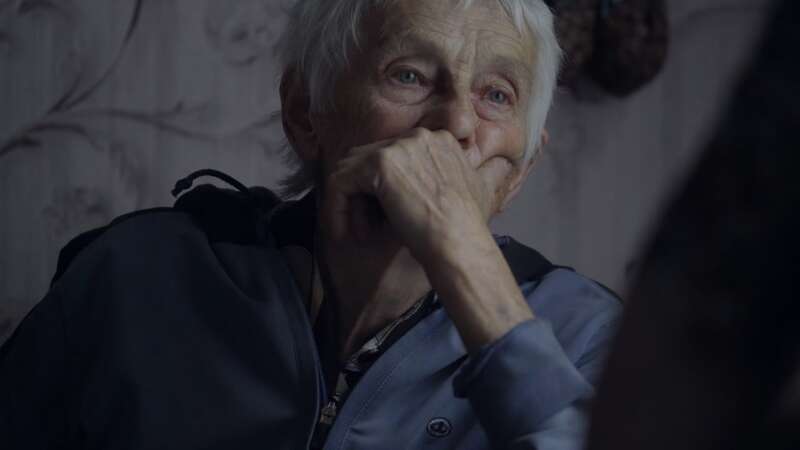
When I started reading my grandmother’s letters, I knew that a big part of the film would be silence. Silence persisted because my father never returned and kept only sporadic contact with the family. I was aware that this silence should have an important place in the film.
Sometimes it’s not important what we are talking about, but how we are silent together with my family. I tried to keep some of these moments in the film. But with the war in Ukraine, the silence became bigger, longer and more important.
Also, my step-grandfather is from Ukraine, and he has a family there. And the family there is also broken because of this war, because some are on the side of Russia, some on the side of Ukraine. The war will end one day with a peace treaty, but it will continue to live on in this family, probably again across generations, just as the Second World War is still present.
Making the film during the war, in these difficult circumstances, helped me cope with it and its realities, and to navigate this difficult family relationship. That was my initial goal: to go back in time to understand these family traumas and difficult memories, which my father is not so easily able to articulate, to learn to live with them. This film taught me to live with this family’s past, but also with the reality which is still happening today.
The war will end one day with a peace treaty, but it will continue to live on in this family.
How does all this, from a filmmaker’s perspective, translate into the film’s visual language?
I tried to create three layers in the film. The first is reality, which you see in the film. The second layer is the letters from my grandmother, which somehow contrast with my family’s conversations and mine. The third layer was my own voice-over as the last generation, expressing myself on all this, what is happening in the film, on the letters, and on this past.
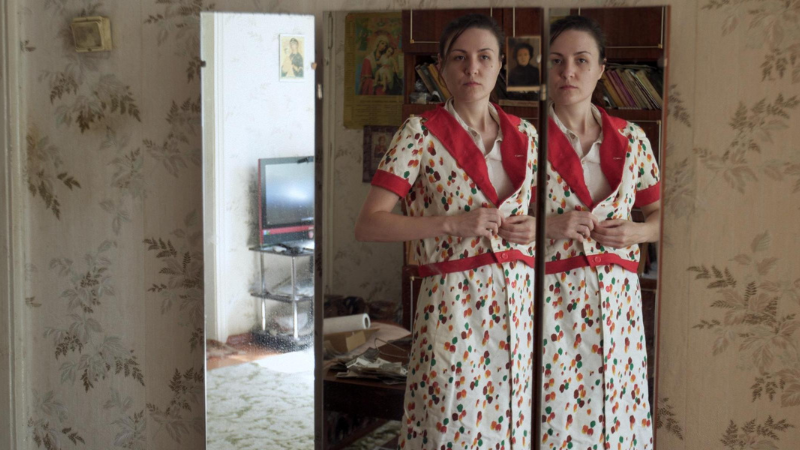
The apartment is also a protagonist in the film. It’s a different kind of protagonist, and it’s a very important place for the family because several generations have grown up there. I tried to let this apartment talk through the visual elements, but also filmed it in different atmospheres with the family.
When everybody gathers, it seems like a happy family gathering, but it’s also really awkward. That’s what silence does for people. When you see these pauses in the film, it’s really pressing, because when there is silence, we always try to break it with talk.
These family gatherings are really strange, I think, in the film. I tried to keep this strangeness because, on the one hand, we are family; we try to play as a family, but at the same time, we don’t have this link. Through the film, this link grows closer. Over time, as the relationships deepen, you feel the ice between us melting. Then again, a new geopolitical shift ruins what they tried to build in the film.
It’s not my first time making a personal film, nor is it the first time I’m trying to make a persona from a space. My previous film, My Uncle Tudor, is in a way doing the same exercise. The family house also becomes a protagonist of the film.
My Uncle Tudor was a short, and this is a feature-length documentary. What did you draw from your experience making the short to expand a narrative?
My Uncle Tudor was also a very difficult and personal film, but it was a bit easier because the shoot lasted just 10 days, whereas Last Letters lasted 5 years. Also, during the production, I filmed much more. I filmed in Moldova, for example, but it had to be cut during editing.
Working on a personal story for 5 years is a nightmare. I think it’s my last personal film, because on one hand, it was very therapeutic, but on the other hand, psychologically, it was really, really difficult. Probably that’s how therapy works. To cure a deep-rooted wound, you need to open it up, and it’s painful, but then it gets easier.
Do you notice any difference in family members when the camera is turned on vs off?
Filmmaking is a very performative act. Even if we pretend it’s so realistic, the camera still changes how people behave.
What I discovered in this process is that its effects on people vary. For instance, my step-grandfather was much more open on camera than behind it, because the camera was an excuse to show me things and talk with me about them. I tried to introduce the camera from the beginning of our relationship. On the first trip to Russia, I brought it and started filming. Then the camera became a very natural part of our conversations.
I was quite surprised by how open and nice he was with the camera. I think it actually strengthened our relationship. But it was completely different from my father. Although I thought he would be an easy protagonist, he proved to be the toughest in the film. Although you don’t feel it, I had certain expectations, because I knew him all my life, and I heard all the stories which he told me, which were the trigger for the film, and he gave me this box.
I expected him to be much more collaborative. But at the same time, he is the person who bought me my first camera. He is the person who participated in my first photo shoots. When I was working as a wedding photographer, he went with me to the weddings. So he is really aware of this documentation process.
Every time I asked him questions, he knew what I wanted him to say. He was like, «Okay, you asked me that because you want me to say that, but I will not say this because I know you want this.» Every time we were in front of the camera, there was a layer that gave him a certain aesthetic in the film.
But then, in some shootings, I let him go alone with the cinematographer. He was much more collaborative because he felt he was in control of the process and responsible for it. In the scenes when he is very collaborative, when he asks important questions, these are the scenes when I’m not there.
A complex relationship, but understandable.
Yes, because my father is my father and I’m the daughter, but when you become a director, and your father is the protagonist, these dynamics are opposite. I think it was quite difficult for him. But now he’s happy with the film.

What is the ideological dynamic between your generation versus your father’s in terms of looking at the Soviet Union with an eye of nostalgia?
This was one of the triggers for making this film, because it was really difficult to understand my father’s duality. He is now living in Spain, near the coast, and sometimes uses webcams from the Urals to see his city. So a normal person would think, okay, he’s really nostalgic for his city. He probably misses it. That’s what I thought too.
But when he arrives there, from the first day, he becomes depressed in his city. It’s not what I expected, or what you normally expect, for him to come there and be happy to see his family, the place where he grew up and spent all his youth. It’s the opposite. He wants to escape the city as soon as he arrives. After completing his military service, he tried to move as far as possible. It was Moldova because he was given an interdiction on leaving the Soviet Union for 10 years after service.
Indeed, each Soviet generation is not only nostalgically distinct but also constructed differently. They think differently. We also see in the West that under different political regimes, more leftist, more rightist, the narration on the news is changing. But in the Soviet Union, it wasn’t like a four-year mandate. It was as long as Stalin lived, as long as Brezhnev lived. Under Stalin, an entire generation grew up under his system of values and fear and repression, and it formed them in a certain way—the same with my father.
For me, I’m a completely different generation. As Svetlana Alexievich says, a person who wasn’t born in or didn’t live in the Soviet Union can never understand someone from this space.
Even if it was a parent?
Yes, because when I was one month old, the Soviet Union collapsed and my country declared its independence. So my country is as old as I am.
I think it’s easy to imagine life in the Soviet Union, but when you go to practice, it’s really difficult. While filming with my father, we were travelling through the Urals, where there are over 40 secret, closed cities. What a closed city means is that there is a fence around the city, and you can get inside through only one control zone. But as an ordinary citizen, you are not allowed.
One night, we stayed in a hotel 20 kilometres from one of these cities, and one day, police officers came. We were outside with my father, just taking photos with our phones, when he saw them and said, «They’re coming for us.» I, growing up after the collapse, was shocked.
Was this during the filming?
Yeah, I couldn’t understand why the police would come for us, especially now living in Belgium, where the police never stop your car just randomly. In post-Soviet countries, it’s really common for police to stop every car to check it. In Belgium, there are checks like that, but it’s normally an exercise. You don’t expect to pay privately.
Now, working on my PhD dissertation, I have only just started to understand how complex the Soviet Union was. It wasn’t about communism. It’s not about a planned economy. It’s much more complex because many other systems flourished there, such as the black market.
Regarding nostalgia, I think that after doing this film, I started to understand my father. I don’t want to travel back to the Urals, but I also feel a connection to this place. This love-hate relationship that forms is really difficult to explain. Only by going through this journey can you understand it.
I’m not nostalgic for the Soviet Union, and I find it difficult to understand the post-Soviet generation’s nostalgia for it. I think it’s more constructed memory through the cinemas and Russia. Putin is now using this construction quite strongly and intensively, as you can see in schools, where he is bringing back classes similar to those in the Soviet Union. He also writes papers himself, which he pretends to be historical.
I think this construction, especially in Russia, persists quite strongly. This, of course, also affects people outside. That’s why I think films like mine are important: they try to break the constructed image of the past through real family memories. The myth of the Second World War is constructed, not only in Russia but also in the West, because people tend to be silent about the most traumatic experiences.
The conventional American narrative around World War II does its best to forget any Soviet participation. Whoever the speaker is has to be reminded of this many times… And England just gets forgotten by both of them.
When I started working on my PhD, a very banal discovery emerged during a conversation with my Belgian supervisors. For Russian and post-Soviet territories, the Second World War is the Great War. And for the West, the Great War is the First World War. Also, the Great Patriotic War of the Soviet Union didn’t start on the same date as the Second World War. It starts with Germany’s invasion of the Soviet Union. This shows how historical memory continues to shape our lives to this day.
Everything now lives in a binary yes-or-no. Russia is good, Russia is bad, America is good, America is bad, etc.
I think there is an aversion to Russian in Europe and the United States. But again, language is not government. A language can be an instrument of power, but it is not necessarily the foundation of state power.
After working five years on a story as personal as one can be, in its visual and physical language, how do you feel if it isn’t given a chance because it is in a language considered the enemy?
I can understand that, and I had an inner conversation about this. For one, the Russian language was imposed by force in Moldova, a country that identified with it. But on the other hand, not speaking Russian because Putin speaks it, for me, would mean giving him credit for the language, which is not the case.
Russian is also Solzhenitsyn. And for me, it was an act of being honest with myself, but also not giving this power to the Kremlin, and owning the language. The Kremlin is banning much of the literature that Russians originally created. It’s all much more complex than that.
In general, the language question is extra complicated because I’m now thinking in three at once. I never learned Russian at school. I learned it for only two years as a foreign language, the same as French. At the same time, in my family, we spoke Russian. My grandparents from Moldova met in Kazakhstan. My grandfather from Ukraine didn’t speak Romanian, and my grandmother from Moldova didn’t speak Ukrainian, so they had to use their common language.
I was brought up in a Romanian kindergarten, school, and university. So I know Romanian grammatically better, but my thoughts often come in Russian, as it was the language of my childhood. It remains a language I speak with my parents. Now, the third layer is English, which is the language I use daily. The way I speak in the film suggests I’m not from Russia and don’t use the language as well as a Russian from Russia would.
Not speaking Russian because Putin speaks it, for me, would mean giving him credit for the language.
I’m assuming no one has come and explicitly said, «Look, we don’t want to screen the film because of its language»
It might indeed affect the film’s festival presence, and I know it could be perceived differently at different times. That’s the reality we are living through.
I also want to add that first-person films are very therapeutic for me. If you decide to do such a personal film and go deep into the past, to your traumas, you need a psychologist next to you and to be sure if it’s for you or not.
I came to first-person films because I used to make films about other people. I think the beauty of documentary cinema, especially author-driven, is when you try, with the process of filming, to go beyond the image, what you see of a person, and go deep into the inner world of that person. At some point, I felt I was asking my protagonists questions I could not answer myself. And that was My Uncle Tudor’s first trigger. Now, with Last Letters, you become a blank. As a filmmaker, you understand what your protagonists go through.
Is this going to be your approach from now on, at least for the next few films?
I already have a new project in development, which is completely different. It’s not a personal film, but it still has a strong connection to my past and Moldova. I was born in Soroca. It’s in northern Moldova. This city is popular for the Roma community, and we have lots of stereotypes about them as a society. My experience of childhood and interacting with the Roma community is completely different. Once the Soviet Union collapsed, only the Roma people in my city had money. The entire city worked for this community, including my father.
It is full of huge castles. We have a copy of the White House. But these houses are not finished, and it has become a very famous tourist destination, with busloads of tourists. This community was quite mediatised, but always through the male voice. What I’m trying to do is approach female voices and create a film with them about this community. After filming myself, I have come to the next stage: filming together.