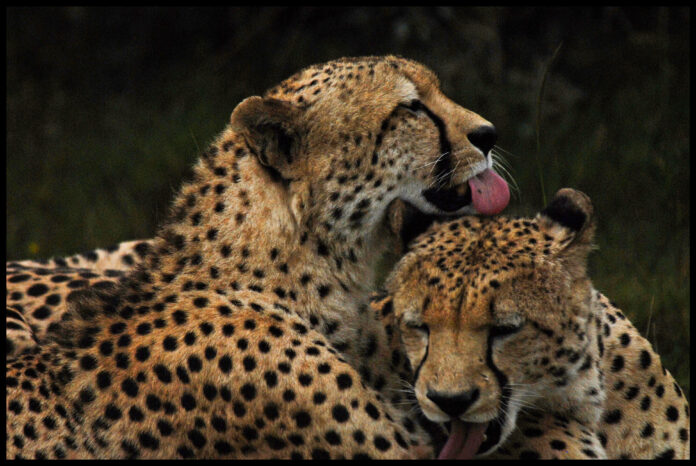
All photos: © Eckhoff
Thinking about escape is pointless and also disloyal. Today, we can talk about escape from all the crises: the Ukraine crisis, energy crisis, inflation crisis, pandemic crisis, and democracy crisis. Not to mention a topic closely related to a crisis «everyone» eventually refers to – the climate crisis. Its twin crisis is called the extinction of species and also has a more accusatory name: ecocide.
The search for hope has taken me to unexpected territory. To southern #Africa and private industry – companies making a mammoth effort for biodiversity: the private game parks.
South Africa’s ecosystems were on the brink of total destruction when the first game reserve, Imfolozi Hluluwhe, was established in the province of KwaZulu-Natal in 1895. The park covers 960 square kilometres and is the genetic home of all the world’s white rhinos. In 1898, Kruger National Park, South Africa’s largest game reserve, with an area of 20,000 square kilometres, was added to the map. Those who want to experience the world’s most iconic animal species up close – elephant, lion, rhino, cheetah, osprey, wild dog, leopard – often travel to #South Africa# and other countries in southern Africa. Until the middle of the last century, however, they had had to search for more than one needs to do today. The land was depleted by poor farming methods and the aftermath of wars; natural habitats were eradicated; wild animals were competitors to cattle; they were carriers of disease and were slaughtered in droves.
Recreating nature
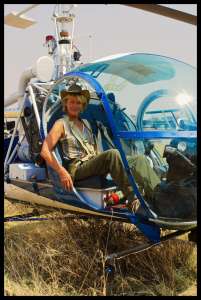
In the 1990s, in the small town of Port Elisabeth on the southern tip of Africa, a businessman sat one day wondering how to find a place nearby where he and his family could enjoy life at leisure. He discovered some nearby farms for sale and bought them, totalling 11,000 hectares. But he quickly realised that to enjoy nature here, he needed to recreate it, depleted as it was by unsustainable farming practices. He tore down fences and gradually built up an intact ecosystem. First, healthy plant life had to be put in place. Then the grazers could move in, and so could the predators.
elephant, lion, rhino, cheetah, osprey, wild dog, leopard
Adrian Gardiner founded Shamwari Private Game Reserve, one of the first of its kind in South Africa. Now, thirty years on, Shamwari has seven luxury lodges, an explorer camp, a learning centre, a rehabilitation station for young, abandoned or injured animals and a police unit to combat poaching. Gardiner’s ‘Country Lodge’ has proved to be a model organisation in terms of biodiversity and animal protection.
The poachers
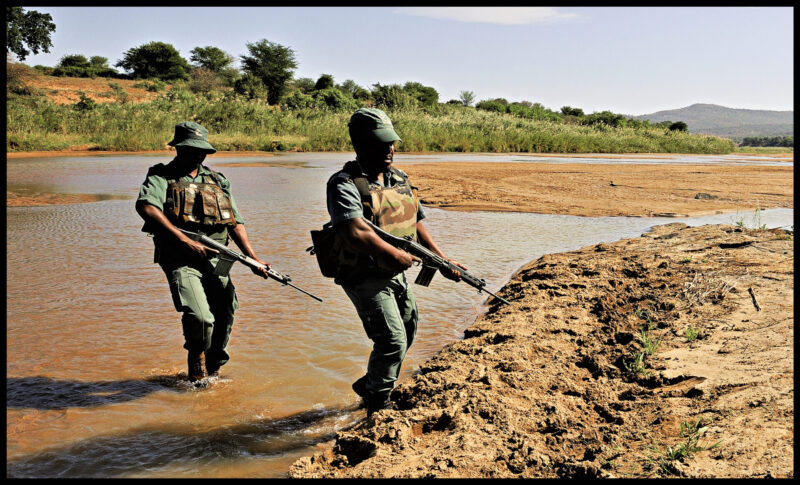
Among the more than 325 employees are some of an extraordinary calibre. One of them is Rodney Visser, a mild-mannered man responsible for the fight against #poachers. «You have to realise that about 58 people are killed every day here in South Africa. Who gets excited about a few dead rhinos? We’re talking about huge profits with low risk.» In the years 2013 to 2017, the number of rhinos killed annually in South Africa was over 1,000. In recent years, the number has been declining, to the relief of the game rangers who protect them with their lives.
The poachers usually arrive after dark. The animal is usually hit by bullets from an AK-47 Kalashnikov. Often, the victim does not die immediately, and the horn is chopped off with an axe and machete. It is not uncommon for parts of the skull to be lost to prevent a single gram of the precious horn from being lost. The animal then bleeds to death with its skull open. Within hours. All because a single horn on the Asian black market is worth more than gold, diamonds and cocaine, as it is believed to have miraculous curative powers.
Rodney has twenty-seven years of experience in the criminal police and concentrates on preventive action. He gathers information about criminals and keeps in close contact with the local population. In emergencies, he has a helicopter at his disposal. And then there’s Anja.
The guardian angel
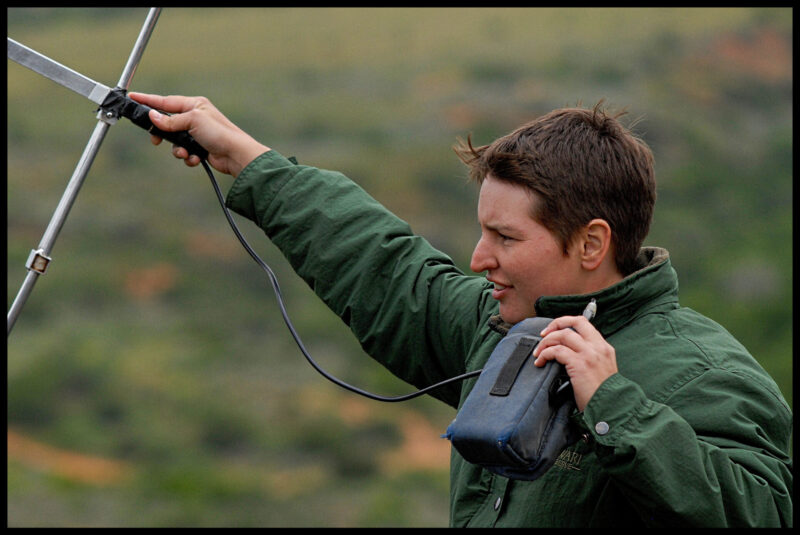
Anja Truter’s office could hardly be more beautiful on this spring day: red earth, lush green trees, yellow meadows and fragrant herbs. A few secretary birds strut past. Just then, Anja has to slow down to cross the giraffes. #Anja Truter# is a boyish young woman in short trousers and a green ranger shirt. Her job is to be the guardian angel for the reserve’s animals – she looks after them and keeps an eye on them – morning, noon and night. The day begins before sunrise, around four o’clock, and ends at sunset, around six o’clock. She works on foot, in her Land Rover, with camera traps – always alone among wild animals. She counts them regularly, gathering a wealth of data that she then evaluates.
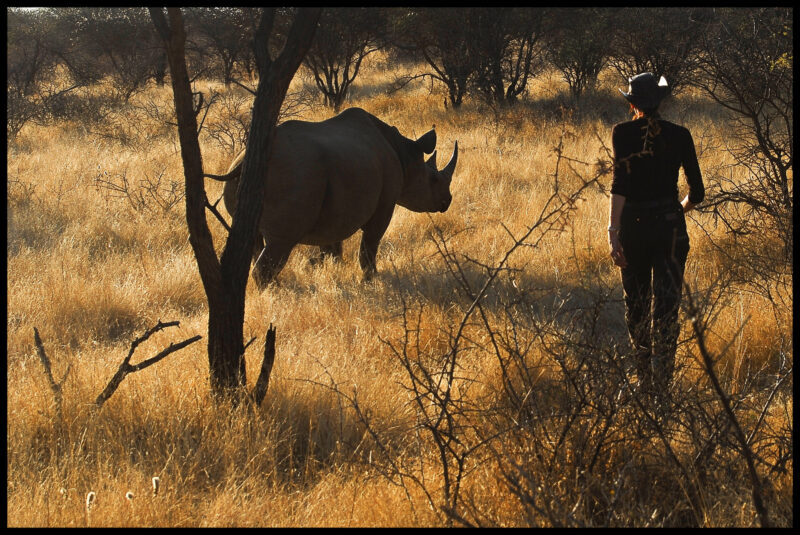
Today, it’s all about the missing rhino W 55. She has now observed several rhinos through her binoculars, but no W 55. This makes her extra vigilant. She knows that any place where there are rhinos is now a potential crime scene. Even in European museums, horns are stolen from stuffed animals.
Anja Truter is a boyish young woman in short trousers and a green ranger shirt.
Anja stops for a short picnic break. It’s needed after hours on bumpy terrain. She explains: «In Shamwari, too, it happened. Two rhinos were killed. I was the one who found them …» Here, her voice breaks before she continues: «I walked around the animals and saw that their limbs were stiff. I actually knew they were dead, but I waited a long time for them to wake up and get back on their feet.» Among her colleagues, the young gamekeeper is known to be rather headstrong, which has earned her the nickname Bhejie – little black rhino. (The white rhino is peaceful, while the black one is rather rebellious.) What she meant to her employer was evident when Anja once blurted out that she would actually like to do something else – get some cows and run a small farm. Shamwari’s chief ecologist, O’Brien, briefly replied: «Yes, that’s a good idea. We’ll bring your cows here.”
A few days after my outing with Anja, a message popped up: «This morning, we were out looking for W 55 again. I found him. Unfortunately, he was dead. There had probably been a fight, probably with another male or perhaps with an irritated female with a calf. He was injured by a horn in his left front leg. Possibly, his heart or a lung was pierced. I am relieved that he has been found and that we can determine the cause of death.» Between the lines, it says: Thank goodness he wasn’t killed and mutilated.
Namibia and ecotourism
Trophy hunting does not exist in the Shamwari Reserve; only shooting is done with a camera. As a result, the reserve has won many awards, including the World’s Leading Conservation Company several times. #Trophy hunting# is often what some would call a necessary evil in private game reserves. But there are costs involved in rebuilding nature and bringing back animal species that have disappeared. Not to mention the resources required to undertake large-scale conservation projects.
only shooting is done with a camera
Erindi Private Game Reserve in Namibia is another reserve in this category. It spans 70.7 hectares of pristine wilderness and offers ecotourism to anyone who can afford it. After four years of trophy hunting in the establishment phase, Erindi now finances its entire operation solely from guest revenue. The luxury factor is high.
You can choose from various #safari options, be served gourmet meals, or otherwise relax with a sundowner on the terrace, with a good view of the waterhole, where elephants and antelopes often come to drink. Erindi has eleven projects to protect nature and endangered species – including wild dogs, cheetahs, elephants, leopards, lions, pangolins and hyenas.
The reserves
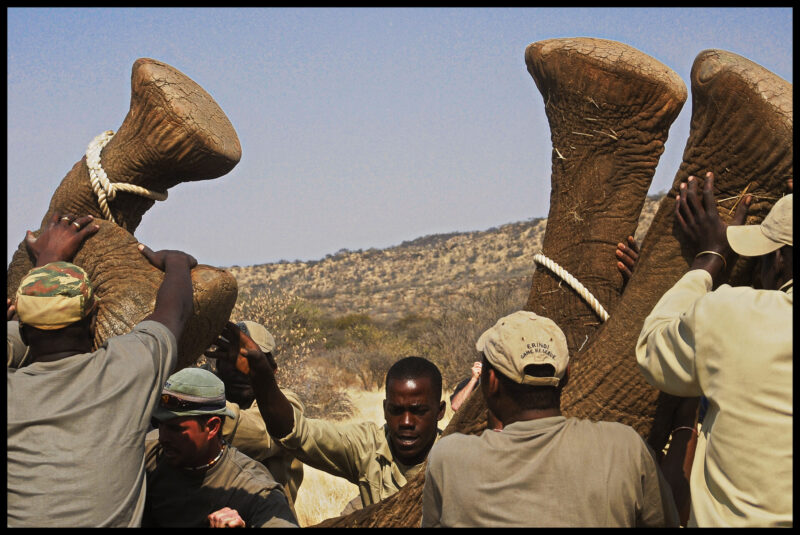
The reserves (approximately 500 in South Africa) represent a spectacular marketplace. The transport of four elephants from Erindi to neighbouring Mount Etjo Safari Farm begins with the vet in the helicopter finding the animals and anaesthetising them. A well-trained crew then loads them by crane into trucks and drives them forty-six kilometres to the buyer’s property. Under minimal stress, the giants wake up in their new home.
And it’s not least about money. The price for a white rhino can be between 85,000 and 185,000 Norwegian kroner. Supervision and passports also cost at least NOK 112,000 annually, according to a spokesperson for Balule Nature Reserve.
The travel and conservation company Africa Geographic uses some figures to illustrate the importance of private game reserves in southern Africa: Game farms employ more than three times as many people as livestock farms. The game ranching industry controls over 20 million hectares of land, more than all national parks combined.
Statistics from Wildlife Ranching SA show that a game farm of approximately 2,700 hectares that is geared towards #ecotourism and #biodiversity is home to an average of 45 mammal species, 266 bird species, 43 reptile species, 29 grass species and over 100 other tree and plant species.
The game farming industry contributes approximately 20 billion rand (equivalent to approximately NOK 11.2 billion) to South Africa’s economy.
In the mid-20th century, wildlife lacked an economic valuation. With the private reservations, species diversity in southern Africa has reached a level that gives hope. So, it may be that the last rhino has not yet been born.