The opening line of The Invisible Committee’s latest book Maintenant drily states that all the preconditions for a revolution are now in place. As the title indicates, the time for waiting is over; we should strike now. No matter where we look, all the signs of the times call for a radical break with the current state of affairs. Everywhere things are falling apart: the economic crisis continues and the political chaos is spreading. Look at the US and Trump’s chaotic presidency; look at Brazil’s accelerating political disintegration, where corruption and politics have become indistinguishable; or take Venezuela, the poster boy of the global left, whose regime has now forfeited the last remnants of popular support. Think of the ongoing climatic devastation, which is so all-encompassing that it raises fundamental questions about the capitalist modernity underpinning every established political program, regardless of party colours. A psychological crisis seemingly affects vast numbers of people in the form of stress and depression. It’s obvious that something quite simply isn’t working.

Screened bodies. But as The Invisible Committee states, revolutions are carried out by bodies, and the bodies are still in front of the screens. As part of an attempt to establish a revolutionary theory for today, The Invisible Committee therefore articulates a situationist critique of capitalism and its forms of dominance, describing in language that is at once poetic and quotidian how a totally incoherent capitalist world reproduces itself as a totality every day. This reproduction is possible is in no small part thanks to various symbolic infrastructures like Google, Facebook and Amazon, which mediate our relationship to our surroundings, each other and to ourselves. We’re subjected to a cybernetic dominance that is constantly recreating an existence that has long since been shattered. Or as The Committee puts it: “The real lie is all the screens, the images, the explanations, that we place between ourselves and the world.”
Selfishness vs. Solidarity. The starting point, then, is a breakdown, a civilizational bankruptcy. Society is no longer holding together; it’s been blown to pieces, and the state of today is a mere hologram. The collapse is staved off by all the various representations, the regulating narratives about “democracy”, “human rights”, “the economy”, “the crisis” and not least “national identity.” The revolution is thus confronted by a two-headed monster: the symbolic infrastructure and the new fascism. It’s not only Trump who wants to make America great again; every politician is desperately trying to create a semblance of order by invoking imaginary historical-national communities. But this inflated self-projection merely serves to hollow out a concept that has already been emptied of all content. The stupidity knows no boundaries; Danishness as hygge and roast pork; Frenchness as wine and de Gaulle.
 Things have fallen apart, and the question is: how do we respond to the breakdown? Do we ensconce ourselves in a bastion of self-suffiency or do we do the opposite by acting in solidarity with the revolts?
«The stupidity knows no bounds: Danishness as hygge and roast pork; Frenchness as wine and de gaulle.»
A wave in motion. Maintenant is The Invisible Committee’s third book, following on the heels of 2007’s L’insurrection qui vient and 2014’s A nos amis. The first announced that something was brewing, that the insurrection was on its way, a fact that few grasped at the time. But as the Committee underlines in A nos amis, they were right. From 2010 onwards the development suddenly gathered pace: The Arab revolts, where petty dictators were toppled or very nearly so; the southern European square occupiers who rejected austerity programmes that left the banks off the hook while hollowing out whatever was left of national welfare systems; the Occupy movement in the US protesting extreme inequality; the Gezi Park protests in Turkey against gentrification; the World Cup protests in Brazil against price rises on public transport and the hosting of the World Cup; protests against corrupt politicians in Bosnia, and the Umbrella Revolution in Hong Kong against increasing Chinese political control. And these are just some of the uprisings.
Not since the late 1960s has the world seen a similar wave of protests move from city to city in a discontinuous pattern, with resistance against oppression and inequality mixing with attempts at creating something different.

Farsighted. To engage in historical speculation is a demanding exercise, but The Invisible Committee did in fact succeed in predicting the revolts. We therefore have every reason to pay attention to the Committee, which has proved to have a finely tuned perception of the historical situation and its possibilities. In their second book, A nos amis, they assessed the 2011 uprisings and analyzed their inability to develop into real revolutions. The uprisings had indeed materialized but remained stuck in the start-up phase. Even in Egypt, which constituted the high point of the wave of protests at the time, the army had retained power and was back on the throne (after the Muslim Brotherhood’s period as a stand-in for the army had come to an end). With this new book, The Committee now goes one step further and – on the basis of events in Paris in 2016 – recommends a genuinely revolutionary strategy under the name of destitution, that is to say “deposal” or “clearing away.”
«Revolution entails distancing oneself from every institution; to abandon politics, to leave it behind and dance on its grave.»
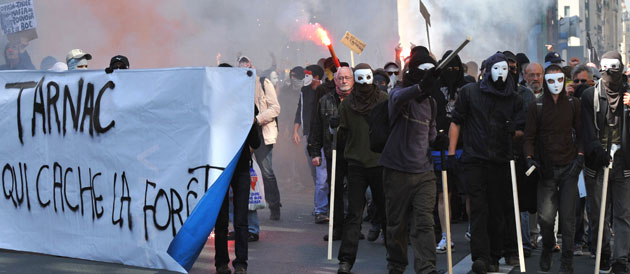
The French Nuit Debout movement that started on 31 March 2015 constitutes the axis around which the new book revolves. Every chapter in the book draws its heading and theme from the movement’s graffiti: “Tomorrow’s been cancelled”, “50 Shades of collapse”, “Down with politics”, “To depose the world”, “The end of work, an amazing life”, “Everyone hates the police” and “Those who come after”. If the cybernetic machinery and fascism together makes up a two-headed monster that saturates our lives with lies, then the Nuit Debout movement constitutes a moment of truth in which people on the streets come together in a liberating rupture from the status quo, and where the constant deferral to tomorrow is rejected in favour of action here and now. It’s about acting together in the present; there’s no future and nothing to hope for, but we can do something together, today.
«The real lie is all the screens, all the images, the explanations, that we place between ourselves and the world»
Politics is passé. The Invisible Committee is engaged in a radical exercise of exposure, where all surviving ideas of revolution and revolutionary organizations must make way for a violent embrace of the revolutionary rupture and the reconfiguration of all existing politics. As The Committee makes clear it’s not about a different politics, but about doing something other than politics by emptying politics of its content. To break free from all the different ideas of politics: politics as party politics, as the state, as security structure, as humanitarian operations, as political economics; but also as activism and identity, where the institution appears on the individual level. Revolution entails distance oneself from every institution; to abandon politics, to leave it behind and dance on its grave, as they write apropos Lyotard. Destitution is not part of a Aufhebung (abolition); we’ve already forgotten politics, and what matters now is to escape.