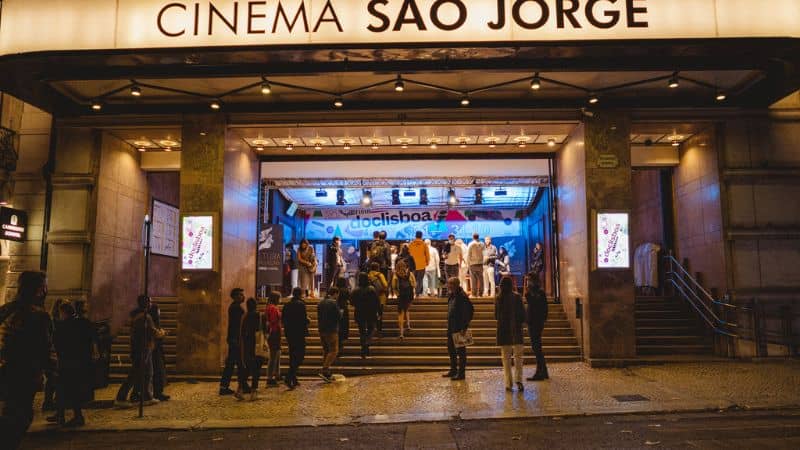
From 6 to 16 October, Lisbon becomes the centre of the documentary world as the 20th edition of #Doclisboa is set to kick off. And, as always, it seeks to imagine reality through new cinematic forms of perception, reflection and action, placing filmmaking into dialogue with its history to question the present of cinema. For 2022, the festival is dedicated to Jean-Luc Godard, whose life is celebrated in each screening across a programme of 281 films.
Ahead of the 20th Doclisboa, Modern Times Review once again spoke with its Festival Director #Miguel Ribeiro#. Here, we look at the role of Doclisboa in the wider festival landscape, its 2022 focus on colonialism, and more.
At Doclisboa, we embrace different methodologies and thrive in generating possibilities for those who work with the unexpected.
As the Festival Director, how do you personally define your role and responsibilities?
Doclisboa has its main guidelines and goals always discussed by its team. We regularly meet and exchange ideas regarding where the festival is headed. To direct it is to take charge of its artistic and political place in our ecosystem. I’d say my primary responsibility is to articulate our constantly evolving desire. By defending it steadily, it is how Doclisboa can remain in the realm of freedom and risk where filmmakers can get inspired.
Doclisboa is one of the autumn «season’s» most prominent documentary festivals, in a month when several high-profile such events occur. How do you see the place of Doclisboa amongst the wider European festival circuit? What space would you say it occupies?
Happily, I see that different events complement each other and respond with different possibilities to different needs. At Doclisboa, we embrace different methodologies and thrive in generating possibilities for those who work with the unexpected. We believe that bringing together films and people that put forward more questions than answers, that embrace fragility and doubt more than they get through with easy ways out will necessarily generate a movement. And this undefined is always fascinating. In times where so many definitions are demanded, we believe that celebrating radical freedom in the modes of translating the world is highly necessary.
Can you talk about the Retrospectives featured in this year’s edition: on #Carlos Reichenbach# and «The Colonial Question». Who/Why were these two curated for 2022, and can you explain the importance of the themes and questions they pose?
Both retrospectives put forward films that were produced in very challenging times and in which their authors believed in the power of cinema and that it was a way for collective viewing. Cinema as a collective experience is core to both retrospectives from their very starting point: Reichenbach in #Brazil making his first films during the #military dictatorship#, or so many African filmmakers (Flora Gomes, Licínio de Azevedo, Ousmane Sembène, to name just a few) who were registering and building realities as their own countries were facing new possibilities.
And both retrospectives allow us to bring to the present films that are much more unknown than they should. Reichenbach’s films astonished us, and many of his films were never shown outside Brazil. There are a lot of worldviews, dreams and desires that few have shared. This is an important aspect when we think of the retrospectives we present to bring to the present-time overlooked moments of film history. The same way that «The Colonial Question» retrospective will screen films that were screened very few times after the moment in which they were made – Ruy Guerra’s Os Comprometidos, for instance, is a film of very difficult access but where we see a trial of those who aligned with the colonial regime in ways that should be part of our conversations in a time when finally serious debates about this moment in history start to take space in the public sphere.
One aspect of Doclisboa that is always intriguing is its music documentary section – a genre which I feel has seen quite an increase in popularity over the past few years. Many festivals offer music documentary sections in their programmes. Why do you think this particular sub-genre is gathering such popularity?
More than a music section, «Heart Beat» is a section where we celebrate creation, arts and artists, and the pleasure of sharing passion. These films have very strong affections in their construction – an artist who loves another artist so much makes a film about them. It’s beautiful! And this passion is often shared by a lot of those watching such films in a cinema. That is always a powerful experience in a movie theatre, so it’s not surprising that in the same way we like seeing a film by an author we admire, we also like to see a film by an author that admires that same artist we do. It’s wonderful to be able to embrace that passion at the festival.
Finally, what are some specific aspects of the festival in 2022 that you look forward to as a fan of documentary?
To know that in a few days, some of the filmmakers I most admire will be coming to Lisbon for the festival is in itself something I’m very much looking forward to #Ruth Beckermann#, #Éric Baudelaire#, #Vincent Carelli#, #Ana Carolina#, #Rithy Panh#, will all be in Lisbon. Also, we will be presenting world premieres of films by filmmakers such as Vladimir Léon, Catarina Alves Costa, #Mike Hoolboom and Michael Pilz#. These are all key moments of this year for me, and I can’t wait to share these moments with the mentioned filmmakers, those visiting us, and the audience of Doclisboa.