The Creative Nonfiction Film Weekend is a new festival in London celebrating «everything documentary can and should be.» The programme runs the gamut from new films, including a couple UK premieres, to a one-on-one VR/performance experience, to films that are over a decade old and included, one senses, because they are favourites of programmer #Orla Smith# that she deems unjustly obscure and thematically related to some of the newer releases. Though it’s in many ways a mixed bag—and there is at least one film I wouldn’t call a documentary at all—in other ways, it feels quite tightly focused, interested above all in experimental first-person documentaries that straddle the personal and the political.
The festival begins, for me, in the front room of a terraced house around the corner from the #Genesis Cinema# in Whitechapel, where the film screenings will take place. I’m here for Charlie Shackleton’s VR/performance documentary As Mine, Exactly. In this one-on-one piece, the sole audience member dons a #VR headset on which Shackleton triggers images, videos, and occasional audio while he narrates his story sitting across the desk from you. And it’s a very personal one: the piece is about his mother discovering she has epilepsy while Shackleton was a child. She and Shackleton eventually agree that he should film her seizures for medical purposes, and these images are the most indelible of the piece. She does not shake and writhe how one envisions a seizure; rather, she becomes serenely, transcendently, alarmingly vacant.
It’s a powerful and strange experience to see these images and hear Shackleton’s voice—and occasionally his mother’s, on recordings—while wearing the headset: it’s both incredibly intimate and somewhat distant. This, I discover, will be one of the festival’s central themes.
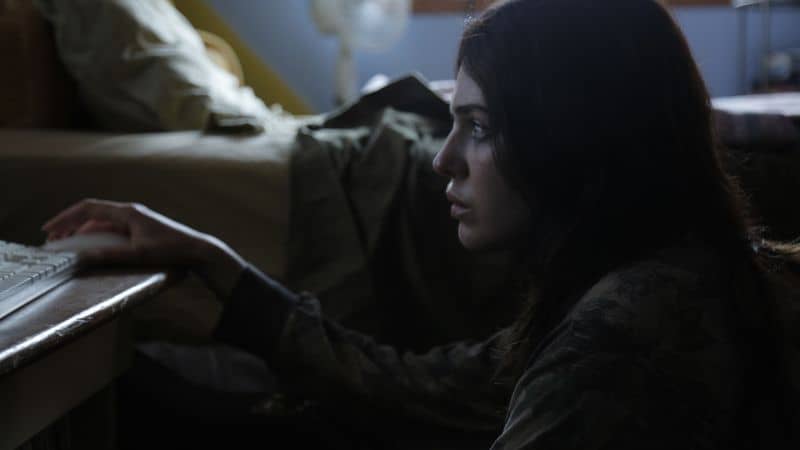
The festival’s first film is the UK premiere of Searchers (Pacho Velez, 2021). It’s a charming look at the hopes and tribulations of #dating apps#. Apart from a signature formal device that superimposes translucent images of the apps as the doc’s subjects scroll through them, it’s a rather conventional film. It does continue to set the tone for one of the festival’s themes: honesty, especially when it comes to personal desire. Some subsequent films take this to extremes that are variously brutal and cringeworthy.
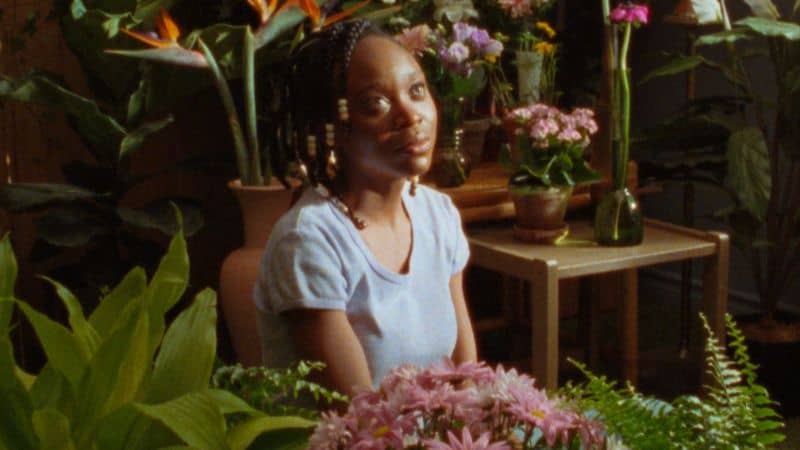
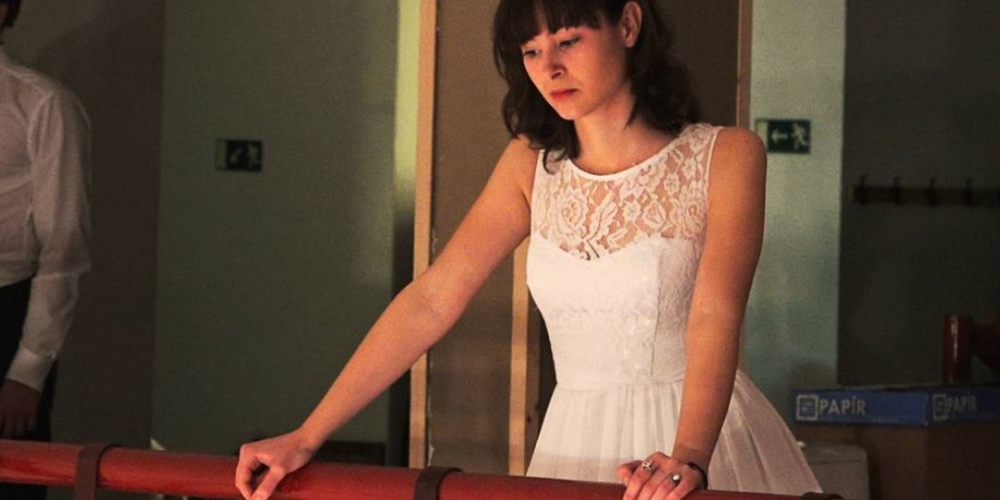
The first film of day 2, Cette maison (Miryam Charles, 2022), is something completely different. Though based on real events, it is in no conventional sense a documentary at all. The film it most calls to mind for me is Paul Schrader’s Mishima. Cette maison tells the harrowing story of a teenage girl—director Charles’ cousin—from a Haitian family living in Connecticut, who is found hanged in her bedroom. It is discovered upon investigation that she didn’t kill herself but was raped and murdered. The film uses an elliptical narrative structure, poetic voiceovers and dialogue, dramatic reenactments, and sparse, theatrical sets to tell this story, with scenes ranging from a doctor’s office, the girl’s bedroom, and—oddly, but suggestively—Quebec in 1995 on the eve of its referendum. It’s easier to list the film’s themes—sexual violence, safety, domesticity, migration, belonging, family relations—than to figure out what exactly the film is doing with them; it is perhaps overly lyrical. It’s nonetheless provocative to think of it as non-fiction.
The day continues with I Didn’t See You There (Reid Davenport, 2022). A first-person documentary from the perspective of a #disabled person in Oakland, California, the film questions the politics of seeing and being seen—and being gawked at or objectified rather than truly recognized. The camera work is frankly stunning, full of tracking shots shot from Davenport’s wheelchair that are attentive to patterns and textures in mundane settings like the subway and the street, as well as lurching shots when he’s walking and static shots when he’s sitting that give a somatic sense of what his life is like. The presence of a circus outside his apartment building reminds him that PT Barnum was born in Davenport’s hometown of Bethel, Connecticut, leading him to think about Barnum’s «freak shows» and wonder whether, in putting himself in front of the camera (or, in the case of this film, behind it), he has become a sort of modern «freak.» It’s a tough and provocative film leavened by the warmth of Davenport’s voice and relationships, as well as the gripping cinematography.
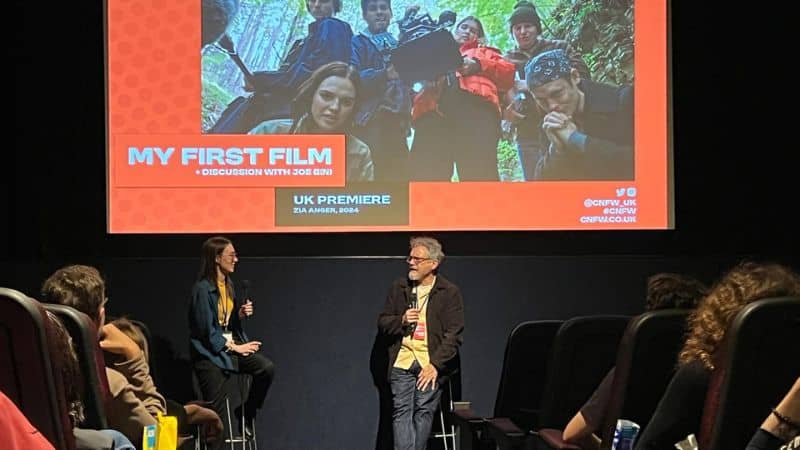
Next up is the UK premiere of My First Film (Zia Anger, 2024). Despite the title, the film is not actually her first film; rather, it is about her first film, an attempt at a microbudget indie film she made ten years ago called Always All Ways, Anne Marie. That film had a troubled production and, when it was finally finished, was dead on arrival—no festivals accepted it, and it was labelled «abandoned» on IMDb. Anger started to revisit this experience of failure in high-concept Covid-era online performances in which (apparently—I haven’t seen them) she would tell the story of the film’s production by typing out messages on screen, share stories on #Instagram with the audience that they would then have to share among themselves, and show film clips and text messages.
My First Film starts with a bit of that—Instagram stories, text on screen—but quickly develops into something a little more conventional: a dramatization of the first film’s production. But just a little more conventional: the film slips between what seems to be documentary, dramatization, and outright fantasy. Everything that can go wrong does: Anger’s crew is perpetually stoned, her actors can’t act, she has to get an #abortion at one point, someone almost dies in a car crash. How well does the film work? Irony of ironies, just like its subject, it too failed to get into most festivals, though it has garnered respectful coverage. In a strange but entertaining post-film Q&A with the film’s editor, #Joe Bini# (a longtime Werner Herzog associate), who hadn’t seen the completed film until that precise moment, he said the film was interesting but stopped short of calling it an unqualified success. It’s certainly an experience, though.
The final film of the day is another programming 180. From the slippery and conceptual takes on non-fiction of Cette maison and My First Film, the day ends with the UK premiere of a film over ten years old: I hate myself 🙂 (Joanna Arnow, 2013). Imagine if the TV show Girls was a first-person documentary, and you start to get the picture. In the film, Arnow documents herself—an inexperienced, nebbishy 20-something—and her relationship with her boyfriend James, a truly repellent edgelord type (picture a mix of Dwight Schrute from The Office and Donald Trump) who stages open-mic nights in Harlem as an excuse to espouse racist vitriol under a thin veneer of humour and irony. In the film’s opening scene, Arnow asks her parents why they think she’s dating James. They can’t answer. In the film’s most shocking moments, Arnow shows her parents the film she’s been making of her life and relationship with James—including footage of her and James having sex. Her parents are not amused. On top of all this, the film is profoundly ugly—shot on a crappy digital camera—and clumsily edited.
It’s an excruciating film. It’s also kind of perfect. Arnow’s relentlessness in revealing her most embarrassing moments and subjecting them to rigorous analysis with her parents and her perpetually naked editor, Max, commands a certain respect. It goes beyond #intimacy. Usually, when we talk about intimacy in film, we’re really talking about something like empathy. With this film, you go way past the point of empathy to some mix of disgust, amusement, and reluctant comprehension of this incomprehensible person. By the end, Arnow feels less like a documentary subject than a friend—a friend who constantly disappoints you, whose decisions you can’t understand, but who somehow amuses you. It makes other films feel somehow slight.
Let me pause here to start to draw out a festival theme. A filmmaker named #Caveh Zahedi# has recently come to my attention. He’s a New York-based documentary filmmaker who mostly makes brutally honest films about himself, revealing far more than is strictly advisable—he has alienated most of his family, friends, and collaborators throughout his career. If one aspect of Zahedi’s influence is extreme honesty, another is interrogating the creative process: in Zahedi’s ongoing TV series The Show About the Show (2017–), each episode is about the making of the previous episode, making lots of space for Zahedi to air his every lust, obsession, and grievance. I don’t think I’m wrong to detect him as a sort of inspiration for the CNFW. For one thing, he appears briefly in Searchers. For another, Zia Anger appears in Zahedi’s The Show About the Show, playing his wife after his wife leaves him, and her film is in a similar spirit to Zahedi’s series. Finally, Joanna Arnow cites him as an inspiration for I hate myself 🙂.
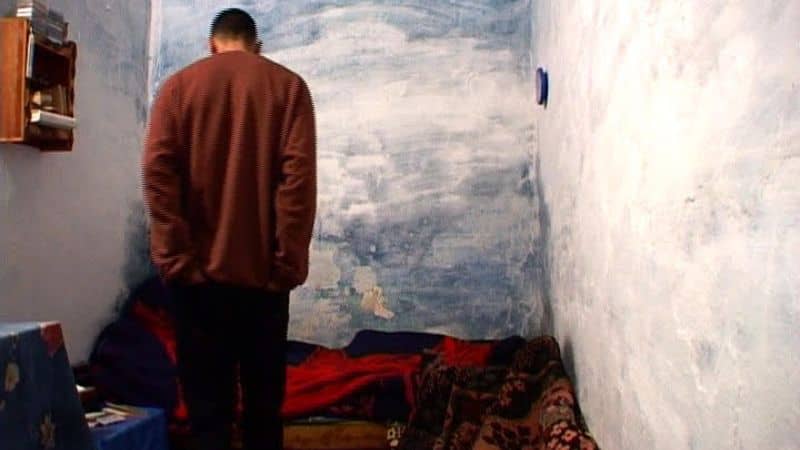
The first film of day 3, I See the Stars At Noon (Saeed Taji Farouky, 2005), uses a similar intimacy and honesty in a completely different context. It’s a film about the #migrant crisis long before it was thought of as such, and it forgoes artifice of any kind in favour of a direct, linear, and enduring engagement with one man, Abdelfattah, trying to cross the Mediterranean from Tangier, Morocco, to Spain. From this limited palette—one filmmaker, one camera, one subject—an incredible complexity emerges, throwing into question Abdelfattah’s reasons for wanting to leave Morocco, which are economic (he wants higher wages) but also social (he knows people who have gone and come back wealthier) and even cultural (he is bored with unemployed life in Morocco and the days of superficial banter in cafes that come with it) as well as Farouky’s motives in following him and perhaps even helping him—is he exploiting Abdelfattah?
Everything ends badly, of course. Abdelfattah pays a trafficker to get on to a cargo boat only to be caught immediately on docking at Algeciras or Tarifa and sent back to Tangier. He tries to get his money back—in vain. A closing title tells us he’s now working in a cafe on the Algeria/Libya border and still wants to make it to Europe. It’s incredibly rare to get such insight into the sober calculations that go into the decision to migrate, and it’s a virtue of the filmmaker’s direct, unadorned, and self-reflexive approach, making himself a participant in the film as well as its maker, that it makes these themes emerge.
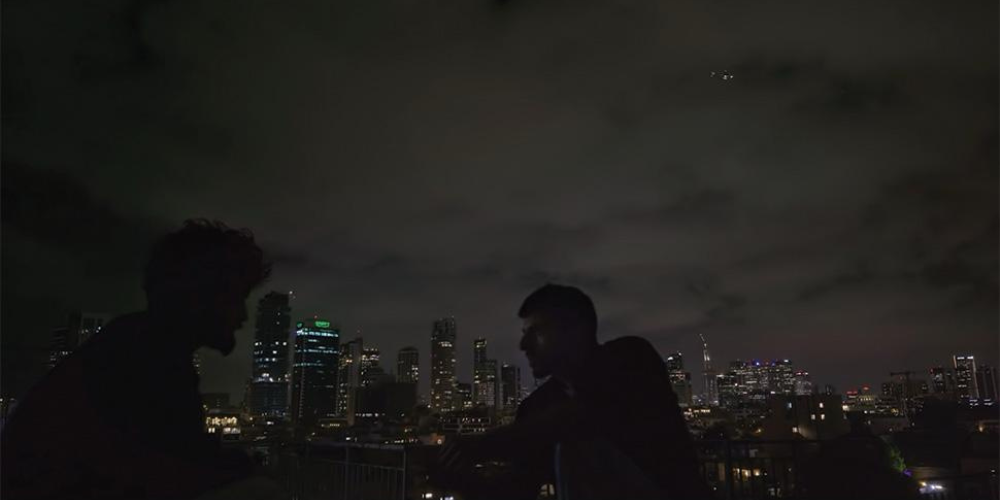
The festival’s various themes—the politics of migration, the complexity of intimacy, the possibility of honesty, the creative potential of hybrid documentary forms—come together in the collage-like Miguel’s War, which follows a gay Lebanese man in self-exile in Spain. He claims to have fought in the Lebanese Civil War and experienced traumatic events that continue to affect his life and sexuality. Following Miguel in Spain and Lebanon and mixing documentary footage with playful animation, the film interrogates this story, questioning Miguel’s memory and motives for possibly refashioning his past.
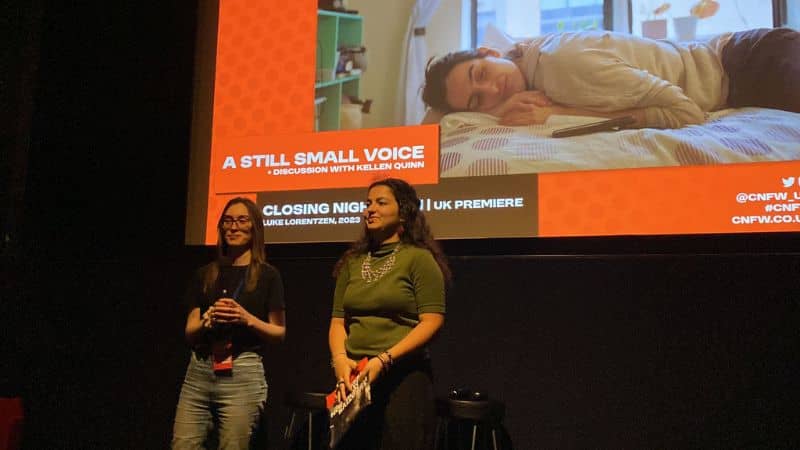
The CNFW comes to a close with A Still Small Voice (Luke Lorentzen, 2023). Set in New York’s Mount Sinai Hospital during #Covid, the film follows a set of chaplains-in-training as they give spiritual care to patients experiencing serious health problems. Mati, the central subject, is a fascinating character who struggles with burnout and comes into conflict with her supervisor even as she offers profound care and kindness to her patients. And her patients are at the centre of some intensely moving scenes, including one in which Mati—who is Jewish—must baptize a stillborn twin baby born to a Christian couple while also celebrating the birth of the baby’s surviving twin with them.
The chief strength of this first edition of the CNFW was to present films that zoom in to focus on individuals, sometimes stripping away as much aesthetic pretence as possible to get as close to their subjects in incredibly vulnerable moments, whether that be embarrassing sex, illegal migration, or the death of a child. Though they don’t really fit that theme, I was also appreciative of seeing the oddball My First Film and the moving though obscure Cette maison. Given the intensity of the films and the fact that few of them are new releases on the festival circuit, I think the programme may have been more effective as a weekly or monthly series rather than a festival. I would certainly welcome a series of first-person independent documentaries. Still, I can’t fault the selection of films. I hope there is more CNFW to come.