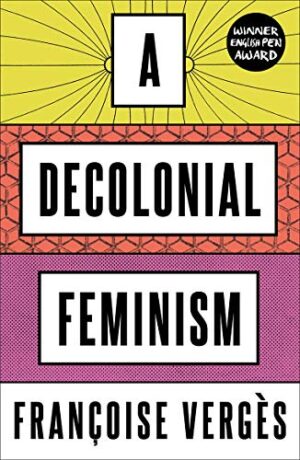
The French author and activist (with a PhD in political science) Françoise Vergès has written a powerful and highly readable book, A Decolonial Feminism. After its release in France in February this year, most national newspapers and radio channels have reviewed it or interviewed the author. She has a clear and important message: Western feminists consume other women instead of fighting alongside them for better living conditions. She refers to these other women as «racisée.» The word exists in French but is not easily translated into Norwegian. Translating it as «etnisk» (ethnic) would be incorrect since it overlooks the politically incorrect reference to #race. For the same reason, it cannot be translated as «fargede» (coloured). «Rasialisert» (racialised) is likely the best Norwegian translation, even though this word has not been an active part of the vocabulary – until now.
One’s freedom, the other’s slavery
Françoise Vergès believes that white Western women have gained many freedoms by continuing to keep racialised women down. She provocatively writes that «the comfortable existence of rich, middle-class women is only possible because millions of racialised women are exploited when they produce the clothes used by middle-class women, wash the houses and offices they live and work in, take care of their children, and satisfy their husbands’ and brothers’ sexual needs.» The rich, middle-class women are more concerned about getting the same wages as their men than about ensuring that racialised women (and men) have acceptable working conditions and wages to live on.
Vergès is outright furious with the privileged equality feminism, which she believes only perpetuates inequalities and oppression in the world. White, affluent women fight only for themselves without considering that their struggle requires someone to take on the dirty jobs. And when well-to-do women on the political right also started calling themselves feminists while making homophobic and Islamophobic statements, feminism lost credibility and relevance. Therefore, we must change our perspective and reclaim feminism.
white Western women have gained many freedoms by continuing to keep racialised women down.
Decolonisation
The perspective of today’s Western feminists is too narrow and egocentric; feminism must be decolonised, just as academia must be decolonised to enable us to view the world from a standpoint other than that of the white West, the author argues.
So, what does it mean to decolonise feminism? It involves two important changes in perspective, argues Vergès. The first is to acknowledge the worldwide oppression of racialised women (and men) and to stop believing that #gender equality# for rich, middle-class women represents anything more than a small fraction of feminism. The second change in perspective entails that those (few) feminists today who are interested in racialised women shift their attitudes from wanting to help them to want to fight alongside them. Vergès refers to the helping attitude as «civilising feminism», with a clear reference to French colonial policies.
The main mantra of «la mission civilisatrice» was that colonial subjects should become like the French: learn the same language, wear the same clothes, believe in the same religion, and have the same values.
The author believes that this attitude also characterises today’s feminists; they see themselves as helpers who will liberate racialised women from patriarchal oppression. However, what they actually contribute to resembles a civilisational oppression akin to that of France during the colonial era. And she reminds us that even though the colonial era is over, #colonialism continues, along with the ideology of the colonial era.

«Femi-imperialism”
When French feminists demonstrate to impose a ban on hijabs in schools, Vergès calls it «femi-imperialism.» The white Catholic women know what is best for the racialised #Muslim women. They want to help them become free, meaning like themselves, says Vergès ironically and brings up the debate surrounding the ban on the burkini – a full-body swimsuit designed by and mainly for Muslim women – in 15 French cities in the summer of 2016. French feminists so eagerly wanted to help racialised women that they forced them to undress to be on the beach. She beautifully writes, «in the summer, a woman must undress, for that is the only way she can show her freedom.» Even though a French court later that summer ruled the burkini ban illegal, it is, according to Vergès, a prime example of femi-imperialism.
Only by decolonising feminism can it remain relevant in today’s world. If feminism continues with its Eurocentric perspective, it will be lost. Middle-class feminists in Europe must stop believing they can «help» racialised women in economically poorer countries. They must understand that help is obsolete. And they must stop exploiting the predominantly racialised «care class» that takes on the dirty jobs so that they can equalise themselves with their men. A collective struggle, nationally and globally, where women (and men) of all origins fight together for common liberation from patriarchy, sexism, liberalism, and capitalism, is the only thing that can save feminism, Françoise Vergès concludes—strong words from a powerful author.
Our website features Amazon affiliate links, and we may earn a commission from purchases made through those links.