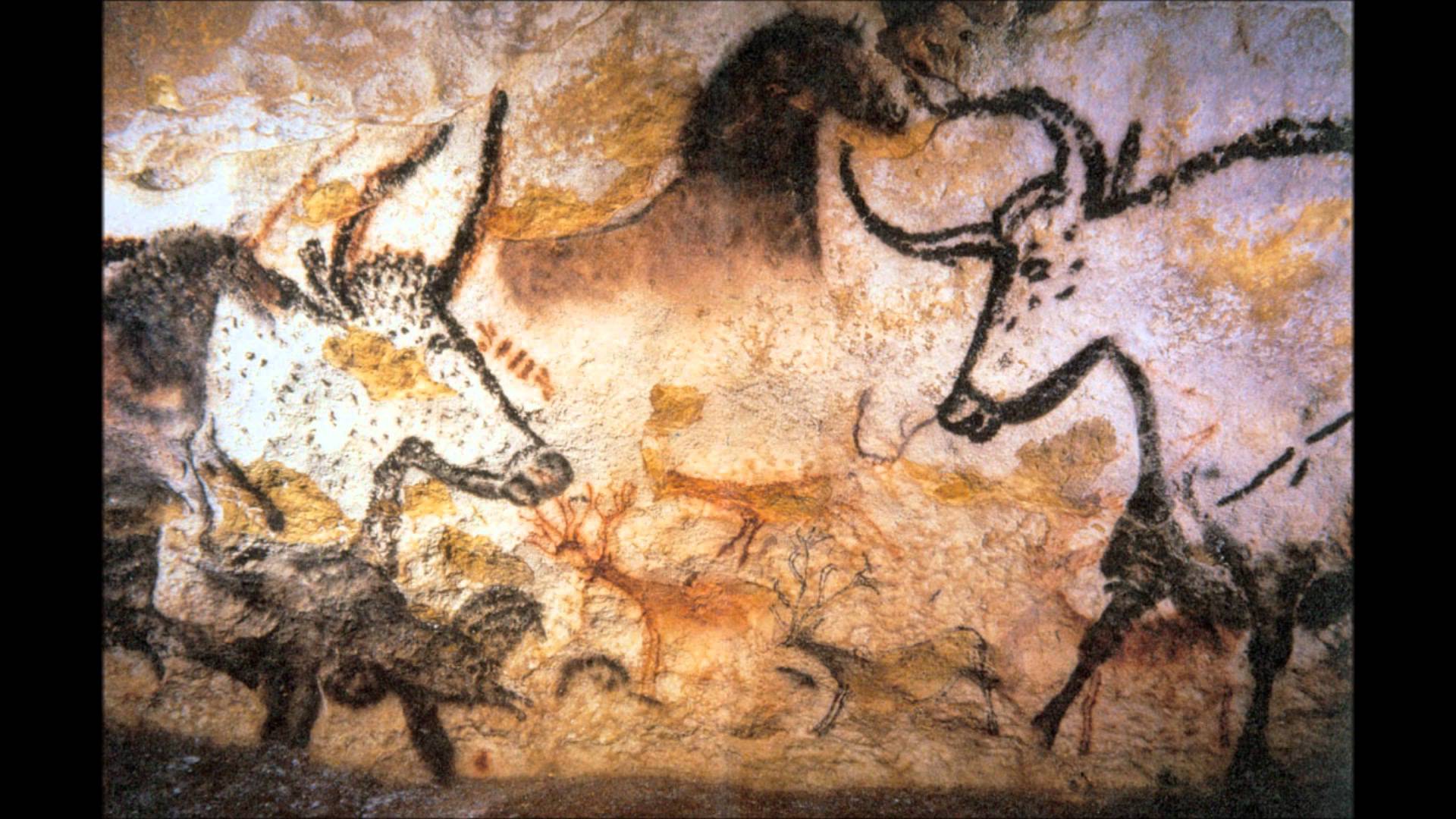
Werner Herzog takes us deep behind the frontier of an extraordinary place. Having gained unprecedented access through the tightest of restrictions and overcome considerable technical challenges, he has captured on film, with specially designed 3D cameras, the interior of the Chauvet Cave in southern France. This is where the world’s oldest cave paintings – hundreds in number – were discovered in 1994. He reveals to us a breathtaking subterranean world and leads us to the 32,000-year-old artworks. We come face to face with pristine and astonishingly realistic drawings of horses, cattle and lions, which for the briefest second come alive in the torchlight.
Utopia is not a place, and no place is utopic. But there is a place, the unknown place, that is sealed as a promise for all time. As if in a dream, we are called by a distant memory to begin our journey to find this place. In Werner Herzog’s latest documentary on the Chauvet Cave, we are almost bound to say that to the most distant times, all paths come together in a disappearing optical illusion. By isolating a segmentary fragment within a large canvas, another remarkable world appears. Frame by frame the eye looks for the impossible within another world. The utopia of our optical perception plays an unusual role in the Western and Eastern conception of the image. The oldest images of our culture produce not only an image but something so alien that it reveals something about what it means to be human.
The Chauvet Cave was discovered in 1994 by the French scientist Jean-Marie Chauvet. Shooting inside the cave was no easy task, and Herzog and his crew had to build a camera for the occasion. Herzog received permission to do this delicate shoot because he was Herzog. Only he could make this film. Together with his cameraman, he began his optical voyage to utopia in the South of France in an area mostly known for it’s limestone-sediment caves. It is here that man had created, perhaps for more than thirty thousand years, remarkable drawings of animals, hunting, and symbols.
Several times during the film Herzog returns to the question of what it is we see and what it is these early humans might have seen. He never attempts to provide us with a clear answer. Part of the answer though, he says, lies outside the cave, within the landscape itself. The place around the cave, the river and its characteristic canyon formation, reminds him of a Wagner Opera. He wonders if this particular formation, rhythm, and dimension of the landscape for these early humans constituted a kind of inner mental landscape as it does for us modern human beings?
In a similar fashion, Herzog and the camera seem to say: You and I are seeing something outside all culture, and yet it is vibrant, organic, and pulsating with life. Since the time of Ancient Egypt, man has moved within the world of nature between the living and the dead, a place where no spirit is completely released from matter itself. With these forgotten dream-images, Herzog reminds us of how we – living in an indefinite stream of vague images with no inner necessity, leaving no traces in memory – are in need of new images, sharp images, images that make us think again. Images offering us a new perspective are also the beginning of thought. Like a shaman, with a humorous flash in the eye, Herzog dreams of entering another soul, a primordial crocodile; a primordial man learning what it means to see.