The network collaboration «Communities for Futures» aims to integrate transformative regional and local development policies into the European Commission’s «European Green Deal» (EGD). A focus on community-led initiatives with the EGD in the future is intended to provide a widespread, locally governed response to the #ecological crisis# with specific policies in areas such as food systems, energy, renovation, etc.
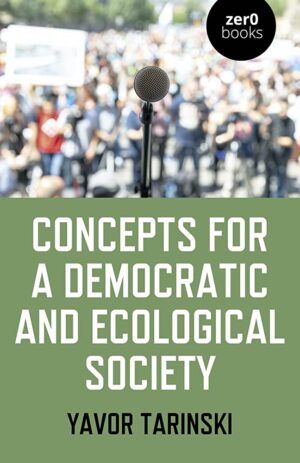
Author and activist Yavor Tarinski has provided a theoretical framework for such a concrete initiative in his book Concepts for a Democratic and Ecological Society. In the book, Tarinski presents various ideas on how development can be reversed and provides some basic systemic approaches to a comprehensive cultural shift.
Direct democracy
Today, #democracy and #capitalism are often used interchangeably. Cities no longer serve as frameworks for public discourse; on the contrary, they have become temples for capitalist growth, turning their inhabitants into alienated and passive consumers.
With references to #Cornelius Castoriadis# and #Murray Bookchin#, Tarinski clarifies these concepts. Both were concerned with the genuine self-determination of individuals and the development of institutions that can uphold personal authority. Ultimately, such potential will always be present and can represent the potential for people to come together and collectively decide how to manage vital resources on which their livelihood depends.
It will be necessary to abandon the capitalist economism of #homo economicus# completely and instead embrace the active citizens of #social ecology#, passionate about public affairs and aware of their symbiotic relationship with nature.
According to Tarinski, it is not enough to criticize the environmental consequences of production («environmental reflexivity») with its risk awareness and scepticism of innovations. Just as the labour movement put #socialism on the agenda, critics of the Anthropocene’s obvious destructive tendencies must focus on fields such as microbiology and Earth system sciences.
In a truly direct democratic framework, the majority of the population will make decisions that concern them directly in their neighbourhood assemblies.
Think globally, act locally
Every year, the public is reminded of the failure of world leaders on a global scale, particularly concerning the «Global South» at COP conferences and the CO2 reduction goals of the #Paris Agreement#. Since #Paul Crutzen# introduced and highlighted the #Anthropocene era, the complexity of transition has multiplied. It can perhaps best be described as the necessity of a cultural revolution, viewed as the relationship between society, power, and nature. For Tarinski, it is evident that global development within the planet’s boundaries cannot be achieved through top-down decisions, not even within an extra-social set of scientific knowledge or pseudo-enlightened elites.
The late #Bruno Latour# (together with #Nikolaj Schultz#) contributed, before his death, a note on how to create a proud and self-aware ecological class. With Yavor Tarinski’s book and the efforts of «Communities for Futures» to bring community-led initiatives into European political reality, a new door may be opened for the necessary transformation.