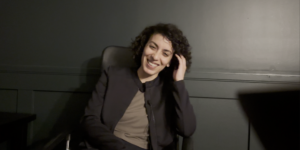
BAFTA-nominated, Emmy and Peabody Award-winning documentarian #Deeyah Khan#, who was also the inaugural UNESCO Goodwill Ambassador for Artistic Freedom and Creativity, can now add the 2020 Fritt Ord Foundation Prize to her mantle. The Norwegian-Pakistani filmmaker was recently honored «for her intrepid, methodical and innovative documentary films on extremism.» Indeed. Beginning with 2012’s Banaz: A Love Story, which detailed the life and untimely death of a British-Kurdish woman murdered by her own family in a senseless «honor» killing, and on through 2015’s Jihad: A Story of the Others and 2017’s White Right: Meeting The Enemy – which involved Khan embedding with those on diverse sides of the #extremist divide – the UK-based activist-artist has proved to be an uncompromising talent with one heck of a fearless gaze.
And most recently, Khan has trained that gaze across the pond with not one but two films out this year, America’s War on Abortion and Muslim in Trump’s America. How she’s found time to tackle these explosive topics while also running Fuuse, the media and arts company she founded in order to put «women, people from minorities, and third-culture kids» in control of their own narratives, is a question that’s lately been front and center in the Modern Times Review mind, which is why we’re grateful Khan took a breather from her busy schedule to fill us in on choosing subjects, gaining access, and sitting down with those dedicated to making the world a more hateful place.
So how exactly do you choose your subjects? Are you primarily seeking great characters and story, or do you first look for a specific social issue to tackle?
Deeyah Khan: Mostly they start with my own sense of curiosity. They are born out of my need to understand. I try never to go out with a defined story to tell – I go out wanting to learn. My films do tend to explore social issues, but they’re ones that I feel a personal impact from – not necessarily in that they relate to my own life, but issues that resonate with my own experiences and questions. And they’re issues that confuse or trouble me, issues that I want to learn about.
I’ve always learned best from talking to people and finding out what motivates them. I’ve always sought to connect the social, and the #political, with the personal. And it’s that process of learning, and of making those connections, that structures my process. I want to document and share my journey towards understanding with the viewer. I want the experience to be transformative for the viewer, just as the process of filming is for me.
What piques my curiosity in the first place can be very different from project to project. Mostly I find characters while researching a topic rather than start from there. I didn’t know former #Neo-Nazis Ken Parker or Jeff Schoep before I started filming White Right, but it was their candor and willingness to engage with me that made that film the success that it was. It was the same with Abu Muntasir when I filmed Jihad. People would say it took courage for me to approach them – but in my view, it took courage for them to be so honest with me and on camera.
But the other side of this is my first film, Banaz: A Love Story, which was on the topic of «honor» killings. The subject was hugely important to me, as a woman that comes from a culture where «honor» still constrains our lives. But part of the tragedy of the film is that we could only see her as a silhouette, almost. I heard from people who knew her and loved her, but I was always one step away from fully knowing her. I think that was why I resonated with the experiences of the police officer who worked her case – Caroline Goode. She, like me, had this really intense relationship with a person that neither of us had met or ever would. We both grew to feel so strongly attached to Banaz. This is why I described that film as a love story, despite it being a tragedy.
I remember interviewing Alison Klayman awhile back about her #Steve Bannon# doc The Brink, and she said something that struck me as quite profound: «My daily mantra was, ‘Let him be underestimating me, and let me never underestimate him.’» I’m wondering if you approach difficult characters in a similar way. How do you go about getting the incredible access that you do?
Khan: I’m so glad you shared that quote with me, as it resonates deeply. And I wish I’d had a chance to talk to Steve Bannon, but that never happened. I’m sure I’d feel exactly the same way in dealing with him. I actually did try to reach him for my Muslim In Trump’s America film, as he has been the architect and driving force behind many of Trump’s anti-Muslim stances and policies.
As a woman and as a person of color I am used to being underestimated – not just by people I’m filming but also by the industry within which I work. It’s true that very often the harder-edged men I’m filming start out underestimating me, or condescending to me, and in some ways, that’s a way under their defenses.
Sometimes they are too busy posturing and patronizing, and through that, they share more than they realize. But ideally – even if it’s a great foot-in-the-door that lets me get their measures very quickly – that’s not where I want the relationship to end. I want to develop a sincere connection with people, even those I disagree with. I want them to be honest with me, and I want to be honest with them too. The developing of the relationship and a sincere bond, and treating them with dignity no matter who they are and what views they hold, is absolutely core to my filmmaking process.
And that same relationship-building is shown through how I go about getting access. I don’t have a team that makes contact on my behalf and sets up encounters. I do get tips from my researcher, my networks, and other people I’m already talking to for the background work. They might pass on details of people I’d find it interesting to talk to. But I don’t allow anyone else to speak for me.
Nobody gets contacted by my assistant trying to set a time for a chat. I do that myself, always. It’s very important to me that they relate to me, directly, with no barriers from the very outset. For me, the relationship begins long, long before the camera rolls – and often extends long, long after. I’m still in touch with many of the people I’ve made documentaries about. It’s a bonding experience because it’s emotional, so you build a real human connection despite starting off completely opposed to each other. Even friendships have developed with many of the people I have filmed over the years. Of course, that’s not to say that it’s the case with everyone I’ve filmed, but far more have become lasting relationships than not.
The developing of the relationship and a sincere bond, and treating them with dignity no matter who they are and what views they hold, is absolutely core to my filmmaking process.
I’m also curious about how you might deploy one or more of your multiple identities when approaching various subjects. For example, with a film like Jihad: A Story of the Others, I was thinking your Muslim background might get you in the door (while your Western upbringing would need to be played down); whereas with White Right: Meeting The Enemy it’s probably more helpful to be seen as Western European and even female (since it seems to me that male extremists have a tendency to abruptly toss aside hatred for the attention of a pretty woman).
Khan: As with anything in life, one’s background can be a massive resource or a massive hindrance when it comes to connecting with people. For me, while there’s always a sense of being between cultures, there’s also a way in which having a multifaceted identity creates a lot of points of contact. It helps to find some point of shared interest to start a conversation, make a connection, spark a relationship. I can always find something we share, and that’s where it all begins. If I can’t connect with someone through one aspect of my culture and experiences, then hopefully it is possible to go deeper into someone’s life and experiences. So I can often find points of connection with people very dissimilar from myself.
Like so many of my films, there was a political and personal starting point behind making Jihad. I wanted to explore violent #jihadism because it was a huge contemporary social problem that I felt wasn’t being understood in a way that took account of the human dimension. I felt it was politically very important to fill that gap. But also, I had a personal insight as a victim of harassment and death threats from Muslim extremists – so that fueled my desire to understand their motivations at a personal level. It was actually terrifying at first to confront people who were part of a movement that had, quite frankly, driven me to fear for my life. But in the end, it was a healing experience for me, to see that what I had feared weren’t monsters, but troubled and vulnerable men.
As for the white supremacists – of course, it helped that I’m a friendly person, but also it helped that I was completely unlike any of their expectations. They had two stereotypes of Muslim women – meek, submissive, and veiled, or an angry, ranting extremist. That’s not me. And that threw them completely. Jeff Schoep, at the time the leader of the biggest far-right organization in the US, told me that I reminded him of someone’s sister because I wouldn’t stop needling him as a sister would. I don’t think either of us saw the relationship between us developing that way.
But the personal dynamic there was forcing them to recognize the dynamic – that they related to me, they liked and respected me, even if they disagreed with me completely. And that this feeling was mutual. Yet I was a «shitskin» according to their systems of thought. It was this contradiction that collapsed their belief systems in some cases— not being able to reconcile the developing friendship between us and their white supremacist ideology that told them I am not even human. And that helped some of them break away from the movement entirely.
https://youtu.be/KmvcHD9DQlk
Your most recent films profile the anti-abortion and anti-Muslim factions in the US during the (almost over with, thank goodness!) #Trump administration. As an American old enough to remember Operation Rescue when it was at its most dangerous, and Bush’s Orwellian, post-9/11 Muslim registry, I’m curious to hear how you think these groups have evolved, especially in terms of tactics, in recent years. Have they been more emboldened to act radically and lethally? (It seems to me that a lot of these folks have actually decided to pivot to the mainstream, focused on appointing Federalist Society judges and attempting to go the clean-cut, «boots to suits» route of the #Richard Spencer# types.)
Khan: I would agree there’s been a professionalization of both hate groups and anti-abortion activists. I think that as American politics have become more polarized over the decades, there’s been an increasing space at the far ends of the spectrum. The middle ground is eroding, and the extremes are sliding in there.
With the anti-abortion activists, they always had a formidable organizational network based on the infrastructures of religion – evangelical #Christianity, and to a lesser degree the #Catholic Church#. For a long time, they’ve been getting their supporters into all levels of civil society, from top to bottom, from school boards to the Supreme Court. As single-issue voters, they gave Trump a block vote. Trump certainly didn’t care about women and was happy to do what they wished for their backing.
My film was set on the frontlines – as I wanted to honor the healthcare workers who were rolling up to work every day while protestors were spitting hatred at them. But far from the frontlines, in offices and meeting rooms and courtrooms, there’s an entirely different level of campaigning, through politics and lawmaking, to diminish women’s reproductive control over their own bodies. I didn’t think I could deal with both of these levels in the same documentary and do it justice, so I went for the level where you could really feel the impacts on women’s lives directly – the healthcare workers and the women who needed their help and the barriers they confront. I always film a lot more footage and talk to a lot more people than what ends up onscreen. I wanted to show the impact of these policies, as a warning to all women as to how we’re having our rights legislated away.
When I was filming Muslim in Trump’s America I was conscious of not wanting to repeat White Right – but in a way, it does track the expansion of #prejudice in America. There’s obviously a lot of common ground between hatred based in race and hatred based in «culture» like #Islamophobia. This has been the key shift of white identitarian movements. As it got less tenable to insist on a racial hierarchy, «culture» came in to fill that gap. Now it’s not their genes that make them superior, it’s the heritage of European culture.
So instead of seeing me as coming from an inferior race, as the white supremacists do, the argument now is that I come from an inferior culture – and that that culture is #Islam. There is no Muslim race. A fifth of the world are Muslims. In the UK, my current home-base, most Muslims are South Asian, like my parents. In America it’s a different situation – there’s a lot of African-Americans and Somalis. The country with the biggest Muslim population is Indonesia. Race just doesn’t work as a discourse against us.
So instead of race realists recycling 19th-century racial stereotypes to give a veneer of science to their prejudice, yesterday’s racists today claim expertise in some homogenized, simplified, Orientalized form of «Muslim culture.» Islam is understood as completely barbaric and evil.
Of course, #ISIS are barbaric and evil, and #Al Qaeda# are barbaric and evil, and they and the many other groups like them are part of a dangerous movement that threatens everyone who opposes them – Muslims as much as anyone else. But that’s got almost nothing to do with my own sense of my culture or heritage, either as a Muslim, as a European, or as a woman who grew up with South Asian parents. My culture growing up was Michael Jackson as well as khyal music; the Raj and Partition as well as the Battle of Leipzig; tandoori chicken and Norwegian pancakes. I am a Muslim in that my sense of the spiritual is inflected by Islam. But there’s a lot more to me than my faith.
But to Islamophobes, people like me don’t exist. In their eyes, extremists are the only «real» Muslims, and the rest of us – the vast, vast majority – are dupes who don’t understand our own religion, or secret agents of shari’a working to bring about the Caliphate. It’s a very peculiar experience, having your culture explained back to you by people who’ve turned it into a terrifying fairground-mirror distortion.
The turning away from race and towards culture puts Muslims in the crosshairs. It’s this change that allows these people to present themselves as security experts, or defending American values when most American Muslims just want to pay off their mortgages, and for their kids to do well in school. But anti-Muslim extremism and anti-Muslim activism is a very sophisticated and lucrative operation – there’s a lot of funding for their efforts. They call it the «Islamophobia industry.» This is not operating at the level of a bunch of skinheads shouting in a park. They’ve got slick websites, they have formal conferences and seminars – and they did have an alarming level of access to the Trump administration. Thank goodness at least they won’t have that for much longer. But they’re still not going away anytime soon, and they’re very well organized. And as long as that narrative about Islam goes unchallenged, it’s going to make Muslims’ lives harder.
Can you talk a bit about Fuuse – and how your documentary work intersects with your organization’s many initiatives?
Khan: The documentaries are the flagship of Fuuse’s work – and the most demanding projects because they are produced over longer periods of time. But Fuuse has a lot of other media content that complements our general mission to promote intercultural understanding.
We have a series of interviews with young people in the creative industries talking about their experiences of straddling two (or more) cultures. I think it’s important to promote a diverse media, and this is a way of doing that. I also have content on male violence and extremism, for educational purposes, because these are issues that are very important to me. Fuuse has produced short films as well. Karachi’s Kathak Dancers was distributed via #Al Jazeera#, for example. In addition, Fuuse has organized conferences and events, which are a lot of work to put together but so much fun to take part in.
The largest ongoing Fuuse project outside the documentaries is the online magazine sister-hood. I founded that publication out of a frustration that the experiences of Muslim women weren’t well-reflected in the mainstream media. It was all jihad brides and victims of honor killings. But there’s so much diversity in the Muslim world – different kinds and levels of faith, political opinions, lifestyles, ethnic identities, and so on and so on. So I created a platform specifically for women of Muslim heritage – a term that includes ex-Muslims because I felt they very much needed to be part of the conversation.
It’s been running for several years, largely managed by my team who do an amazing job developing and publishing new content every week. I look forward to it every week and particularly enjoy reading a section called «Inspirations,» which I commissioned. It’s a series of articles about women of Muslim heritage throughout history. I keep finding new role models there, getting a deeper understanding of our hidden histories.
I also plan on expanding Fuuse further in the years to come. As a broader organization it’s not just about the documentaries – so that gives me a lot of room for creativity outside the 60-minute format. And it allows for collaborative work with other people whose work I respect.