The French political scientist Jean-François Bayart was one of the editors of the book Religion et modernité politique en Afrique noire (Religion and Political Modernity in Black Africa), published in 1993. Through a series of studies from several African countries, the book discussed the role of #religion in post-colonial Africa. One of the main points was to show how religion and politics were intertwined and how both were used to gain material privileges.
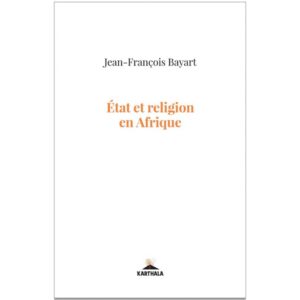
This main point is further developed in Bayart’s new book État et religion en Afrique (State and Religion in Africa), where he also emphasises that this has been the situation long before the colonial era. As in the Old Testament, the following also stands in this year’s book by Bayart: There is nothing new under the sun.

Generous mentor, nonchalant author
I have been fascinated by Bayart since 1993 when his book The State in Africa was published. During a seminar in Leiden three years later, my fascination turned into something even stronger – I became a fan. Bayart generously shared his knowledge, commented on student papers, and provided positive feedback to those who presented papers. Therefore, with some resistance, I find the Frenchman to be too general, theoretical, and nonchalant in this present book. Bayart is a typical French «armchair intellectual»: black suit, freshly ironed white shirt without a tie, medium-length hair, a charming smile, and self-assured. It has been several decades since he spent time in sub-Saharan Africa. Therefore, all his analyses of what is happening on the continent are based on reading others’ works.
Not primarily about religion
In Bayart’s previous book, L’Impasse nationale-libérale (The National-Liberal Impasse), the main idea was that #globalisation and the development of national identity are complementary processes that reinforce each other and create synergies rather than conflicting forces. In the new, much shorter book, the main theory is that religion in Africa is as much about politics as it is about #spirituality and that religion is given too much prominence in analyses of African conflicts.
Bayart talks about the Christian Lord’s Resistance Army (LRA), the rebel guerrilla in Uganda led by #Joseph Kony#, who, from the mid-1980s and for 20 years, kidnapped 20,000 children and turned them into child soldiers, sex slaves, and servants for his army, and whom the world came to hate in 2012 when StopKony and the American organisation Invisible Children got 100 million people to watch a half-hour «documentary»* about Kony in one week.
The political scientist argues that both the LRA in #Uganda and #Boko Haram# in Northern #Nigeria have religious undertones, but the LRA does not represent #Christians in the same way that Boko Haram does not represent #Muslims. Both use religion as an identity-building common denominator, but their interpretations of religion differ greatly from the majority of their respective groups. Those killed or kidnapped by Boko Haram are often Muslims themselves, something we hear little about in #Europe because it undermines the image of Boko Haram as an Islamic threat. It becomes more difficult to gain support for combating Islamist #terrorism if it primarily affects Muslims.
Struggle for resources
The #LRA is the evangelical Christian sister organisation to the Islamist Boko Haram – they resemble each other in structure and organisation around a cult-like but less visible leader. However, according to Bayart, neither movement sees religion as their main cause – rather, the religious dimension is merely a cover for conducting violent criticism of the regime and engaging in political power struggles.
Both the LRA and Boko Haram desire (greater) political influence, self-determination, and a larger share of the state’s resources, just like #AQIM in #Mali and #Al-Shabaab in #Somalia. The main problem in these conflicts is the imbalance in influence and material goods rather than what we in the West explain as religious extremism. The LRA kidnaps more Christians, while Boko Haram kills more Muslims. The conflicts in Africa, both historically and today, are much more about control over resources than spirituality, writes Bayart.
Praising popes
According to Bayart, world religions often have a conservative influence on African politics. Throughout the 1970s and 1980s, the Vatican supported Catholic presidents, regardless of whether they were dictators. Pope John Paul II visited #Ivory Coast# on an official visit. He blessed the cathedral in Yamoussoukro, built in former President Houphouët-Boigny’s hometown, with his own money. In 2009, Pope Benedict XVI visited #Cameroon and stated that the use of condoms worsened the #AIDS epidemic in the country, in line with the views of conservative Christians there.
Evangelical Protestants and charismatic Catholics are becoming increasingly prominent in Africa, and their leaders’ influence is growing in parallel with this growth. It primarily concerns political and #economic influence# rather than moral and religious influence. The same applies to fundamentalist Islamic movements.
I would argue that Bayart’s «nothing new under the sun» regarding the relationship between religion and African politics also applies to his analyses in État et religion en Afrique. For those who still wish to read the book, an earlier edition can be downloaded for free from the website of Études Africaines Comparées at Morocco’s Polytechnic University.