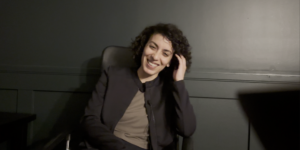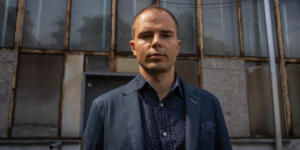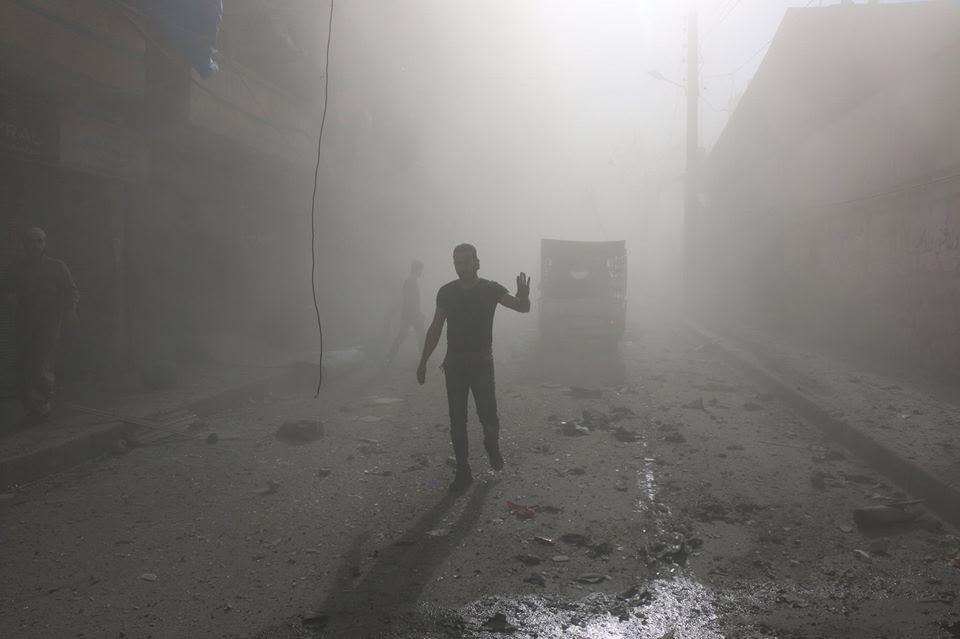
“We trust that the world take responsibility and end the war in Syria,” says the smiling man in front of me. Two years ago, Ali Alibrahim’s family home was bombed; his mother, sister, and friends died in Aleppo. He believes that the world will help them rebuild Syria, when the time comes.

Alibrahim is a Syrian investigative journalist, filmmaker and author. He recently paid a visit to the Norwegian city of Lillehammer for a screening of his latest documentary One Day in Aleppo, a 24-minute film which sees Alibrahim both directing and editing. His creative producer Feras Fayyad recently won several awards as director of Last Men in Aleppo, – the opening film and winner of the main competition programme at this year’s CPH:DOX in Copenhagen. We are seeing a trend of several new documentaries that cover the situation in and around Syria. Courageous directors want to witness and document for history the events of the war zones of the new core Middle Eastern conflict.
“Fear is all people of Syria feel right now”
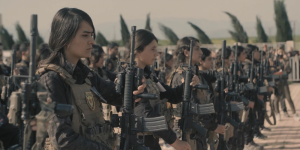
Who is the worst? Syrian rebel movements, which previously enjoyed full support from the West, have been suffering criticism. Demonstrations started with singing and peaceful protesting against Assad’s regime. Soon, the government’s attacks and suppression went so far that the demonstrators were forced to defend themselves using weapons. This is depicted in, among others, the documentary Return to Homs (2013). A few years have now passed, and war methods employed on both sides of the conflict can only be described as beastly. Many have started to question whether Assad was really the worst alternative in this situation after all. Several of the parties, especially the horrendous ISIS, employ pure terror techniques. As a result, it is difficult to understand where, in all this chaos, the support of outsiders can be placed – if the conflict is to be solved from abroad, as Alibrahim believes.

And who does he really think was behind April’s chemical attack on the northern region of Hama? “Only Assad’s regime have chemical weapons. He has about a ton left. I believe the regime did this, yes”.
We continue our discussion: With so many Syrian departments of various rebel groups, and conflicts between these, plus the emergence of the powerful ISIS, many now start to ask for a strong leader.
Within political theory, a Hobbes-esque Leviathan is sometimes a necessary evil. A long-term war zone like Afghanistan is not desirable. Russia seems to think that Assad is the solution. Alibrahim disagrees: “Russia does not need peace, they crave war. This is my country, not the Russians’. We need a new President, a new way of thinking, we need our freedom”.
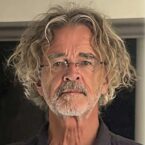
The fear. I study Alibrahim’s face, wondering whether he is marked by the war, whether I can detect the young man’s psychological scars. He has been imprisoned twice: First by the regime of Assad, and then by ISIS. In the latter case, he was sharing a cell with James Foley, the Briton who was decapitated in front of a video camera, in a clip that went viral. When you spend three months in a shared prison cell measuring no more than three square metres, you have to stand up for most of the day. Alibrahim explains that both prisons he was in were terrible, inhumane and featuring the same kinds of torture: “You are unable to think, life stops completely.” But in the end, Alibrahim was released and escaped north through Turkey. He did not become part of the statistics along with the 65 000 who disappeared without a trace. 200 000 people still remain incarcerated.

People were dying all around him, both in prison and in Aleppo: “When you lose a mother and a sister, you are broken and unable to continue living like before. You lose a part of yourself. Over the next two years, I was not able to work at all. I felt that I had lost everything”.
I ask why he did not just give up, living as he was among bombs and ruins. Alibrahim becomes quiet. Looks at me, and replies that what motivates him to live is fear, and fear alone. However, in his experience: “When you encounter people on the streets of Aleppo who believe in a future, and that peace will come – and also those who have lost everything, who are trying to create a future for themselves – it is impossible to think that life is not worth living”.
I ask again what fear has done to him, following his experiences of people around him being killed. What kind of fear does he have of being killed, the way he travels around Syria as investigative journalist and filmmaker? “I do feel fear, but that is all people in Syria feel right now. When I see a picture of a friend who has been killed, I get scared”. Alibrahim despairs: “Why are they killing everyone? These are human beings! Who gets to decide who will be killed? Why were my mother and my sister killed? Why do people have to die all the time? No-one has the answer”.
The camera as weapon. I ask Alibrahim whether he ever participated in war activities, if he ever killed anyone: “No – I am only a journalist. I have a camera and a pen. But both ISIS and the regime see our use of camera and pen as equal to fighting with weapons. It scares them.”
“Why do people have to die all the time?”
The fight Alibrahim and his friends are currently fighting, is one for attention. His friend Feras Fayyad gained enormous attention and worldwide awards for the film of the year, Last Men in Aleppo. The aim of this film was to raise recognition for the rescue workers of the White Helmets organisation. Fayyad has high goals for himself and his work – he wants to motivate people into action to do something and contribute to ending the war. The men in his film repeatedly say that they feel betrayed by the entire world –by Arab and Western nations alike.

Alibrahim’s more poetic, quiet film is equally disturbing – despite being a film without any dialogue. The images speak volumes. My question for the director is whether he thinks this will really have any impact on the international intervention that he calls for. Does the West not tire of constantly seeing new images from this country now bombed to ruins? Europe seems paralysed by nationalist, xenophobic and anti-Islamic undercurrents.
Alibrahim, however, explains that he believes in help from the US. He hopes more people will watch his film. Now and then, though, he travels across the Syrian border from Turkey. But since Assad regained control and IS still operate in the area, he has little possibility to move around in places other than Northern Syria.
New film. Alibrahim’s next project is a documentary which will tell the story of all the lost children of the war – kids without identity, without parents: “They are unable to go abroad, they cannot go to school, they have nothing.”
“Both ISIS and the ASSAD REGIME are afraid of journalists carrying a camera and pen.”
Currently, there are millions of refugees in the local area of Lebanon and Jordan. The richest of the Gulf states are generally reluctant to accept Syrian refugees – or in any way use political pressure to force Assad’s resignation. Wealthy Europe has also been affected by the stream of refugees. Alibrahim comments that “not all refugees come to Europe looking for money and employment. We want to rebuild our country”. He also emphasises that “film, journalism and various artistic expressions can contribute to making you see what level of humanity is required in these situations”.
We end our conversation by my asking Alibrahim whether he believes that Syria – after six years of war – will be able to rediscover peace in the next six years: “Well… This is a real war. Revolutions, whether they occurred in Berlin or Paris, could take a 100 years. When you are fighting for freedom, you have to endure. This war is a revolution”.
Talk with Ali Alibrahim by Truls Lie: