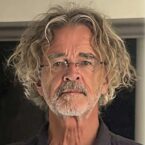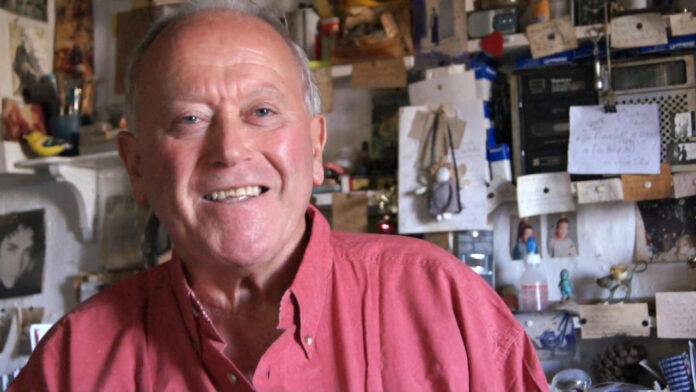
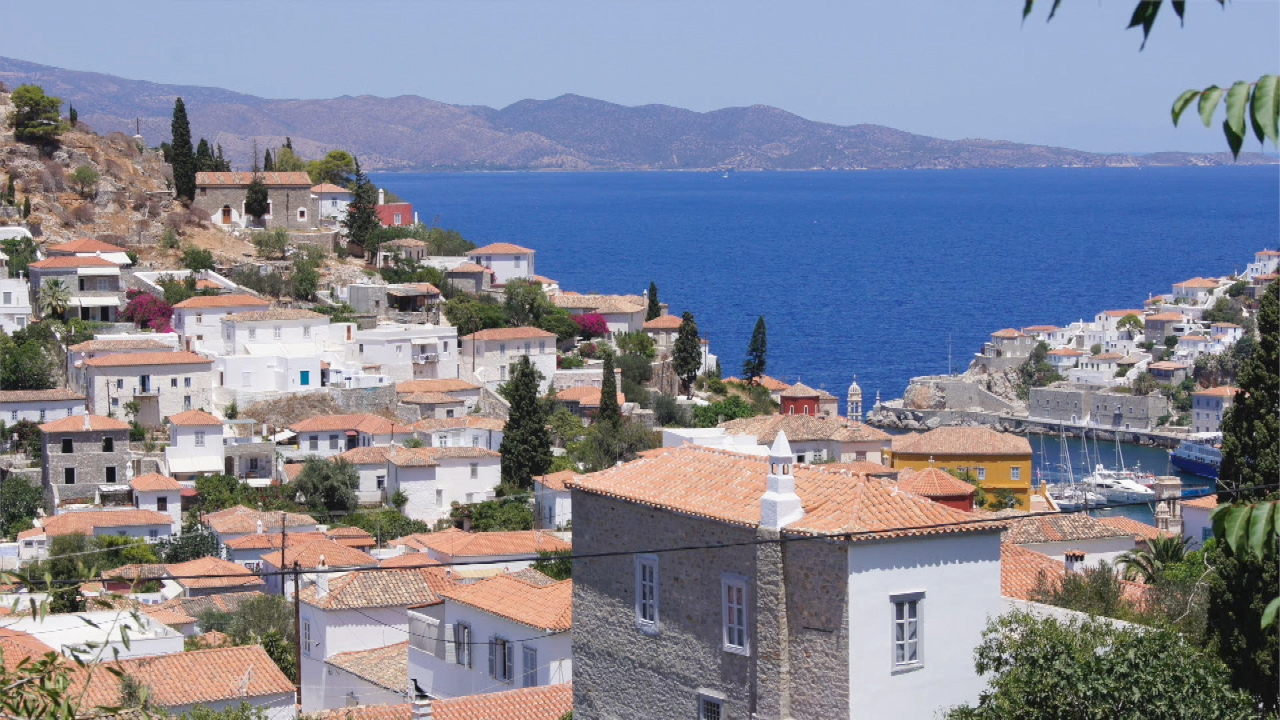
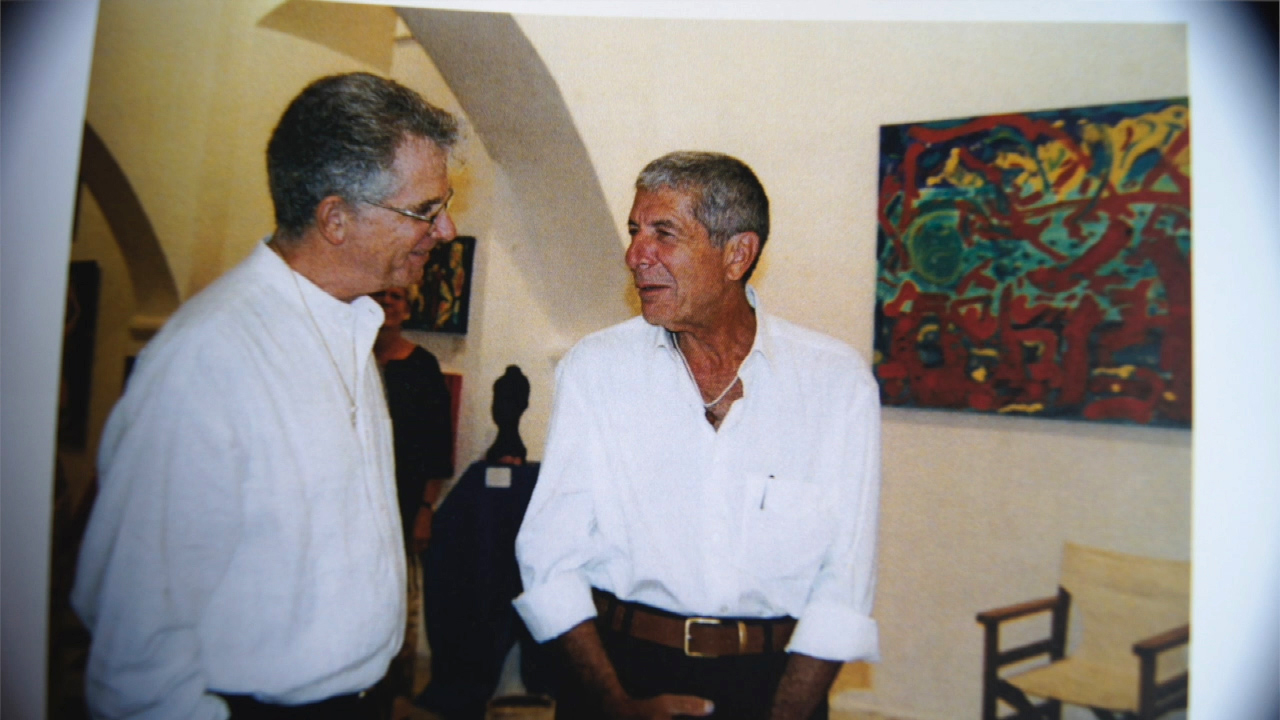
What is it about the Greek island of #Hydra that attracted personalities like #Leonard Cohen#, Axel Jensen, and Marianne Ihlen? Modern Times Review went there and met the British resident who has lived there the longest, #Don Lowe#. He arrived as a 27-year-old and stayed. Cohen and Ihlen’s longtime friend is now over 80 years old – and has written around a hundred books on a manual typewriter. Don – actually «Donald» – is different from most, and a certain namesake’s polar opposite.
Democracy is Falling
Recently, life on Hydra was depicted in Nick Broomfield’s documentary Marianne & Leonard: Words of Love about the time in the 1960s-70s – with flashbacks from today. And Hydra is also current in this year’s bestseller, A Theatre For Dreamers, by Polly Samson.
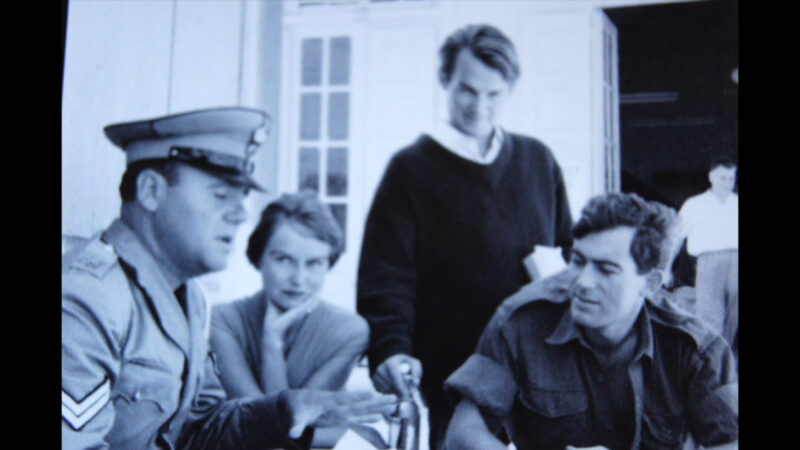
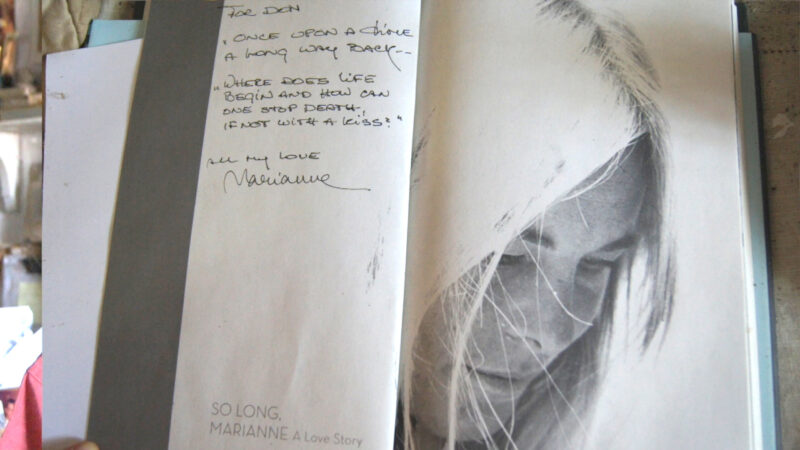
In Axel (2019) by #Torgrim Eggen#, it is told that the Hollywood movie Boy on a Dolphin (1957) – Sophia Loren’s international film debut on this beautiful Greek island inspired many to travel there. Eggen describes the Hydra period from 1957 to 1962 when #Axel Jensen# and #Marianne Ihlen# went there – after Jensen’s book Ikaros (1957) provided enough money for the trip. Publisher Henrik Groth at Cappelen was also generous with advances for the next book and later also with contributions to Ihlen.
A number of Norwegians have flocked to Hydra, including myself. Over 30 years ago, we were three ex.phil.-students who traveled there in April, where we also met the aging Norwegian writer Felix Thoresen. He came there after having «been a guest of the prince in Nepal,» as he said. A debating, eccentric guy who lectured us young ones while drumming with crooked fingers on our wristwatches – for time itself, we would only understand with time. Yes, the Greeks distinguish between «kairos» and «chronos.» And one night, a drunken Thoresen shouted in a bar as he stood up, and the stool fell. He was suddenly excited by our discussion on socialism: «Democracy is falling! Long live the aristocracy!»
Becoming 80 was like «flipping through a page in the book of life.»
Here on Hydra, Don (who also knew Thoresen) today speaks of Greece as both the beginning and the end of democracy and our Western civilization. From the Englishman’s exile, his disdain is clear over «civilization’s» constant use of enemy images, wars, and cynical, exploitative politics from the state and capital. From his books, we find the characterization of the West as «syphilization»: white leaders who, from their powerful roles, «release their anger. Not as wild men, this time, but as civilized barbarians. The new logic that I call the syphilized world – a tropical cancer. I mean a political logic. About what civilization has become, and still is becoming.»
The Women
Among these young people in their twenties on Hydra around the 1960s, several found and lost each other, including Leonard and Marianne. And while Cohen traveled around, Don stepped in with Marianne in his way – so that little Axel asked his mother if she could not just as well marry Don. Well, she replied that he was «married,» so it was not possible. Don was then with a Greek woman, who later left him and took their daughter to Athens. His first cohabitant – an American woman who originally brought him to Hydra – had earlier returned to the USA with their son.
I ask Don about Marianne’s role among all these more or less talented artists and intellectuals – how did she fare? He answers that she was first and foremost their muse: «Marianne was not an intellectual, but became one over time. Women have a fascinating ability to do many things at the same time. Giving birth is the ultimate act of creation. Others put their talent into writing books.»
He tells us, for I sit in his home, where I was introduced by Marianne’s stepdaughter Eva Stang and her daughter Andrea.
Don continues about the Hydra artists’ complicated relationships with women. He recounts an episode where Ihlen is back 30 years later. Coincidentally, Cohen, who had not seen her for all these years, also arrives. When Don meets him on the street, he makes Cohen aware of Marianne, whereupon Cohen, surprised, stops, thinks, and replies: «I think I can handle it …» How would it be to meet your first love again?
Is there always one or more women behind these mythologized men? And did Don brag to me as we wandered around outside the house when he said that with Cohen’s fame, women kept looking for the musician here on Hydra, and when Cohen stopped coming, it became a nice opportunity for him to entertain them …
At the same time: «I am perhaps the one who has known Leonard the longest as a friend. He is a great poet. I knew him very well, and we respected each other like brothers. But I was not a big fan of his because I lived my own way.»
“L.C.,” as he calls Cohen. Both loved women, but both chose a monastic life for years – as an elder, Cohen spent several years in a monastery. But also, Don lived 14 years in celibacy on the island – he had to find something deep in himself. And it was demanding, especially after being left by a woman.
Lowe’s love probably goes deeper than being a womanizer. As he said, after several lonely and hard years without money, homeless, and hungry, he became almost religious – he found a love for life for everyone he met. This radiance was clearly noticeable here we sat, or as the evening before, where he passed the dinner table and was invited to join.
Must one then lose oneself to almost Ibsen-like find oneself? I don’t think Don found God, but rather a pantheistic love for everything and everyone. Also, the animals constantly visiting him, or the black-clad older women embracing him.
Peace and Enemy Images
According to his books, Don was a rebel from when he was young. One who felt closer to those at the bottom. One who chose his outsider status. He left at 17 and traveled around the world twice as a sailor. He then worked with oil drilling in Libya’s desert. He has seen most of it.
What’s interesting about Don is that he really left behind the Western world’s struggles and conflicts. But also that he managed without a money-sending publisher – like Axel Jensen – or a family to return to: «I can always find food in the sea, and I know where there are herbs in the mountain here, or where the almond trees are. I don’t need so much … just some paper and a few typewriter ribbons.»
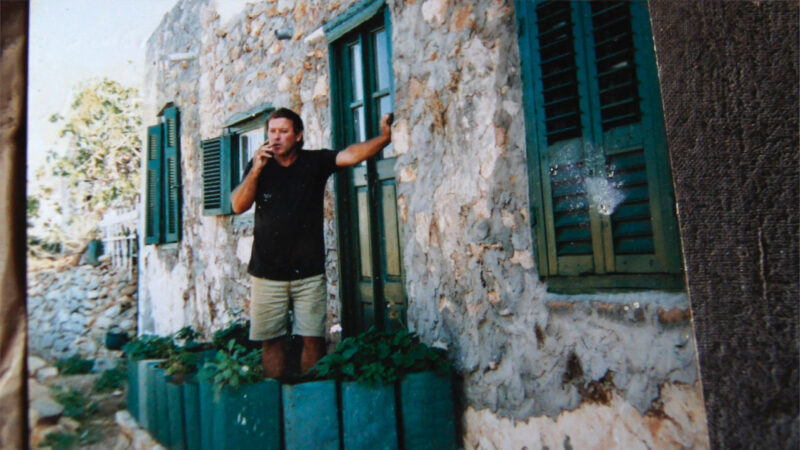
He eventually settled here on Hydra in a dilapidated shack that he rehabilitated from scrap he found, and with a few small coins, he managed to save. At the top of Hydra’s round amphitheater of whitewashed houses, we gaze from the hillside out over the glittering sea with the mainland far away. According to Don, even Edith Piaf once lived here. The Spartan little house still has neither running water nor electricity. He fetches water from a well some distance away. The silence is palpable, only interrupted by occasional pack mules’ howls from the slope, dog barking, or buzzing bees. If not the sudden sound of a neighbor’s harp.
The cheerful boy’s face over 80 talks about nature and the beauty of life. And not least, the value of good health; he swims every day. In periods without money, he survived by diving for squid.
“Do not think that a genius is happy. Be thankful that you are nothing.»
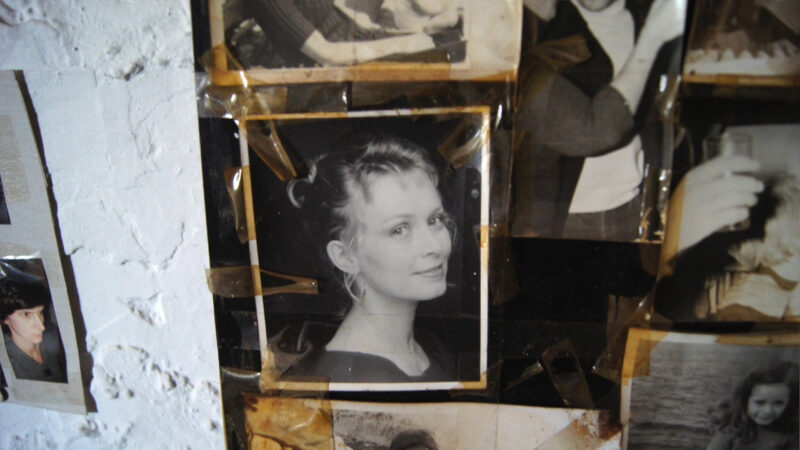
The two rooms are crowded with small things he has collected that testify to a long life here on the island, like the photographs on the walls. Don also has an annex where many a guest has stayed, leading to countless conversations about life. Here, one is far from a busy everyday life.
According to Don, the original democracy was destroyed by «the white West.» His version is that our civilization is destroyed by an intense focus on bombs and banks – just as Jens Bjørneboe once formulated it (see also the middle section). In Don’s conversation, the urge to hate and create enemy images is the most «bestial.» He refers in the conversation to Henry Miller – the war against your neighbor or neighbor should be outdated: Such «ideas as the oppositions between good and bad people, right and wrong, him or me, friend or foe …» Don adds that if you change the uniform on the soldier, or put all the naked corpses in the same grave, you don’t see the difference.
Yes, do we really understand what mess we are in?
Don describes the Greeks’ hospitality and how one feels welcome here on Hydra. Also, guests with writer ambitions, musicians, and artists are noddingly welcomed by the island’s local mayor, the priest in a long black cape, the police chief, and the doctor, all sitting together at a harbor table, where they may have an ouzo – «the welcoming committee,» as Don calls them. But not least, the way they don’t elevate themselves above people – like an authoritarian «I am the police chief!»
Don illustrates the truly Greek democratic mindset by telling about when Alexis Tsipras, as prime minister of «little» Greece, went to Brussels, the EU capital. He asked for open and honest conversations with Angela Merkel and David Cameron. Well, the Greek did not find it necessary to wear a tie like the others and was regarded as a little guy on a moped – who didn’t play along in the game, according to Don.
Singing to the Sunrise
After his American companion brought young Don to Hydra, he has never been able to leave this paradise. When she went back home with their eight-month-old son, she promised to return. But without him getting running water, as Don said, it never happened… And Don didn’t want to give up the freedom he found on Hydra; he wanted to live life, «sing to the sunrise, dance at sunset.” He never wanted to return to England, be governed by authorities, have a stressful, conventional everyday life, or live with the aggressiveness he saw in the West.
But he learned a lot from her, the American, as described in the book Becoming 80, the book with all the retrospectives, in the chapter «Love and War.» She left her homeland to live in Greece: «Paradise, she said, is here and now! The balance of man is essential, body and soul.» Don writes about her interests on Hydra: «Drawing, painting, writing, poetry, ceramics, sculpture, dance, yoga, an active imagination, sedentary dream interpretation, the study of all humanity’s classical and modern myths, experimental work – doing something physical alongside just talking. For her, all this was part of new experiences now. Rather than ‘losing life’ in the Western world, it was essential to return to nature and break free from the consumer society.»
Don mentions her saying, «Women must again learn to run with wolves,» meaning reconnecting with the wild, fresh, visionary qualities in one’s instinctive soul – in the sense of the natural. This unnamed American woman once held workshops on Hydra: A group of women could stand on all fours for a long time to connect with their animal nature. He quotes her: «Women are the earth. To a greater or lesser degree, women need to honor and heal their much-abused bodies, so they might now heal men who harm and abuse the planet.»
But then Don immediately shifts perspective from love to war in the same chapter: «I am going through my Balkan papers again here, my collection of horrendous images from NATO’s bombing during the war in Yugoslavia in the 90s – which I have written a lot about before. One clip falls to the floor, showing a picture of a cluster-bombed destroyed convoy of farmers fleeing NATO’s ‘bombardezmos,’ as the Greeks would call it.» Don also writes about the picture of an old man in rags, bleeding. A woman with her arms in the air, standing with a confused face, quietly crying up to her God. He describes local creatures from the collection of pictures as «such as sheep and cattle, dogs and goats – lying dead or wounded around.»
Then to write about the peasant boy alone and in shock, depicted on a burnt-out tractor while he is almost about to scream out: «Where art Thou?» Don ends the chapter: «Tears press on, dear reader, as I see him and the state of the world again. Tears run. After a while, the vision is completely blurred.»
Terrible People
We talk about how some get high on power when Don tells about the time the Norwegian Bjørn Saastad here on Hydra showed him a youth picture of himself with #Jens Stoltenberg#, with the naivety or «innocence» such a picture could express. Don then mentions that he recently heard Stoltenberg speak on the radio as NATO chief: «I heard that this young man had become prime minister, but didn’t know much about him. But when he became NATO’s Secretary General…»
Don describes Stoltenberg’s Dutch and later Danish predecessors as terrible people. He had thought that the Norwegian could stand for meaningful leadership. The disappointment came: «NATO would, of course, not choose anything like that. Stoltenberg’s speech was almost unbelievable. He became a clown in this situation, speaking as their puppet – in poor English. This is shameful for Norway. Well, they’re not asking for a new cold war but are happy to send 400,000 new troops to Russia’s neighborhood.»
He hints at the pretexts people use to kill – such as doing it in God’s name and using weapons to create peace. Don thinks we can still try to fight devils – but when you meet pure stupidity, you are completely helpless.
So, how were Norwegians generally perceived here on Hydra? «Some of them painted. But did they really let loose, as one can here on the island? Not really. They didn’t settle here. I never thought this would be the center of life for them,» says Don.
Well, some went home, others further out into the world. Some discovered LSD, and others ended up in institutions. Don adds: «I don’t understand why Norwegians drink so much – often three days in a row so that they can rave around here helplessly drunk? It seems like a pressure that needs to be released. And the same with other drugs. But you don’t need that here!»
«Do not think that a genius is happy. Be thankful that you are nothing. ”
Don doesn’t need to get high on substances, he says. He’s high from being here. He tells that he has now written 100 books, and maybe the last one was about turning 80 years old with the subtitle «Looking Back, Forward + Sideways Down-Under + Up-Above on Turning Eighty on a Greek Island.» I received one of the ten copies he had photocopied. Chapters like «Love,» «Kids,» «Some men are islands,» «Growing Old,» «The Wisdom of the Heart,» «Syphilization,» «The Rebel,» «On War,» «On Madness,» «War and Peace in the Balkans,» and «From Art or Revolution.» Large parts of the book are about meetings with people.
Turning 80 was like «turning a page further in the book of life.» As Felix once told us young visitors, Don says, «his existence, the existence of all things, is not measured by time at all.» What matters is what you feel and that health holds. Yes, he still swims every single morning and writes until twelve. Then he strolls down to the harbor, down the thousand steps, checking for newcomers on the daily ferry.
«Time is not money,» he writes, «that should have been discovered long ago, and you can neither control nor own time. So why not enjoy it, every minute, and forget the rest?»
Eco-Anarchist
So, who did I really meet – a kind of eco-anarchist? Don is onto something: «Someone told me that all Greeks are anarchists in their heart. A wandering story also goes like this: When God created the world, it is said that he had a handful of stones left over. As he threw them into the sea, he said: ‘I call this Greece!’»
Even though he has tried, his books or «A4 binders» from Hydra have not been published. But a radio performance of a play has been done. Once, Someone asked for film rights.
It’s the little things that count in life, writes Don. «Don’t think a genius is happy. Be grateful that you are not one – you get further with a smile for everyone and anyone.» He falls «in love again and again» and asks us to forgive our parents for bringing us «into this ‘fucked-up’ world of war, hunger, and inequality.»
Don feels like a 60-year-old and thinks he can live to 100 as long as his health holds. He feels like a citizen of the world. If you have not achieved peace in your own soul, you cannot bring peace internationally, no matter how much you try. No, peace is not achieved with weapons. That should have been realized long ago, I reply.
Let me conclude with Don’s reminder in the chapter «Letting Go» from Becoming 80: «You cannot take anything with you when you finally leave your bodily presence in the world. Nor those you deeply love.»