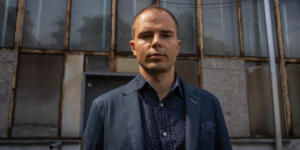
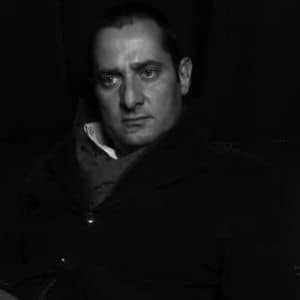
Eclectic photographer Marco Di Lauro studied Italian literature and art history at the State University of Milan before following a course in journalism at Boston University and then obtaining a diploma in photography at the European Institute of Design in Milan.
During his studies, he began his photographic career covering social issues in India and Peru, as well as fashion shows in Milan and Paris where he worked as an assistant photo editor at Magnum. In 1998, he decided to go to Kosovo at his own expense and documented the ongoing war and ethnic cleansing and began working as a staff member at Associated Press.
Back in Italy, he documented the jubilee of the Catholic Church in Rome. He followed the G8 in Genoa and after the 11 September 2001 attacks, he decided to go to Afghanistan, which he reached on foot from the North, crossing the mountains. Arrived in Kabul before its fall, he was wounded by a Taliban sniper during an ambush on 13 November 2001. He obtained an exclusive contract with Getty Images News Service in 2002 and covers the Middle East conflicts, first in Palestine, and then in Iraq where he would remain for almost 3 years. He travels the world: Gaza, Africa, Latin America, the Balkans…, always in search of the human dimension of events or conflicts. He also continues his work of analysis of society in Europe from the Palio of Siena to religious themes in Sicily, Spain or Rome, to the Vatican. He has worked for the United Nations, Unicef, Save the Children, and CNN.
Marco Di Lauro’s work has been published by the biggest American and European newspapers and magazines such as Newsweek, Time, New York Times Magazine, Washington Post, Vanity Fair, The Times, The Guardian, Der Spiegel, Stern, Die Ziet, Paris Match, le Monde, Libération, Internazionale, La Repubblica, Corriere della Sera, El Mundo, El Pais, etc.
Marco Di Lauro has received numerous international awards worldwide including two World Press Photo in 2002 and 2011.
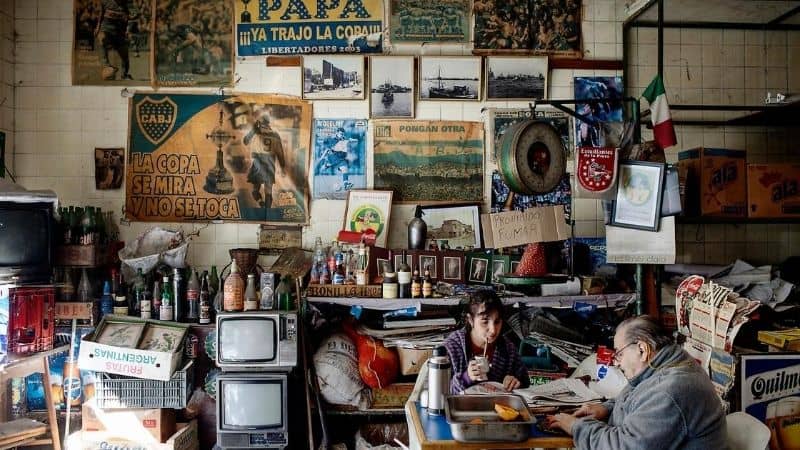
You started photography with an Olympus OM10 then with a Canon taking analogical photos that you developed yourself. Now, which camera are you working with? How did you experience the transition to digital? Is it a loss in quality or does it give you more possibilities?
I started with an Olympus OM-10 because it was my mother’s camera and she taught me how to photograph with it. Then, when I became professional in 1998, I started using a Nikon until the end of the Iraq war in 2005. When I came back after those 3 years in Iraq, my equipment was destroyed and I had to buy a new kit. I chose Canon just for a matter of economic convenience. For me, one camera is as good as another. Cameras and photographic techniques don’t interest me and never have, for me the camera is just a household appliance, like a blender or a refrigerator, and photographic technique bores me to death. In any case, I am the son of digital because I am a professional photographer since 1998 and only the first two years in Kosovo I shot in analogue.
Cameras and photographic techniques don’t interest me
Your first professional works were on social issues: children raped and abandoned in India, poverty of the inhabitants of the Peruvian Andes, but at the same time you also took fashion pictures, how can you pass from such challenging themes to those of maximum superficiality and wealth?
To be precise my first job as a professional photographer was the war in Kosovo in 1998. Fashion, India, and the Andes were practically unpaid experiments prior to my professional work. The first photo I published as a professional, and for which I have been paid, was a Kosovo Liberation Army militiaman in combat published in July 1998 in the Italian newspaper La Repubblica and taken for the Associated Press. And, in any case, in the fashion sector, I mainly photographed fashion shows and spent more time as an assistant to a great fashion photographer than operating myself, but I also shot books for models.
Anyway, beauty, suffering, the Andes, wealth, poverty, superficiality, raped children, and everything you listed are different sides of the same coin, life and the world around us. I am interested in telling the world and life, superficiality exists only as behavior and attitude towards things, I do not consider wealth or fashion superficial or more or less superficial subjects than those on a raped child or on war. They are obviously very different but, for example, if the wealth of a philanthropist serves to save raped children it is no longer superficial.
You are attracted by beauty in general as the truest expression of all life forms, but you soon became a war correspondent. Is there beauty in war too? Or is it your sensitivity to human suffering that drove you to this form of journalism?
I don’t find beauty as the truest expression of all forms of life, just one of them, one of many. I am attracted by aesthetics and beauty but not in a superficial way and as an end in itself. I do not find there is beauty in war itself, but in everything there is beauty, and so even in war there can be moments of beauty: a sunset, a landscape, a place of worship, a person’s face, an emotion, a feeling.
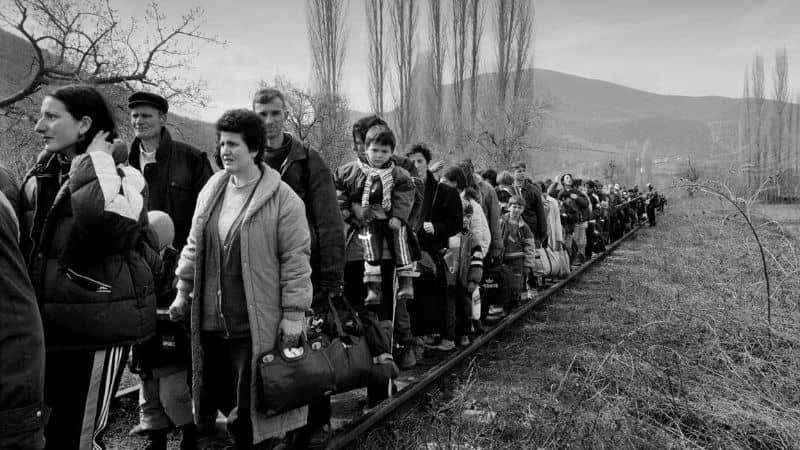
You have covered many conflicts, in Kosovo, Afghanistan, the Middle East (Gaza, Iraq) in the late 90s, and at the beginning of this century, even after being wounded in Afghanistan, why? A challenge to life, unconsciousness, absolutely need to testify?
I don’t feel unconscious like I don’t think anyone who does my work is, it was a precise choice, some jobs consist of greater risks and reporting. As I said before, they consist in giving voice to those who don’t have one. That was my choice and if the risks are part of it, they are only one of these work characteristics.
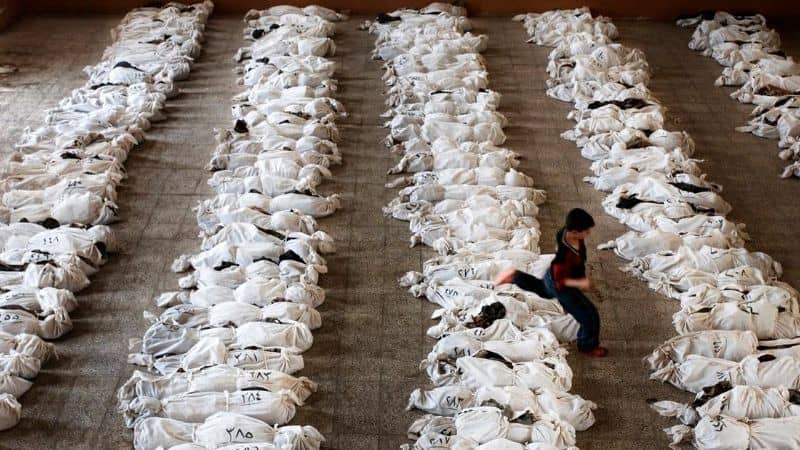
Some of your photos have been used out of their context, even by personalities like US Secretary of State John Kerry. I’m thinking of the one you shot in Iraq in 2003 that represents a child jumping over lines of hundreds of corpses found in a mass grave in southern Baghdad and deposited in a school to be identified. The photo was used as a photo of the war in Syria. What do you think about these embezzlers? Is it so easy to cheat people and what can be done to prevent it?
Unfortunately, you can’t always have control of the content and of its use. «Fake News» and propaganda have always existed and will always exist, even if with the advent of social media it has become an increasingly predominant threat of the utmost importance. For instance, «Fake News» is influencing the electorate during political elections and shifting important balances. To realize the situation, it is enough to remember what happened during the last American elections or of the media and propaganda machine set up by Matteo Salvini when he was Minister of the Interior, a machine not by chance called «The Beast».
some jobs consist of greater risks and reporting.
Religious issues are numerous in your work and contrary to that on war, you still continue to investigate and report on them. What attracts you? Spirituality, the sacredness of faith, or the beauty of the images that can be made in religious decorum?
What attracts me, for a non-religious and atheist as I am, is the mysticism, the sacredness, the power, the beauty of religion, which in the end is nothing more than an instrument of coercion and control of the people, serves the powerful, the tyrants or the despots to control the masses. Perhaps this control aspect is what fascinates me. If I think of the Catholic Church, the scandals, the many cases of abuse reported, the many priests responsible for crimes, it seems to be no different from any other sect that defends its interests and its members. Suffice it to think of the endorsement that Nazism had in Germany and the controversial role of the Pope of the time, Pius XII, whether he favored the flight of Nazis to Latin America is still a debated question. All this has a certain charm if we can call it that way.
With the Covid-19 sanitary crisis you spent a week «embedded» in a Red Cross team in Bergamo. How did you live this dramatic period? Any resemblance to your experience as a war correspondent?
My recent work documenting the Covid-19 in Bergamo was one of the most painful and traumatic works I did, mainly because it was my people who were suffering, my people who spoke my language there was not the filter of an interpreter. In any case, pain is always the same.
Your images, even the rawest ones, all have a very strong aesthetic dimension. When you talk about the «hot» places where you found yourself, you say you were lucky enough to find yourself in the right place at the right time. But when you have to find the right angle to take the picture in a difficult situation, how do you do it?
Instinct, experience, sensitivity, expectation, patience, dedication, humility, knowledge, these are the things that come to my mind.