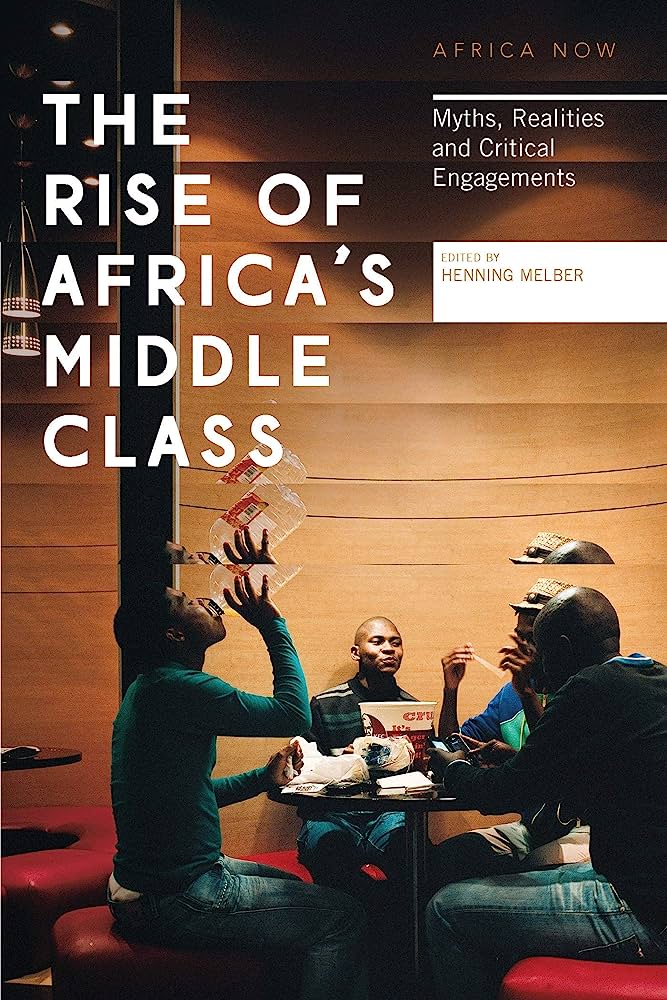
Myths, Realities, and Critical Engagements is the subtitle of this book, edited by the Swedish sociologist, political scientist, and Africa researcher Henning Melber. And that is what this book is about. All ten chapters critically examine the prevailing mantra of the last decade: Africa’s #middle class# is rapidly and significantly expanding. This myth originated in 2011 when the African Development Bank defined the middle class in Africa to include anyone with a daily income ranging from two to ten dollars, resulting in 300 million Africans, almost one-third of the continent’s population, being classified as middle-class. It was already a fact that African economies had experienced significant growth in the 2000s, and the increase in the middle class, implicitly indicated that wealth was benefiting more people.
Unequal distribution
The Rise of Africa’s Middle Class is a very solid academic work where all the authors are critical, to some extent highly so, of this understanding of the middle class in Africa. Few of the authors agree that an income-based definition alone is appropriate for the middle class. Among those who emphasise economic definitions the most (Carola Lentz, Tim Stoffel, and Oluyele Akinkugbe), none accept that an income as low as two dollars per day qualifies someone as middle class. If the middle class is required to earn over five dollars each day, it becomes extremely small in Africa. This suggests that the economic growth the continent as a whole has experienced in the last 15 years is unevenly distributed among the population. On the contrary, the authors show that the #inequality between the rich and the poor is increasing significantly, and the middle class, as the intermediate stratum, is not receiving its share of economic prosperity.
global middle-class amenities such as an old used car and higher education usually cost more in Africa than in Europe.
Increasing disparities
Sirkku Hellsten uses her chapter to demonstrate no direct correlation between an expanding middle class and an increased (demand for) democracy in Africa, as many claim was the case in #Europe. She argues that class analyses lose explanatory power in today’s Africa in so many different value systems, mixtures of traditional solidarity and individualism, patrimonialism, and assertiveness. Moreover, Hellsten writes primarily about #Tanzania, where she states that the middle class depends entirely on the elite’s goodwill to engage in entrepreneurship or secure a decently paid job in the public sector, which does not necessarily make them advocates for a strong #democracy. This would weaken the elite’s power, thereby diminishing the middle class’s ability to remain middle class. That role is fulfilled by the numerous poor. Akinkugbe and Karl Wohlmuth touch upon the same issue when they argue that the middle class must be a driving force for the state to provide public services such as security, education, healthcare, and infrastructure if they want to contribute to changing the societies they live in. However, they conclude that the upper middle class purchases the services the government is expected to offer on the private market because the state fails to fulfil its obligations. The lowest stratum of the middle class does not have the economic means to do so nor the capacity to pressure the state to deliver services at a low enough cost. As a result, the lowest middle class remains marginalised and left behind, while the higher middle class aspires to become part of the elite.
Middle class for all
In addition to the general chapters in the book’s first half, it also includes case studies from #Kenya, #South Africa#, #Nigeria, #Angola, and Tanzania. Such detailed studies have been lacking in previous academic analyses of the «middle class» in Africa. I use the term «middle class» in quotation marks because I agree with the authors in the book, who are highly sceptical of applying this term to Africans in general. In his chapter on Angola, #Jon Schubert# prefers to use the term «politically aware, non-poor individuals» rather than «middle class» to describe this population group in the country. #Dieter Neubert# argues that the «middle class» in Kenya is characterised by strong family ties, religiosity, having someone in their social circle who has migrated and sends remittances, as well as being active users of mobile telephones. However, he points out that the same characteristics can be found among the poor as well as the elite.
Nevertheless, the «middle class» shares more similarities with the poor in constantly experiencing uncertainty regarding unemployment, illness, and price increases of basic goods. Neubert’s attempt to divide the Kenyan population into Bourdieu-inspired sociocultural groups shows that almost everyone, in one way or another, can be said to belong to the middle class. Very few would identify themselves as either poor or rich. Both labels carry a stigma, although wealth is more accepted than poverty—Neubert questions whether the lifestyles of the global middle class inspire the aspirations of the African middle class. In any case, it is evident that the African Development Bank’s economic definition does not indicate who belongs to the middle class, as global middle-class amenities such as an old used car and higher education usually cost more in Africa than Europe.
the «middle class» shares more similarities with the poor in constantly experiencing uncertainty regarding unemployment, illness, and price increases of basic goods.
South African exception
Editor Melber concludes by saying that the concept of the middle class is challenging to use effectively in Africa. Although class may have some relevance, he points out that other identities and shared interests such as ethnicity, #religion, clan affiliation, and skin colour (or pigmentation, as he politically correctly refers to it) play a much more significant role than class. And even though the chapter focusing on South Africa concludes that the class aspect is highly relevant and the middle class is indeed present, I would argue that South Africa constitutes the exception on the continent. The country has experienced both #apartheid and extensive mining, which have provided a basis for a common working-class identity, where some individuals, since 1994, have gradually transitioned into the middle class. In the rest of Africa, however, I agree with the contributors who argue that «middle class» is a category of limited usefulness for understanding solidarity and identity among Africans today.