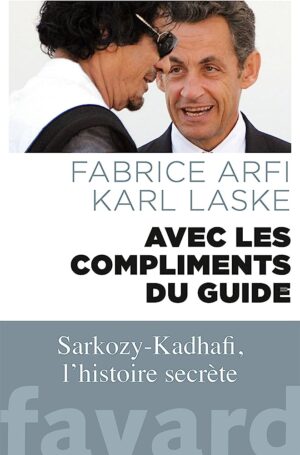
While #Jan Petersen# and his small team investigate Norway’s bombing in Libya, journalists Fabrice Arfi and Karl Laske have shown, with great patience and detailed source investigation, that «protecting civilians» was merely an excuse to eliminate the unpredictable #Gaddafi in 2011. One of the main reasons was to prevent the disclosure of Gaddafi’s financial contributions to Sarkozy’s election campaign. Arfi and Laske argue that Al Jazeera’s «bloodbath» reports were used to influence public opinion in the West, urging them to demand concrete action from their elected officials. Concrete action came when the #UN Security Council invoked the «Responsibility to Protect» and adopted Resolution 1973 on protecting civilians in Libya. In hindsight, we all know how unwise this turned out to be.
A true crime story
The book is constructed like a thriller spanning almost 400 pages. If the text weren’t filled with footnotes, I would have thought the journalists were exaggerating heavily. But the reality described by the authors surpasses most James Bond films. One chapter is devoted to the arrest of former President Sarkozy’s trusted ambassador Boris Boillon, nicknamed «Sarko-boy» in the French media. He was stopped by French customs officials at Gare du Nord in Paris with 350,000 euros and 40,000 dollars in cash and later convicted of corruption and money laundering. Another chapter focuses on Gaddafi’s former oil minister #Choukri Ghanem#, who was found drowned in the Danube on April 29, 2012. The day before, the website Mediapart, where the authors work, published a document showing that Sarkozy received 50 million euros from Gaddafi to finance his presidential campaign in 2007. The chapter indicates that Ghanem’s death was likely a murder rather than a random cardiac arrest. Ghanem reportedly transferred 30 million from the Libyan oil company to Sarkozy’s campaign. In parentheses, I’m tempted to mention that Ghanem also signed the agreement between the Norwegian fertilizer giant Yara and Libya for a joint company based in #Tripoli exactly two years before Norwegian fighter jets bombed Tripoli in March 2011. In 2014, when Yara was convicted of corruption in Libya, the evidence included payments of five million dollars to Ghanem’s son in Switzerland.
Gaddafi posed a threat
The book primarily focuses on Sarkozy—his collaboration with Gaddafi before 2011 and his ambition to eliminate him in 2011. The authors present solid evidence from various published sources in three languages, classified intelligence reports and their own interviews with key decision-makers to support the claim that France initiated the bombing in Libya to eliminate Gaddafi. Gaddafi threatened France’s influence in Africa by investing in neighbouring countries and generously providing them with economic assistance. Gaddafi also threatened France’s monetary hegemony by planning to replace the French CFA franc with a common African dinar, similar to the #euro. But Gaddafi also posed a personal threat to President Sarkozy—increasing evidence indicated that the Libyan regime had sponsored the French president’s election campaign in 2007-08. Additionally, the French air force needed practical training. Stoltenberg even admitted that this was one of the reasons for Norway’s involvement, as stated in Daniel Suhonen’s book «Partiledaren som klev in i kylan» from 2014.
Gaddafi threatened France’s influence in Africa by investing in neighbouring countries and generously providing them with economic assistance.
«The bloodbath»
France pushed the Security Council for the «international community» to take action against the «bloodbath» unfolding in Libya. France, the United States, and the United Kingdom drafted Resolution 1973. None of the 15 countries on the Security Council voted against it, but the veto-wielding countries #China and #Russia abstained. #Germany, #Brazil, and #India did the same. The resolution obligated UN member states to protect civilians in Libya, establish a no-fly zone over the country, and implement an arms #embargo. However, as this book reveals, there was no bloodbath in Libya. Gaddafi threatened the rebels with going «house to house,» but it did not mean he intended to kill civilians. He aimed to confront the rebels. The media made it appear as if a bloodbath was taking place. However, in February and March 2011, the media in Libya was primarily synonymous with the Qatar-owned TV channel Al Jazeera. Qatar wanted Gaddafi gone; he was too tolerant of different branches of Islam and more interested in Sub-Saharan Africa than the Arab world. Qatar wanted a leadership in Libya that was more explicitly Wahhabi/Salafist-oriented. The «bloodbath» we feared after two days of uprising against Gaddafi on February 16 and 17 turned out to be only 24 civilian deaths. If we define the armed rebels as «civilians,» the death toll in those days reached 257. The authors emphasize the importance of this distinction since the UN resolution aimed to protect «civilians.» Did #NATO countries have a responsibility to protect the armed rebels in Libya? That’s what we did. It’s called a «robust interpretation of the resolution» in the Defense Forces. As a result, we bombed Gaddafi to death and plunged Libya into chaos.