The subject of this text is the dangerous technological way of life or way of thinking of our time – but more on that in due course.
At the time of writing, we do not know whether the war in Ukraine will escalate globally with fatal #nuclear weapons. However, the prelude to Putin’s desperate and very destructive acts of war is as much armament to the #United States# / #NATO. Despite promises not to expand eastward after 1989, NATO gained 14 new member states, and with Ukraine’s ability to launch missile bases in the neighbourhood, the «sleeping» bear was awakened. So Putin’s Russia is not alone in being aggressive – NATO’s so-called collective self-defence, even with the US / NATO bombing and forced regime changes, can be mentioned with keywords such as #Serbia (1999), #Iraq (2004) and #Libya (2011).
Here in Europe, we love open, liberal societies, so what does president #Putin think justifies attacking Ukraine, in addition to preserving the interests of Russia and its country? As pointed out by the editor-in-chief of Consortium News, Joe Laura, in the wake of Putin’s 3350-word televised speech recently – admittedly criticised for having several historical errors – he wants to protect a difference. Putin referred, among other things, to the thinker Lev Gumilev. Gumilev promotes a kind of «bio-cosmic» inner energy or emotional substance typical of the Russian, called passionarnost. But is this really deeply thought of as an endangered cultural identity, or more a pretext to retain the great power and the dream of what was lost with the dissolution of the #Soviet Union#? Does Putin really believe that Ukraine as a NATO member would be the starting point for an attack on Russia? Or is it the dictatorial power that Putin sticks to – a power that in the West is often more hidden behind #big business#, #technology and #militarism? Is it the desire to see its enormous military apparatus in action? Or is it mostly psychological, after being ignored for 30 years – neither the EU nor NATO would have Russia as a member – with the feeling of being isolated and ignored? And hence the victim role where Putin is the tragic hero – an overly dangerous desperate Putin who now, with some nuclear threat, declares that even «death can be beautiful»?
With the invasion of Ukraine, Putin has now achieved the opposite of being listened to – instead, he and Russia now face enormous economic and political losses. If not, we all perish in the apocalypse someone prescribes after the protracted conflict.

Total mobilisation
Is it possible to find deeper insights or philosophical critiques of the enormous military-industrial complex the world has equipped – via overly rapid technological development? It does not seem that human wisdom has developed at the same rate as this total mobilisation.
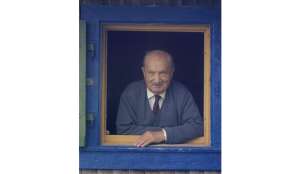
In Peter Sloterdijk’s The human greenhouse, a reference is made to the philosopher Martin Heidegger’s statement: «The vulgar mind does not see the world, just beings». #Heidegger was more concerned that we, all dominated by our own will, lost the ability to reflect or really see the essence or character of technology – as something far more intrusive to our way of being than just to be considered technical tools or «prostheses». Long after the extreme world wars of the last century, #Sloterdijk describes us today–as spoiled and thoughtless, «more unstable, volatile and more unfaithful in our being than any animal before them». With Heidegger, he points out that «masculinity of war and random brutalisations have blocked the insight into the apparatus of evolution. violence has influenced us in its inner and outer manifestations». A «creeping decadence» from long periods of peace has lost thinking’s ability to be against violence and be prepared for its consequences. As emotionally unstable «deficient beings» with too much will and too strong drives, Sloterdijk’s diagnosis is that we – and here we can include the actions of NATO and Russia – have built up a group irritability «which can release paranoid, orgiastic and self-destructive violence».
Sloterdijk adds – because we know the benefit politicians and the media have of using enemy pictures – that the «increasingly suspicious attitude also in the future […] is particularly strengthened by the fact that the American warlords did not refrain from immediately using the most extreme technical weapon of all – namely the atomic bomb». The barbaric use of high technology in Hiroshima and Nagasaki at that time showed how unrestrained the use of destructive technology could be.
But is there any way out of this, à la Sloterdijk? He points at least forward via ecology for a «relational ethics without enemies and dominance». Let us move on.
The question of technology
«Total mobilisation» is an expression from Ernst Jünger, the author who also described the downfall of the West. Heidegger also used the term in 1938 to critique Hitler’s progress.
Heidegger’s critique of technology is known from his lecture and essay The question of technology in 1957. This became a well-known reference for the critique of our Western mentality, where technology gave way to a dominating, will-based, challenging way of thinking. The way we choose to govern by words like order, produce (not seduce Baudrillard), and exhibit (in German/Norwegian, auftellen, herstellen, austellen) – with production, control and framing of most things («stellen, Gestell»).
As we who read Heidegger at a young age perceived this, the use of technology and machines became part of us and our way of thinking and acting. Not only did we put ourselves as subjects above nature (objects), but eventually, we became objects like gears in a global apparatus or machinery based on the «mood» or prevailing way of life that follows our current historical era or existence. Today, we can probably add the influence of technological algorithms and media, but not least how we, as before, constantly turn things and environments into resources and storage that are ready to be used. An object is interpreted as a stock.
With the United States, the world has now created a huge bestand of weapons and top-trained, technologically equipped soldiers. Annually, the military-industrial complex costs over 2 trillion euros – a destructive waste that has doubled since 1995. And we can add the hypermodern information war – with cyber war and artificial intelligence. As Putin himself pointed out in a lecture for children, anyone who controls the technology of artificial intelligence will dominate the future.
It does not seem that so-called «strong» top politicians manage not to use everything that is there for use (resources or stock to be used). When the opportunity arises, military technology and «trigger- happy» soldiers are released.
All-inclusive technology
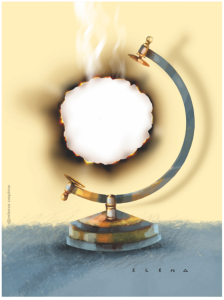 More up-to-date than Sloterdijk’s book (published in German 20 years ago) is Technology diversity by Yuk Hui from Hong Kong. Here, too, Heidegger’s thinking is fundamental.
But first to former US Secretary of State #Henry Kissinger#: In connection with his statement that Ukraine (meaning «border country») must never become a NATO member, his text from 2014 was now republished on CNBC: «All too often, Ukraine as a topic has been presented as a test of strength: whether Ukraine should unite with the west or the east. But if Ukraine is to survive and prosper, it must not be one outpost against the other – the country should act as a bridge between them. «Interestingly, Yuk Hui refers to Kissinger’s recent article «How the Enlightenment Ends» in The Atlantic from 2018. The point is that the light from the Enlightenment now gradually leads into the deepest darkness: Has man, with the emergence of artificial intelligence, lost sight of the machines? Has civilisation passed its peak, according to what #Oswald Spengler# once suggested? The former war monger (Indonesia / Vietnam) Kissinger wrote in his diploma thesis about Spengler when he went to Harvard as a young man: «Life is suffering, birth carries death in it. Perishability is the lot of the living. No civilisation has been able to last, no one has really been fulfilled».
But according to Hui, the enlightenment is not over; rather, it is the case that modern technology maintains the idea of enlightenment – but more like #Marshall McLuhan# once pointed out that «the medium is the message». This is because the all-encompassing technological apparatus we inhabit and surround ourselves with in our modern everyday life – I would say everything from tools, weapons, transport, machines and ongoing communication – has become our life practice, the very meaning of our daily life. A scientific-technical way of thinking dominated by efficiency and a rationality that tries to incorporate everything and everyone in its «universality».
Yuk Hui writes about this form of #nihilism as the «technical apparatus that surrounds us and its enormous force that pushes us towards an apocalyptic endpoint. What Heidegger calls ‘the end of philosophy’ is nothing but the victory of the anthropological machine. «Here, Yui expressed a pessimism like Kissinger’s.
A planetary thinking
Is there thus any way out of this destructive situation of today’s western behaviour or our being unless a nuclear war will soon be decided by the strongmen Putin, #Stoltenberg and #Biden — which puts an end to the possibility of a livable civilisation?
Heidegger prescribed a meekness, mildness («Gelassenheit»), a let-it-be (Beatles) in dealing with our environment: To be able to say both yes and no to the technology or see the difference between fine technology and raw technology. The thinking was heard in the east – as some Japanese Buddhists visited the German thinker in Freiburg. Hui from Hong Kong, for his part, prescribes one technodiversity, a pluralism, in which he looks at a number of local customs and Eastern ways of thinking (examples from China and Norway, so-called cosmic techniques). However, not a pure ecological nostalgia but more closeness to the nature of things. Let me add French Félix Guattari’s Deep Ecology also as caring with each other, or Norwegian Erland Kiøsterud’s ecocentrism based on Chinese language and thinking.
Hui ultimately calls for a critique of globalisation and our planetary mobilisation of matter and energy, rather a planetary thinking, as a free relationship with technology. Is it possible to reverse the reckless mobilisation we see today with the US 800 base around the world – and now soon bases (as potential bomb targets) in Norway? Sweden… Or Russia’s aggressive military-technological invasion of Ukraine that could escalate?
Today, one can speak of one Chinese nuclear missile stored with five directional warheads hitting five major American cities simultaneous – that is, causing the death of 200 million people.
Hui calls for replacing what he calls «two twin monsters: on the one hand imperialism, and on the other hand fascism and nationalism», a new orienteering which can be found locally. Maybe something like that passiarnost?
Anarchism also promoted the local in the global – yes, can’t we just be left in peace where we are? Why can’t these powers just let us be…?
This article originally appears in Norwegian via NY Tid