The English journalist and author Polly Samson (do not refer to her as Mrs. David Gilmour) based her new novel, A Theatre for Dreamers, on written source material and the photographs of #James Burke#, a photojournalist and friend of George Johnston, who was based in Athens and took 1573 Leica photographs for #LIFE in 1960.
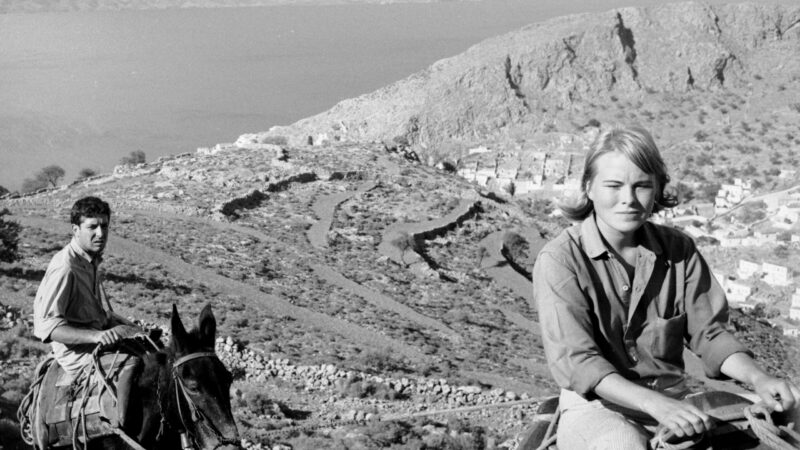
Hydra in 1960
The port of the Greek island of #Hydra is constructed like an amphitheatre made of marble. The extras and stagehands are men unloading ships, passing bags of sand, crates of mandarins, and clay pots from shoulder to shoulder and onto carts. Fishermen shout to shell divers, baskets of octopus are put on the pier.
At the harbour cafe sits a tanned superstar, the Australian essayist #Charmaine Clift#, with her husband #George Johnston#, a war journalist for LIFE Magazine. They both drink more, write more, swear more, and help others more than anyone else in the artist colony in 1960. A young Canadian poet, #Leonard Cohen#, has just moved in with Charmaine and George. There wasn’t really room for more drama on Hydra at this point, but this morning, everyone drank their coffee peacefully together at the cafe.
A sailboat arrives at this harmonious scene. On board is the author #Axel Jensen#, a «Nordic demigod», and his wife, the Norwegian «goddess of beauty», Marianne Ihlen. She wraps her newborn son in a white silk scarf to protect him from the sun.
Everyone in the port of Hydra stares at them, and the one who stares the most is Leonard Cohen.
Hydra was not a good place for new young mothers to be. Everyone had seen Axel bury his fingers deep in the back pocket of the «that American girl’s» miniskirt while his wife had been in Norway giving birth safely. Everyone knew it except «poor Marianne.»
Normally, readers’ attention is directed towards Jensen and Cohen, but Samson’s focus is on Marianne Ihlen. Samson uses the novel’s complementary narrative perspective to describe the dreamers’ theatre. Like when a too-young backpacker arrives on the island with a writer’s dream and a stack of blank sheets but is met with the fact that she would earn more money stripping than writing. This challenges the theme of «man and muse», about women in literature versus male author myths.
In the wake of Samson’s novel, Håvard Rem’s Cohen translations (1993) also seem unsuccessful.
Axel and Marianne
Ihlen had already travelled with Jensen to Hydra in 1957 when they were 22 and 24 years old. Jensen had bought a house on the island with the payment for his backyard novel, Ikaros (1957), about a young man who travels through the Sahara Desert. In his next novel, Line (1959), the restless man returns to open cars, sailing and parties on Oslo’s west side and Hankø, and falls in love with the upper-class girl, Line. Jensen bought a sailboat and a Karmann Ghia sports car with the payment for the film rights based on the book.
Although barefoot life on Hydra represented freedom from Oslo’s west side gender and class belonging for Marianne Ihlen, life was, expressed with war journalism precision, about «polishing Axel’s shit until it shines.» He floated, and she kept things practical. She dreamed of a nice, little family, he wrote. She carried paraffin, firewood, and water up all the hills and served coffee and lunch. She cooked and lit the lamp in the evening. She was «beautifully trained by Axel in the arts that facilities good writing», like a sort of geisha, according to Samson.
Samson’s Hydra version punctures the heroic worship of the anti-hero.
Marianne and Leonard
It was during one of Cohen’s early concerts in Norway in the mid-1980s that Marianne was first referred to in Dagbladet’s article as Cohen’s Norwegian romance, now living in Norway, in the song So Long, Marianne. Later, in a radio documentary by NRK journalist Kari Hesthamar (2006), Ihlen tried to correct the portrayal of their relationship by emphasizing Bird on a Wire (1968) rather than So Long, Marianne.
Ihlen and Jensen were divorced in 1960. Soon after, the sound of Cohen’s typewriter could be heard from the window of Jensen’s house. Cohen’s poem Tonight I burned the house I loved was written when Jensen denied Ihlen and their son and left Hydra. Ihlen stayed on Hydra, possibly hoping that Jensen would return to her and their child.
Most of the young Hydra writers had muses, except for the three-time mother Charmaine Clift. Cohen was lucky, according to Samson, to have taken over Ihlen, but Cohen was far beneath Ihlen’s dignity, «like a bird on a wire.»
Cohen also did not want children, and he eventually left Ihlen. We do not know why; Ihlen may not have known either. Cohen later referred to her as «a beautiful, unattainable woman.»
The unpleasantness for Cohen afterwards may have not only been leaving but also leaving Ihlen and their son to consequences he could not foresee. Ihlen and Jensen’s son had major problems and was sent to various boarding schools until his father took him on a trip to #India and introduced him to #LSD at age 15. Samson quotes Ihlen as saying, «Every parent should know this. For some fragile souls just one trip can turn out to be a cul-de-sac in hell.» Ihlen’s only son has spent much of his life in psychiatric institutions.
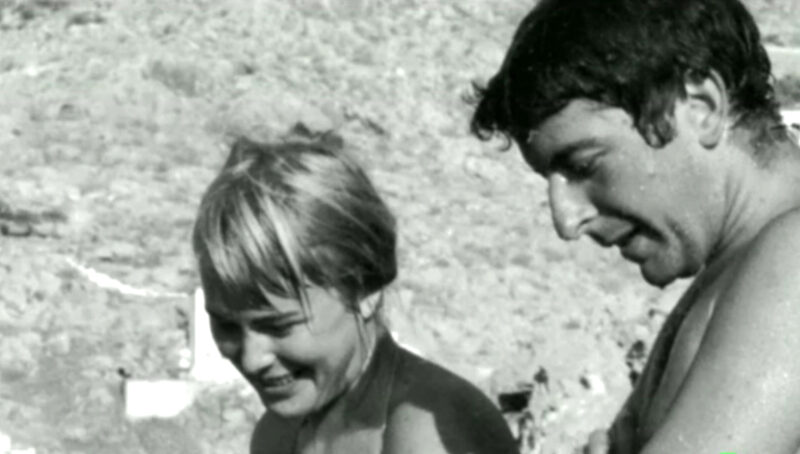
Mythologizing
After Nick Broomfield’s documentary Marianne & Leonard – Words of Love last year, the relationship between Ihlen and Cohen received renewed attention. Dagbladet’s Inger Merete Hobbelstad referred to the film as one of the most romantic of the year.
But Samson’s perspective is anything but romantic. On the contrary, a fundamental doubt is left about the mythologization of writers, about freedom and responsibility, about life and literature, and about women’s place in literary life. As Broomfield pointed out to underscore the themes in the novel, he had also been one of Ihlen’s lovers.
Jensen has been referred to as Norway’s greatest writer, including as a mix of Knut Hamsun and Jack Kerouac by Dagbladet’s Fredrik Wandrup. Samson’s Hydra version punctures the heroic worship of the anti-hero. Was the uncompromising freedom worth it? Jensen had five children with four women and failed them all fundamentally.
Unlike Broomfield and Wandrup, and despite the novel format, Samson moves from sensationalism to reality. She is merciless.
In the wake of Samson’s novel, Håvard Rem’s Cohen translations (1993) also seem unsuccessful. The first version of Cohen’s text opens as follows: «Like a bird / on the wire / Like a drunk in a midnight choir / I have tried in my way to be free.» In Rem’s translation, this becomes «Like a sparrow on a string / Like a drunk in a rowdy choir / I have tried, tried to be Me.» Cohen’s «midnight choir» refers to the Catholic midnight mass, significantly different from Rem’s «rowdy choir.» Cohen’s text deals with something unpleasant, a rawness, that is destructive to fragility. Cohen links this to «to be free.» It is in the tension between the beat-obligatory irresponsibility and a moral obligation that Cohen’s inadequacy arises. In Rem’s translation, the main point of Cohen’s poetry is lost, but also the core of the authorship.
Cohen has opened all of his concerts with Bird on a Wire. An attempt to restore irreparability?
Eventually, the artist colony in Hydra dissolved, marked by #alcoholism, pill abuse, #death, and #suicide. The dreamers’ theatre became a tragedy for many.