Every documentary success has a visible conclusion: a premiere, an award, a film finding its audience. Less visible is the earlier work of connecting a director and producer with the commissioning editors, festival programmers, distributors and peers who could help carry an idea forward.
When the Institute of Documentary Film (IDF) was founded in Prague in 2001, few such routes existed for documentary filmmakers from Central and Eastern Europe. The region had talent, subjects and artistic ambition, but lacked much of the professional infrastructure that could take a project from an early treatment to international co-production, distribution and recognition. IDF set out to build it.
A recent run of films makes the value of that work concrete. Mr. Nobody against Putin, part of the East Doc 2025 programme, won the 2026 Academy Award for Documentary Feature Film. Pianoforte, presented at East Doc Forum in 2022, won the 2024 International Emmy for Arts Programming. Fiume o morte!, presented at East Doc Market in 2024, was named European Documentary at the 2026 European Film Awards. These three awards are only a fraction of what IDF’s programmes have helped make possible. Each film came through a different IDF activity and at a different stage of development. That range is precisely the point: IDF’s strength lies not in a single flagship programme, but in an infrastructure built to meet films at different moments and help them go further.1
Making the region visible
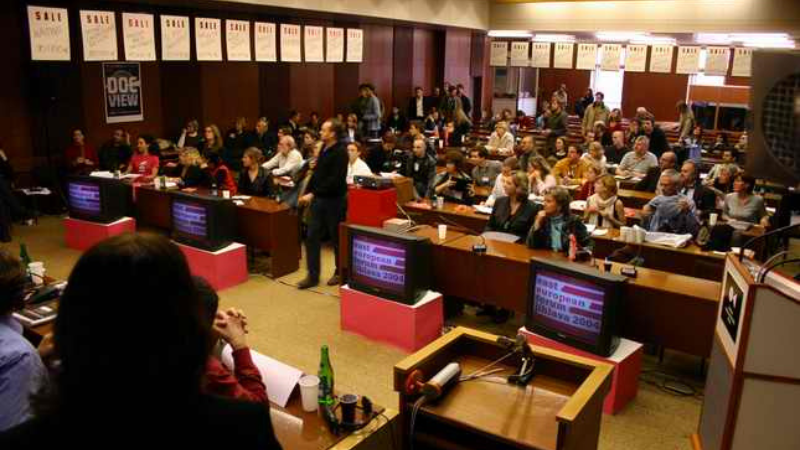
An image from the early East Silver market captures the problem IDF first addressed. Rows of televisions and video players, later replaced by DVD players, stood at venues of the Ji.hlava International Documentary Film Festival. Visiting programmers and commissioning editors could sit down and discover documentaries from countries whose work was barely visible to them. The market had grown from a VHS library, catalogued in a spreadsheet and shared with anyone who asked.
![Insert image: early East Silver library in Ji.hlava]](https://www.moderntimes.review/wp-content/uploads/2026/09/modern-times-review-east-silver-early.png "modern-times-review-east-silver-early")
After 1989, filmmakers across Central and Eastern Europe gained freedoms long denied to them, while much of the state production and distribution system around them disappeared. Western Europe already had pitching forums, specialist training, commissioning networks and established routes into international co-production. In the region, these mechanisms were scarce.
IDF was founded in Prague in 2001 by Filip Remunda and Andrea Prenghyová, who were classmates at FAMU with Tereza Horská and Ivana Pauerová Miloševičová. All four shaped and curated the programme of the first pitching forum, held at Ji.hlava that same year under the name Burza námětů.2 That first edition marked the beginning of IDF’s long-standing presence at Ji.hlava. From the outset, the forum drew on guidance from both the European Documentary Network and Czech colleagues, among them filmmaker Jan Gogola Jr., who attended as a representative of Czech Television.
At the European Documentary Network, its director Tue Steen Müller was among the first to support the team, alongside Paul Pauwels and Stefano Tealdi. Mikael Opstrup and Marijke Rawie also contributed, bringing an established model and an international perspective. Leena Pasanen and Wim Van Rompaey were among the first commissioning editors to take part, extending the forum’s connections with the wider industry, while Müller later lectured at Ex Oriente Film for many years. Under Prenghyová’s leadership, the initial gathering grew into a lasting support system for developing projects, strengthening filmmakers’ confidence and building international relationships. She moved to dok.incubator in 2012. Horská, Remunda and Pauerová Miloševičová remain involved and now serve on IDF’s board.
One of the first films to test this emerging infrastructure was Czech Dream (2004), directed by IDF co-founder Filip Remunda and Vít Klusák. Its fictitious hypermarket provoked a national controversy and became an international festival success; its inclusion in the East Silver 2004 collection showed that documentaries from the region could travel. The larger task was to ensure that this was not an isolated Czech success, but part of an infrastructure open to filmmakers across the region.3
That regional commitment is especially visible in IDF’s long relationships with Ukrainian and independent Russian documentary communities, built well before Russia’s full-scale invasion of Ukraine. Roman Bondarchuk’s Ukrainian Sheriffs (2015) premiered at IDFA and became the first documentary Ukraine submitted for the Academy Award for Best Foreign Language Film. Filmmakers Alisa Kovalenko and Alina Gorlova, and producer Daria Bassel, also worked with IDF through its programmes, alongside a long partnership with Docudays UA. Independent Russian work arrived through the same network, much of it from Marina Razbezhkina’s school, including Askold Kurov’s films about the imprisonment of Ukrainian director Oleg Sentsov. Alexander Rastorguyev, part of that circle, was murdered in the Central African Republic in July 2018 while investigating the Wagner Group. Today, many of those Russian filmmakers work in exile, beyond funding instruments built around member states.
IDF’s strength lies not in a single flagship programme, but in an infrastructure built to meet films at different moments and help them go further.
The work before the pitch
The first forum exposed another missing element. Strong ideas often arrived before they were ready to meet international partners. IDF responded in 2003 with Ex Oriente Film, a long-term development programme for creative documentary projects from the region.
Directors and producers join while their films are still vulnerable and changeable. Across several sessions, they test the story, visual language, production plan and route to audiences with tutors and peers, including Ivana Pauerová Miloševičová, who served as Head of Programme for the East European Forum and Ex Oriente Film workshop from 2003 to 2011 and is now Head of Documentaries at Czech Television and an IDF board member. More than 200 projects have passed through Ex Oriente Film.
In 2008, some Czech filmmakers warned that professional training could mould projects to market expectations. Prenghyová argued that knowing the industry’s ‘rules of play’ could instead give filmmakers greater freedom.4 In a 2025 interview with Modern Times Review, former Ex Oriente Film Manager Anna Kaslová and tutor Diana El Jeiroudi stressed the uncertainty of working with projects at their earliest stages and the need to put filmmakers, rather than market-ready packages, at the centre of the process.5
Participants describe the result in personal and practical terms. First-time director Maris Salumets said the guidance helped her «trust my instincts and find my voice». It also strengthened her project internationally and contributed to a three-country co-production. That combination of authorship and professional viability is the substance of development.6
The films that followed show the programme’s longer reach. Rabbit à la Berlin took part in Ex Oriente Film and the East European Forum in 2005, then received an Academy Award nomination for Documentary Short Subject in 2010. Blind Loves, developed through Ex Oriente Film in 2006 and later presented through IDF’s market and festival activities, premiered in Cannes’ Directors’ Fortnight in 2008 and won the CICAE Art Cinema Award. Motherland went through Ex Oriente Film in 2019 and East Doc Forum in 2020 before winning the main DOX:AWARD at CPH:DOX in 2023.7
«The tools will keep changing, but a documentary only comes alive when somebody sits down to watch it. Our task is to keep building the routes that make that encounter possible.»
Support across a film’s life
Each IDF activity grew from an obstacle revealed by the last. Ex Oriente Film helped projects mature; the East European Forum put them before potential partners; East Silver made completed films searchable. Its travelling festival service, long known as East Silver Caravan and renamed East Doc Caravan in 2026, works with selected titles on festival strategy, premiere timing and direct contact with programmers. In 2025, Caravan supported 90 screenings at 79 festivals.8
East Doc Platform brought these functions together in Prague in 2012, in cooperation with the One World International Human Rights Film Festival. East Doc Forum concentrates on projects seeking co-production and finance; East Doc Market arranges tailored meetings for projects closer to completion; and Czech Docs: Coming Soon presents forthcoming Czech documentaries. Counting from the first pitching forum, held under the name Burza námětů in 2001, the East European Forum and its successor hosted more than 800 filmmakers and producers from the region and more than 300 international decision-makers. IDF reports that more than 350 documentaries have been completed with the forum’s support.
The value of a pitching forum is easier to see over years than over a weekend. In March 2020, at the nineteenth East Doc Forum, a Montenegrin-Serbian project called The Last Nomad was pitched in Prague at an edition rearranged mid-week as COVID closed Europe. It won no award there. Six years later, as To Hold a Mountain, Biljana Tutorov and Petar Glomazić’s film took the World Cinema Documentary Grand Jury Prize at Sundance 2026. Between those two dates sat a Eurimages Co-Production Development Award at CPH:FORUM, grants from the IDA Enterprise Documentary Fund, Chicken & Egg and Catapult, a Rough Cut session at CPH:DOX, and a five-country co-production. IDF was the first stop on that route rather than the whole of it. The forum’s function is to put a project in front of the people who fund the next six years, and unsuccessful pitches are part of how that works.
The same long curve appears elsewhere, and not only through development. Joanna received one of its earliest prizes, the Silver Eye Award, before its Academy Award nomination in 2015; Communion came through East Silver Market and won Silver Eye in 2016, then was named European Documentary at the European Film Awards a year later. More recently, Better Go Mad in the Wild was at East Doc Forum in 2021 and won the Crystal Globe at Karlovy Vary in 2025; If Pigeons Turned to Gold was presented at Czech Docs: Coming Soon in 2024 and received the Berlinale Documentary Award in 2026.9
Films rarely move forward through funding and training alone. They also need a professional network: peers who challenge the work, partners who open doors and relationships that last beyond a single workshop or pitch. IDF’s role is therefore not only to support individual projects, but to help filmmakers become part of a wider documentary community. Ukrainian producer Oleksandra Kravchenko’s experience makes that role concrete. An Ex Oriente Film participant in 2020 and 2022, she said IDF helped her «become a member of the European documentary professional community».10
IDF turned to audiences in 2015, when it launched KineDok. A documentary could complete development, find co-producers and tour festivals, yet still struggle to be seen beyond that circuit. KineDok brings films to galleries, libraries, cafés, museums, boats and improvised venues, usually pairing screenings with filmmakers, local guests or discussions.11
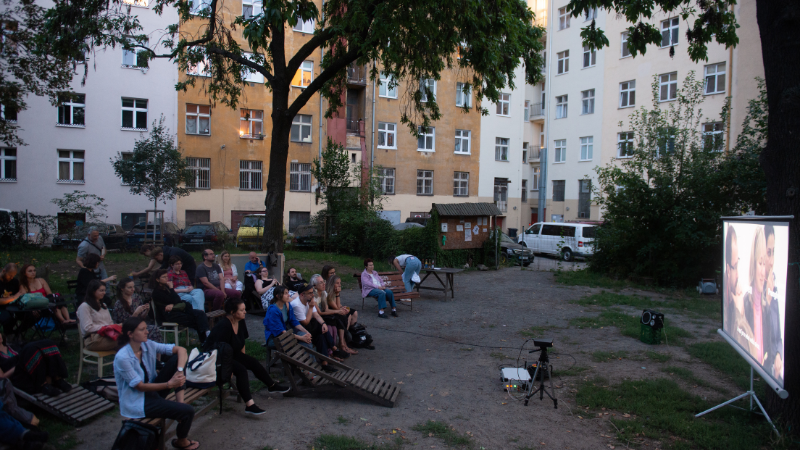
Filip Remunda, who initiated the project, described its principle in 2024: «A screening in a village barn is a unique format, combining a film screening with a community experience.»12
In 2025, KineDok operated in five countries through 198 venues, presenting 753 screenings to 18,673 visitors. That scale rests on local hosts and on conversations that continue after the film ends. It also closes a circle opened by the televisions in Ji.hlava: after making the region’s films visible to international gatekeepers, IDF is helping to keep documentary culture public as conventional cinema and television offer fewer places for it.13
Building the next routes
The system around documentary film is again changing. Financing is less predictable, and the commissioning editor with a documentary slot and budget no longer provides a reliable centre of gravity. Projects rely on more fragmented combinations of public funding, co-production and industry support, while the markets and training programmes connecting them are themselves vulnerable.
Production, distribution and exhibition are shifting too. Generative AI is entering research, translation, production and post-production, bringing questions of consent, authorship, evidence and synthetic images. Short-form and online viewing are changing what reaches audiences and how they find it, while VOD and immersive formats sit alongside cinemas, festivals and community screenings. The pandemic normalised online industry encounters. Political pressure on media, civil society and cultural institutions in parts of the region has made spaces for independent documentary less secure. The broadcaster-led route to a festival premiere and television audience still exists, but it is neither the only route nor a dependable one.14
IDF is responding by redesigning programmes around where projects and audiences now are. Docs Beyond: Audience, Impact & AI, created in 2026 for projects in production or post-production, places generative AI within the wider practice of audience design, outreach and impact producing. This keeps questions of consent, authorship, evidence and synthetic images inside the creative conversation.15 Audience strategist Dimitra Kouzi, who worked with Ex Oriente Film participants at East Doc Platform 2026, argues that this thinking belongs at the start of a film’s life: «when we think about the audience early on, we don’t limit a film».16
IDF is also widening the range of projects and filmmakers it supports. Ex Oriente Film added a dedicated documentary series strand, Ex Oriente Series, in 2023.17 Short Pitch Program gives emerging makers of short documentaries pitch training, one-to-one meetings and direct contact with decision-makers, addressing both the shortage of development routes for shorts in Central and Eastern Europe and their growing importance online. Participant Danilo Stanimirović said the support gave him the confidence to begin shooting his first professional short documentary.18
KineDok is extending access without abandoning collective experience. Its local screenings and discussions now sit alongside a VOD selection and immersive work, including a collection of three VR titles. A barn, a home screen and a headset ask different things of an audience, but each can create a route to a film.19
As IDF co-founder Filip Remunda puts it: «The tools will keep changing, but a documentary only comes alive when somebody sits down to watch it. Our task is to keep building the routes that make that encounter possible.» From the rows of televisions in Ji.hlava to screenings in barns and library back rooms, and now to VOD and headsets, the means have changed, but the purpose has not. Twenty-five years on, that remains IDF’s work: making sure the next documentary from the region can find the people it was made for.
Notes
- Award records: Academy of Motion Picture Arts and Sciences, ‘The 98th Academy Awards’ (oscars.org); International Emmy Awards, ‘2024 Arts Programming Winner: Pianoforte’ (iemmys.tv); European Film Academy, ‘Winners 2026’ (europeanfilmacademy.org). IDF programme participation: supplied activity histories and DOKweb archive. ↩
- is.muni.cz/el/phil/podzim2019/FAVBKa20/um/prezentace/DCK_DF_KOMBI_2.pdf ↩
- Institute of Documentary Film, internal 25th-anniversary documents and activity histories supplied for this article; public programme archive at dokweb.net. ↩
- International Documentary Association, report on the East European documentary sector and IDF, 2008; quotation and context reproduced in the supplied IDF source document. ↩
- Steve Rickinson, ‘East of convention: Ex Oriente Film’s human-centred method’, Modern Times Review, 17 September 2025: moderntimes.review/ex-oriente-film-2025-interview. ↩
- Institute of Documentary Film, Ex Oriente Film participant reactions: dokweb.net/activities/ex-oriente-film/2025/reactions. ↩
- Institute of Documentary Film, Ex Oriente Film activity histories: dokweb.net/activities/ex-oriente-film/2025/about. Award records: Academy Awards, Cannes Directors’ Fortnight/CICAE and CPH:DOX official archives. ↩
- Institute of Documentary Film, Final Report 2025; East Doc Caravan programme information: dokweb.net/activities/east-doc/2026/east-doc-caravan. ↩
- IDF/DOKweb activity and award histories for To Hold a Mountain, Joanna, Communion, Better Go Mad in the Wild and If Pigeons Turned to Gold; official award records from Sundance (2026), Academy Awards (2015), European Film Awards (2017), Berlinale (2026) and Karlovy Vary (2025). ↩
- Institute of Documentary Film, Ex Oriente Film participant reactions: dokweb.net/activities/ex-oriente-film/2025/reactions; participation years as recorded in IDF’s collected participant feedback. ↩
- KineDok, project history and anniversary materials: kinedok.net; venue types listed in the KineDok manual for screening organisers: kinedok.net/cs/chapters. ↩
- Filip Remunda, interview for KineDok, 14 October 2024; Czech original supplied by IDF and translated for this article. ↩
- Institute of Documentary Film, Final Report 2025: KineDok operated in five countries through 198 venues, presenting 753 screenings to 18,673 visitors. ↩
- Sector context: Institute of Documentary Film, internal editorial source supplied for this article; European Commission, Creative Europe MEDIA Programme, digital-strategy.ec.europa.eu/en/policies/creative-europe-media; Sunny Side of the Doc, ‘No edition in 2026’, sunnysideofthedoc.com/news/no-edition-in-2026; European Commission, 2025 Rule of Law Report, commission.europa.eu — 2025 Rule of Law Report. ↩
- Institute of Documentary Film, ‘Docs Beyond: Audience, Impact & AI’: dokweb.net/activities/docs-beyond/2026/about. ↩
- Dimitra Kouzi, public post on East Doc Platform 2026 and the Ex Oriente Film workshop: instagram.com/p/DWRAMFhjPaY. ↩
- Institute of Documentary Film, Ex Oriente Film programme information: dokweb.net/activities/ex-oriente-film; ‘Ex Oriente Series 2025 returns to Sunny Side of the Doc for its first session’: dokweb.net — Ex Oriente Series 2025. ↩
- Institute of Documentary Film, ‘Short Pitch Program’: dokweb.net/activities/east-doc/2026/short-pitch-program0; Danilo Stanimirović participant feedback supplied for this article; Julian Wyllie, ‘Why independent documentary filmmakers want new and improved funding models’, Current, 5 August 2021: current.org — funding models. ↩
- KineDok, ‘#KinoKdekoli – nově i ve virtuální realitě’: kinedok.net — #KinoKdekoli; current VR collection, kinedok.net/cs/selection/vr-filmy; VOD catalogue, kinedok.net/cs/vod. ↩