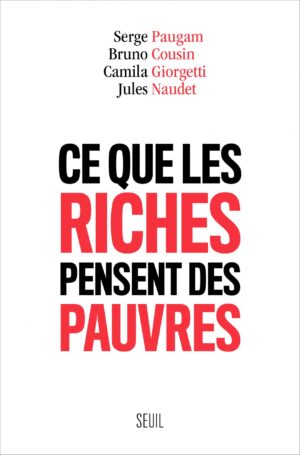
Four sociologists, three French and one Brazilian, all based in reputable research institutes in #Paris, have examined what the wealthiest in Paris, #São Paulo#, and #Delhi think about the poor.
Eighty interviews have been conducted in each city, totalling 240 wealthy individuals who have spoken at length—for one to two hours, according to the methodology chapter—about their perceptions of the #poor. Extensive direct quotes from the interviews occupy a significant portion of the book’s first 200 pages, which is very good. I get a sense of reading a kind of updated version of Bourdieu’s La Misère du monde (1993)—but instead of, like #Bourdieu, speaking with impoverished French people about housing, work, and (lack of) #education, the authors of this book engage with the richest of the rich and their views on the same issues. The mentioned quotes, the analytical approach, and the topic itself, however, cause Bourdieu to linger in my reading, even though the authors do not mention him explicitly many times.
Not In My Backyard
The book’s starting point is a protest led by some of the most privileged individuals in Paris. Almost two years ago, there was talk of establishing a centre for #refugees and the #homeless in the #Boulogne Forest# to the west of the French capital. Forty thousand signatures from Paris’ 16th arrondissement—the district that houses most embassies and is considered the most expensive and chic in the global city—were submitted to the mayor in protest: The rich and successful did not want a refugee centre so close to them. This may not be shocking in itself; resistance from residents against development projects that they believe harm them economically, culturally, socially, or in terms of health has become so common since the early 1990s that it has acquired its own name: NIMBYism (Not In My Backyard). But the resistance in Paris prompted the sociologists to investigate what the rich think about the poor thoroughly.
Corrupting Morality
After several hundred interviews, we now know that the wealthy in Paris, São Paulo, and Delhi all desire to maintain a physical distance from the poor. We know that the rich are sceptical of the personality and character of the poor, and their attitudes border on discriminatory and racist. While Paris’ wealthiest emphasize the poor’s negative attitudes and lack of education as the most problematic, the rich in São Paulo speak more about the poor as dangerous, criminal, and unpredictable. In Delhi, the poor are perceived as dirty and foul-smelling.
The wealthy’s views of the poor can be categorised as either moral objections, a need for self-protection, or various forms of legitimising #economic inequality#. The poor are said to corrupt the morality—propriety, decency, and discipline—of the rich in several ways: drinking too much alcohol, not distinguishing between good and bad quality, being dirty and smelling bad, and having bad manners. The poor behave indecently and lack (self)discipline. They spit on the street, rarely wash themselves, openly drink, steal, and speak loudly. Consequently, they become a threat to the bourgeoisie’s lifestyle and values. The wealthy live as they do because like-minded people with higher education and good manners surround them. People who know how to behave and look decent. «Normal people,» as they say.
We know that the rich are sceptical of the personality and character of the poor, and their attitudes border on discriminatory and racist.
Robbery, Stench, and Abuse
The desire for protection is strongest in São Paulo, where extremely poor and affluent neighbourhoods coexist. Here, the wealthy invest significant resources to exclude the poor from their areas; entire neighbourhoods are fenced and guarded. In addition, people have private #surveillance cameras and their own security guards outside their walled and theft-proof homes. São Paulo’s rich fear robbery and assault by residents of the slums, so they mostly stay home. No one uses public transportation. In Paris, however, it is not a crime that the wealthy fear the most, but contagious diseases, bad odours, and dirt. The metro exposes them to all this, but the affluent Parisians still use it, at least during the day; they drive their cars when going out in the evening. In Paris, the rich are not afraid to be outside.
In contrast, the wealthy move very little in the public space in Delhi. Affluent women and girls take great care and are specially protected. They fear sexual advances and aggression directed primarily at wealthy women. Furthermore, the traffic is so congested and the air so polluted that the upper class does not like to venture outside their «own» safer neighbourhoods.
Their Own Fault
Finally, the analysis examines how the rich legitimise the significant inequality and the presence of many poor people. Wealthy Parisians often explain poverty by attributing it to the laziness of the poor; they have not utilized their talents and therefore do not deserve better. In São Paulo, on the other hand, wealth and #poverty are discussed as completely natural phenomena: There is no point, nor anyone’s responsibility, in addressing the poor living conditions of large parts of the population. In Delhi, caste, karma, and class largely legitimise the differences between the rich elite. Here too, the poor are largely seen as responsible for their own situation; they must have done something morally reprehensible in their past lives to have ended up in such dire circumstances.
Although the attitudes of the upper class towards the underprivileged differ on the three continents, all interviewees express a desire for distance from the poor physically and morally. Some express a certain solidarity, but it only materialises as long as the distance is maintained. The authors speak of a «solidarité à distance,» which we can loosely translate as «distanced solidarity,» for example, by being a sponsor for organisations like Save the Children.
Pioneering Work
The study is fascinating reading. We gain detailed insight into a little-known mindset—the attitudes of the rich towards the world’s poorest. We receive methodological assessments, analytical categories, and relevant comparisons that provide important new knowledge. Moreover, once Ce que les riches pensent des pauvres is translated into English, we will have a new French academic reference work.