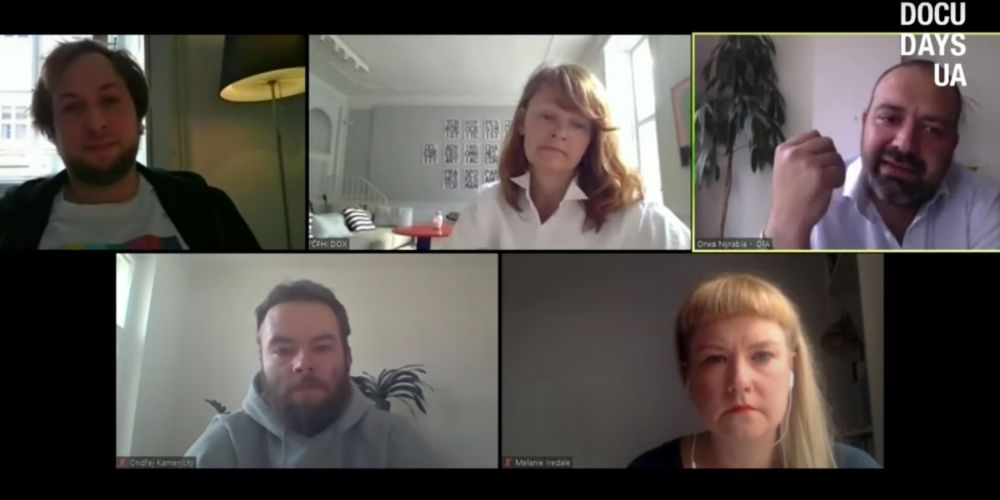
«Will our world ever be the same after this crisis?» moderator/IDFA artistic director Orwa Nyrabia asked via live stream to the likewise virtually-attending panelists at this year’s (digital) Docudays UA DOCU/CLASS «Force majeure has happened – and it’s global. How will festival policies change now?» The doc industry vet’s opening question is one that’s been on the minds of many of us. (At least here in the West. Among the many surprising things the pandemic has revealed is the extent to which other populaces – such as the Ukrainians who host Docudays UA – have taken this global crisis with a grain of salt. Yet one more uncertainty in their eternally unstable world.)
First to tackle the question was Tine Fischer, CPH:DOX’s founder and festival director, who was adamant that the world will never be the same – something she hoped for. We as citizens «have changed at the speed of light,» Fischer pointed out, and she now felt a heavy «responsibility» to continue on that trajectory. «I hope and believe the world will never be the same after COVID-19,» she declared.
That said, Fischer did express skepticism that online screenings will ever replace the theatrical experience. Simply put, arthouse films are developed for the arthouse experience – they need to be seen there. She would always «defend the institution of cinema.» In turn, Fischer was thankful that digital showings have broadened the CPH:DOX audience – something which will be of great importance in the future. Not all films require the big screen, she conceded. A film about AI, for example, could probably play even better online. Indeed, Fischer envisioned a «hybrid» fest for the future (which is, perhaps, not all that surprising since CPH:DOX was at the forefront in showcasing «hybrid» docs). She then also noted that it’s expensive to travel to festivals – thus the idea of making CPH:DOX accessible to underserved and marginalized communities was an attractive notion as well.
Fischer mentioned too that she’d gotten great feedback – and plenty of rave reviews – from producers about CPH:DOX’s digital market this year. This inevitably was balanced by the many filmmakers who nevertheless missed the coffee-and-drinks component – and the attendant happy accidents, such as bumping into producers they hadn’t been scheduled to meet.
Simply put, arthouse films are developed for the arthouse experience – they need to be seen there.
Ondřej Kamenický, a director of the International Human Rights Documentary Film Festival One World, noted that everything changed for him when One World had to switch smack in the middle of the fest. (They’d opened with limited in-person screenings before pivoting to digital.) Nothing will be the same from here on out. While online showings do have the advantage of broadening the audience, they still can’t reach everyone, he stressed. What about the senior citizens who don’t watch films online? he wondered, before pointing out that often film festivals are the only cultural events in many small towns. Also, Q&As are inevitably changed once they transition online. Nothing can replace the experience of sharing a physical space with a filmmaker, he concluded.
For her part, Melanie Iredale, Deputy Director of Sheffield Doc/Fest, mentioned that she too doesn’t think the world will be the same – nor should it be. The global pandemic had exposed way too much – how we’ve been ruining the planet, our systemic inequalities. That said, the human desire to come together for the personal experience will remain a collective need.
Iredale added that she is «keen on the festival experience,» that it’s important to have a (limited) program in the cinemas even while shifting to the online realm. To that end, she planned on spreading out smaller screenings over a few months in the fall. Though she agreed that virtual showings often attract new audiences, she also felt that viewers can only be truly immersed in a film when they are in a darkened theater – and thus it’s important to create the conditions for this. As for whether younger generations even want that darkened theater, she pointed out that Sheffield Doc/Fest actually has a relatively young audience – and one that is enthusiastic for the cinema experience.
In addition, online fests can sometimes overwhelm – so specific outreach around particular films is just easier at an intimate IRL fest, Iredale theorized. That said, Sheffield Doc/Fest went ahead and put its marketplace online this year – a decision she called a no-brainer since the industry aspect was so important to the filmmakers. In order to do so, though, she first reached out to other festival directors – including CPH:DOX’s Fischer – to figure out the best way to go about the tricky transition.
As for Victoria Leshchenko, a program director of Docudays UA, she expressed the sentiment common among Ukrainians – that cataclysmic change is normal for #Kyiv, so responding quickly to disaster is something they’ve gotten quite good at. True, the world won’t be the same again – but in her world this is a shrug-worthy fact. Ukrainians are a resilient people.
To that end, Docudays UA decided to put all their planned activities online – and it seemed to have worked. «The Soup» conversations (lunchtime chats over soup with filmmakers), Leshchenko noted, went especially well.
Fellow Ukrainian Iryna Tsilyk, both a filmmaker and a writer, was then asked by Nyrabia how she personally felt about pivoting to online screenings so quickly after such a great festival start. (Tsilyk debut feature The Earth Is Blue as an Orange picked up the World Cinema Documentary Directing Award at #Sundance back in January. Her doc’s shift to virtual occurred soon after, during One World.) Tsilyk responded that, as a first-time feature-length director, she actually doesn’t have anything to compare this current experience to. Sure, she had dreams for the festival circuit – so those have certainly been dashed. That said, the director was thrilled that a variety of viewers have been able to watch her film at the digital Docudays UA – and not just the usual festival audience. (She still wanted theatrical distribution, of course, but wasn’t sure if that would happen now.)
The world changes, we change, so we have to adjust to that, she then added (thinking like a true Ukrainian). Still a firm believer in the big-screen experience, Tsilyk nevertheless felt inspired by the online power of collective watching. During the 24-hour period her film showed at Docudays UA, she received hundreds of messages – many from people who had physical disabilities or were in small towns. In other words, her film managed to touch folks who would never have been able to see it at a film festival.
The world changes, we change, so we have to adjust to that…
Which prompted the moderator/IDFA director to wonder how Tsilyk might feel about doing Q&As from her home rather than in person. She admitted to «selfishly» having dreams of traveling the world with her film. On the other hand, Tsilyk hadn’t participated in any digital Q&As with her doc yet. She was still quite open to the idea that it could indeed work to replicate the filmmaker to audience connection after all.
As for Martin Horyna, a programmer at the Karlovy Vary International Film Festival, he likewise agreed that things won’t ever be the same. The experience will change us all – including how we view our position in the world. Even as the new reality has changed the film industry, though, he remained a strong advocate for a return to the cinemas.
As a result of the crisis, KVIFF ended up canceling its separate documentary and fiction competitions – melding them together instead. It was a development Nyrabia expressed unabashed enthusiasm for (and to which I second. I had actually expressed dismay with KVIFF’s hard fiction/nonfiction division years ago when I first attended the fest). Docs often struggle to gain wide theatrical distribution, Horyna noted – but now with online screenings that tendency has been turned upside down. In other words, digital showings seem to benefit nonfiction films above all.
And today’s reality – even pre-pandemic – is that everyone watches more films at home than in theaters. Period. That said, this just isn’t the strength of Karlovy Vary, Horyna explained. It’s not in his fest’s «DNA» to be an online event (which makes sense since KVIFF is a cinematography-centric festival after all). Karlovy Vary chose to skip this year’s edition after coming to the consensus that it would harm their films more than help in far too many cases. «Out of the crisis will rise something new,» Horyna then concluded on a more hopeful note.
As for the IDFA leader’s POV, Nyrabia opined that there is absolutely no way to know what the best answer is to the question of whether to cancel a fest or to continue online – that that’s purely a festival by festival decision. Everyone is still in the «try something and see what works» phase. Uncertainty aside, Nyrabia found himself ultimately heartened by the solidarity the #COVID-19 crisis had catalyzed. Festival directors were suddenly reaching out to one another for advice. The question isn’t one of winning or losing in the transition to digital, he added – as festivals must go online when it comes to certain aspects such as the markets. He then pointed out that, just like radio didn’t kill print #journalism, online fests won’t put an end to theatrical releases.
Wrapping things up with a smart question from the chat – How will online screenings affect the policies for premieres? – Nyrabia put the final query to the entire panel. Horyna advised that premiere requirements are not the ultimate goal, but a tool. This crisis was an opportunity to think deeper about those policies. Fischer added that our current moment calls for all festivals to come together to figure this out – and to hopefully stop competing with one another for premieres. (To which Nyrabia wholeheartedly agreed.) Kamenický thought it best to include distributors in the process of discerning what to do.
Everyone is still in the «try something and see what works» phase.
Iredale, though, worried much more for the more immediate future – as the economic crisis might cause distributors to become ever more risk-averse. She revealed that she was now focused on diversifying the Sheffield Doc/Fest slate, and perhaps screening fewer films that already have distribution, that don’t necessarily need that festival boost. She just didn’t want those projects to take slots away from the undistributed, under the radar gems.
Nyrabia concurred in desiring that balance. Before closing the virtual proceedings he urged that, if nothing else, they should all grab the opportunity to create new spaces for new filmmakers in the brand new post-pandemic world.