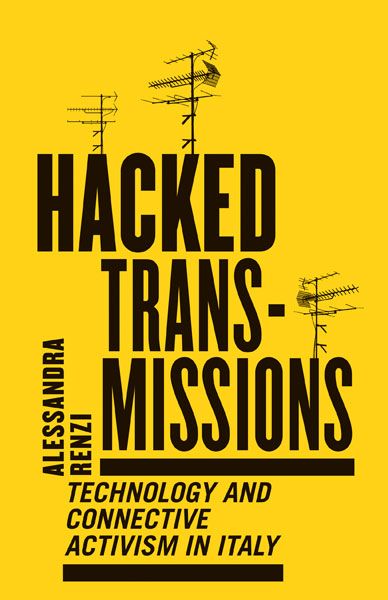
Alessandra Renzi has explored the celebrated but often disputed potential of #social media# as a tool of #social change#. She does so from the perspective of its convergence with broadcast media, as well as in view of the recent history of using broadcast media for community building in #Italy. She has applied an innovative research methodology, in which thorough theoretical analysis intertwines with first-hand experience, elaborating an important contribution to contemporary #media theory#. Her book is simultaneously an insightful historic overview of post-1968 Italian media, a comprehensive framework for understanding contemporary mediascapes, and a good starting point for an informed and responsible approach to building the post-Covid19 world.
Is this a society at all?
Only a few days after the first #Covid19 patient was diagnosed in Italy, another tragic event took place. In Naples, a few hours after midnight, a 23-year-old soldier in civilian clothes shot a 16-year-old boy. The soldier was sitting with a girl in a car, parked in the old town, when the victim, driving a scooter together with another teenager from the suburbs and carrying a plastic gun, attempted to steal his watch. The soldier fired three shots, injuring the boy, who died shortly afterward. Learning about his death, the victim’s relatives and neighbours ransacked the emergency room, so service had to be suspended and patients transferred to other wards and hospitals. They also fired pistol shots in front of the headquarters of the Provincial Command of the Carabinieri of Naples.
Only a few days after the first Covid19 patient was diagnosed in Italy, another tragic event took place.
Several details, starting with the gun – a plastic toy according to relatives; a metallic ‘replica’ of a real gun according to the police – would be cleared up within the investigation. But the first TV images of the ravaged emergency room speak of how we have lost the basic consensus on the sense of living together. What should we think about a society where not all its members believe that an emergency room is there to benefit all? Is this a society at all?
The power of activist media
Seen from this perspective, the key premise of Hacked Transmissions is immensely relevant. Social media is often defined by its unprecedented capacity to link individuals in sharing vast amounts of information as a form of participation in public life. In many cases, they have, indeed, facilitated large mobilisations. However, facilitating networked mediation for political mobilisation is not the same as fostering social connection. Something that broadcast media, when used as #activist media#, in particular, can do.
Renzi focused on a particular Italian form, the street television: Telestreet microtelevision stations transmitted at the neighbourhood scale, using ultra-high frequency (UHF) analog frequencies that commercial networks cannot use because of physical and territorial obstacles. The nationwide network of stations such as Disco Volante TV, SpegnilaTV, TeleAut, AntTV, OrfeoTv, etc was formed in 2002 and lasted until Italy switched to digital broadcasting in 2010. Some of its microstations outlived the network and the researcher’s interest persisted through her involvement with the TV channel insu^tv in Naples.
The author’s findings contradict the linear view of social media as enabling a more democratic communication compared to traditional broadcast media. In several telling examples, Renzi shows how, with activist broadcast media, the interaction centred around the process of collaborative production, fostered a sense of belonging and social connection. With the broadcasting antenna gone, there was less need to work on common formats, and people were pulled in different directions by parallel projects. Two that particularly stand out are collaborative documentaries (such as Genuino Clandestino/The Genuine Clandestine, 2011) and instant docs (documentary shorts on news neglected by the mainstream media, for example, Lampedusa Next Stop, 2011).
The ties forged during the process of media making were crucial for connective activism more than the fact that these stations reported on protests and events.
These projects developed as part of a new media infrastructure where the availability of the means of production put stress on distribution. Several features of this new infrastructure, such as the #algorithms keeping users within their networks of friendships and media consumption habits and the simplicity of the new technology allowing individuals to work alone, contribute to, what Renzi calls, the molecularization which transpires in the new media landscape of individual or small cells of media activists. Users of social media tend to be grouped according to algorithms and design criteria that seldom map onto the #heterogeneity of the social fabric of a place. Since a single individual can use a smartphone or small camera to produce video, post it on their own #YouTube channel and promote it on their social media networks, the collaborative and lengthy production processes of broadcast-based street TV stations are no longer necessary. The ties forged during the process of media making were crucial for connective #activism more than the fact that these stations reported on protests and events.
Antagonism
Hacked Transmission enables a better understanding of activist media and brings new light to the particularities of media infrastructure in times of social networks. Outlining an ample historical passage from Radio Alice and tactical media, on through to raves, bulletin board systems, Telestreet and insu^tv, the book is also a precious source on the history of Italian media, both in terms of #historiography and interpretation. The Telestreet network was developed as a direct opposite to consumerist-style TV networks owned by #Silvio Berlusconi#, yet they both originated from the antagonism toward the rigid social structures inherited from the Italian Communist Party and the Catholic Church alike. In her comprehensive interpretation, the author also provides a rare insight into Italian political and media theory, as well as contemporary #philosophy. From the notion of «autonomia» and the epic work of Italian media theorist Franco ‘Bifo’ Berardi, who cofounded Collettivo A/traverso, from where Radio Alice as its’ direct extension came on the scene. To the #autonomist feminists# like Mariarosa Dalla Costa, Leopoldina Fortunati, and Silvia Federici, with their conceptualisation of reproductive care and affective labor as integral to the reproduction of #capitalism, and also of communication and language as important elements of social reproduction.