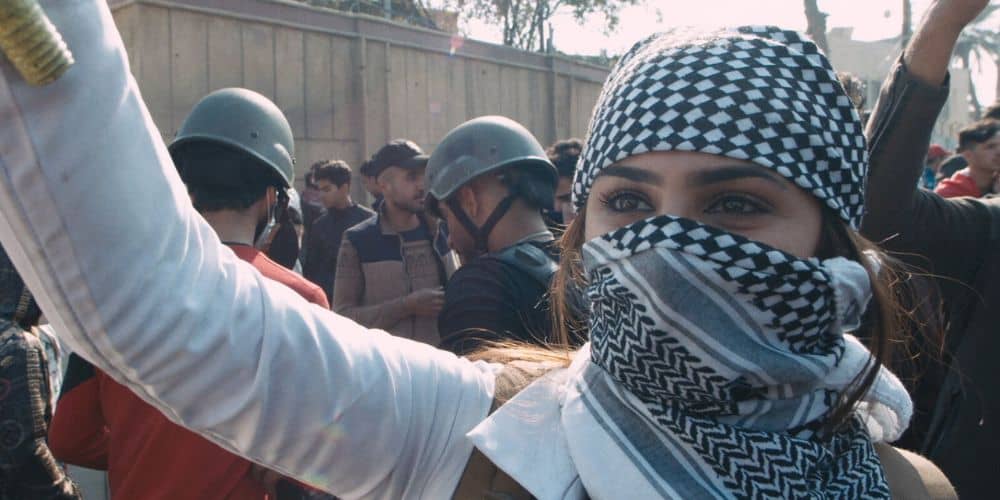
Fighting for #freedom and #equality. Twenty years have passed since the US-led invasion of Iraq in 2003 and the fall of #Saddam Hussein#. In October 2022, thousands of young men and women gathered at #al-Tahrir Square# in the middle of #Baghdad to celebrate the third anniversary of the largest youth demonstrations in the history of Iraq, which happened in 2019. They demonstrate against chaos, #corruption, and conflicts that have followed in the aftermath of the American invasion.

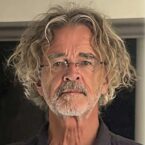
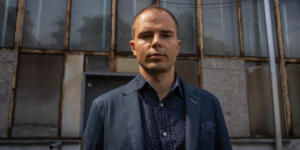
Modern Times Review met the film director #Karrar Al-Azzawi# (and his producer, see below), who was born in Baghdad but ended up in #Norway as a #refugee, seeking asylum. During his five years in the asylum process, he made the short film Just Crumbs (2016) and organised an international photography exhibition called Forgotten, which was shown in several European countries with the aim of raising awareness about the refugee situation around the world.
Here in Milano, where his first feature film, Baghdad on Fire, is screened at the Visioni dal Mondo festival, we sit down to discuss the attempt for a revolution or change in Iraq. What was his motivation to make the film:
«I have been part of these demonstrations back in 2014 and 2015. I’m from Baghdad. I have been part of it, organising it and demonstrating. Since then, I wanted to show and tell what was happening. But in 2019, the demonstrations started again. I had to tell the story of my generation. We are the forgotten generation of Iraq, the youth. I wanted especially to tell it from the Iraqi women’s perspective.»
Why did he have to flee his country, I ask: «I had to flee Iraq in 2016. Partly because I was participating in the demonstrations in 2015, but also because I was also trying to discuss different topics with youth, trying to make them aware of what it is to be free – not led by religious leaders or others. That created more than one problem for me, So I got threatened by the militias. Then I had to leave. I had no other option.»
«We are the forgotten generation of Iraq, the youth.»
The female protagonist
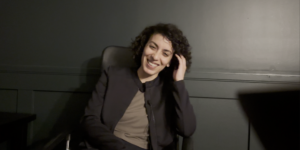
One of the demonstrators was 19-year-old Tiba Fadhil, who is his main protagonist. She calls herself a protester and revolutionary. This young Iraqi woman was born in Baghdad in 2000. When asked what she wants from the revolution, she answers, «My homeland!»
The film follows Tiba’s transformation from forced marriage and abuse to a young woman fighting for her rights. She wants to study and have an independent job, fight for #democracy, and for a new generation to be together in a different way than their parents. As one of the leaders of the 2019 demonstrations, Tiba chooses to continue her fight for freedom, a new Iraq, and a better future, even though she’s traumatised and depressed.
Why did Al-Azzawi choose a female character as the protagonist, I ask him: «I chose the female character in my film because the Iraqi, Muslim and Arabic women are misrepresented in the #media in general. Because when you think of Iraqi women, you will think of her wearing black, hiding at home, having no voice, no rights, no choice, having nothing. But it is actually the opposite, although you do also have this. There are so many women fighting for their rights now. I wanted to show that»
Al-Azzawi then adds: «My dream is to see Iraqi women and men free and liberated. Where everyone has freedom of expression and the same opportunities. Tiba and I share the same dream. We want to see Iraq free of religious control and militia groups. Her transformation from an abused girl to one of the leaders of the youth movement is very inspiring. Tiba and I also share the same childhood. She was three years old, and I was 9, when the US invaded our homeland, Iraq.»
«When I was searching for the main character for my film, I was looking for a strong Iraqi woman who is part of the youth demonstrations and wants to make change in Iraq. I wanted to tell the story from the woman’s perspective – but it’s not easy to find an Iraqi woman who agrees to be filmed. When I first met Tiba, I was confident I found my character. I found in Tiba’s story what is very much like many Iraqi women’s stories.»
One can wonder what kind of equality Iraq has, for example, compared to Norway, where Al-Azzawi now lives: «Before, in the seventies, Iraq was totally different when it comes to the equality of women and men, uh, because women were in position, and they were quite equal. But then came Saddam Hussein, and this changed.»
«We had to start from below zero.»
The background
The young people looked at each other more like strangers before, and the fight brought them together. But demonstrating involved danger in Baghdad. As Tiba says in the film: «Every day, we are facing a massacre. We are dying!». Against this, she still believes there is hope.
Al-Azzawi explains: «In this society that prevents the mixing of the sexes, men and women were standing side by side to fight for freedom and democratic change. This generation had had enough of militias, corrupt politicians, and foreign interference. They wanted Iraq to belong to them.»
Tiba joined her friends Yousif and Khader, along with thousands of other youngsters on the square, to demonstrate. The three friends started a medical team, spending days and nights together in their tent on Tahrir Square. They laugh, cry, are terrified, and face danger, feeling the desire of youth for change – and the strength of Iraqi women.
What happened in the aftermath of the US invasion in 2003, I ask Al-Azzawi: «Iraq lost so much. If you look at the situation in Iraq before 2003, we had the dictator Saddam Hussein. But after 2003, we had chaos because of the American invasion. They took down all the institutions, everything. We had to start from below zero. They came with ‘democracy,’ but we only got chaos and corruption – politicians who just wanted to steal. Also, the religious leaders were involved in that. We think they just want everything for themselves. They are not giving anything to us, the people of Iraq. And after 2003, we had civil war, conflicts between different sects, and then Al Qaida – a lot of car bombs all over the place. Then came #ISIS. I would say the main problem was the invasion. This is where everything started.»
«The peaceful youth are just chanting, waving the Iraqi flag, sitting together, discussing, playing music, writing poems. The government is not used to it. They are so afraid of it.»
Revolution
Normally, the idea of ‘revolution’ is a term of the past or for idealists; today, people would rather experience reforms. But the youth of Iraq are determined; they really want to change the country. When you know the youth represent 70 percent of the population, maybe it is not such a naïve ambition. I ask Al-Azzawi: «I think the revolution is a response of dreamers. Though I think revolutions have an effect, and it can change, not in one year or two years, or maybe ten years. It takes time, but I think it’s very necessary. We need to have these dreamers. I don’t think we are naive. We want to make creative change. But step by step.»
 «People are very aware now, especially the youth, they don’t want this regime anymore. And still, we have, of course, a long way to go to make any change, to throw the regime out. But even the militia now are afraid to say that they are militia. Not like before, when they were proud of it.»
What, then, about the effect of non-violent protests? Will these have any effect on governments? Compared to the more violent ones, I ask him: «The dictators and also this kind of government are more afraid of peaceful demonstrations and revolution than weapons and #violence. They know how to use violence and how to kill people. But they don’t know how to resist us. The peaceful youth are just chanting, waving the Iraqi flag, sitting together, discussing, playing music, writing poems. The government is not used to it. They are so afraid of it.»
Iraq hasn’t been alone in protests against governments in the #Middle East# in our century. Protests or the urge for revolution have been in #Egypt (Arab Spring, 2011), #Tunis, #Syria, and more recently, by the women’s movement in #Iran. But in 2019, the revolution in Iraq was terminated by COVID. Tiba was down there in al-Tahrir Square from October to when COVID happened in April. But why was 2019 such a big event? I ask: «During the #Arab Spring#, we also had demonstrations in Iraq, and I was a part of it. We had many different demonstrations in the past. We are building up each time we are demonstrating, or as we like to call it, making an evolution. It’s becoming bigger and bigger. The demonstrations in 2013–14 were much smaller than the ones in 2019. Hopefully, in 1–2 years, maybe soon, it will be even bigger.»
What about negotiations with the government? «Well, in Iraq, we have been trying to talk with the government; some dialogues have been going on. There have been discussions and meetings with the different governments we have had. But they never do anything with their promises.»
So, where is the way ahead, getting representation in the parliament? «There is a very small percentage of the Iraqi people who are actually voting. In the last two elections, less than 40 percent. We don’t trust the politicians or the parties. But out of the demonstrations, some young people actually established about three new parties. They now have seats in the parliament.»
Foreign powers
Another topic is how foreign powers can influence a country to make a change if they cannot do it themselves. Although the protesters in the film are saying no to foreign powers, I ask if Al-Azzawi believes help can come from outside: «Speaking about the foreign influence on our country is really sensitive. It could be good, and it could be bad. If you look at what happened in the US invasion of Iraq, we don’t want this kind of interference, which destroyed everything. We don’t want foreign support of the militias or support of the regime now in Iraq. I think it is better just to leave us alone – but maybe support the youth so we can change from within.»
What about the regime and how they cooperate with foreign politicians: «During the demonstrations, the Prime Minister authorized the police and the military to kill the demonstrators. He had at the same time a meeting with #Erna Solberg#, for example, at that time the Prime Minister of Norway – while we were being killed in the streets. And also with many other foreign leaders.»
If we talk about democracy, since the West has a lot of issues with egoism, #commercialism, #capitalism, and Western values. What kind of democracy will the Iraq youth have? I ask: «We want to develop an understanding of our own democracy, not importing it from outside, although we will find inspiration from the West. The South is different. For example, capitalism, we don’t want this. We want more solidarity and more people to be equal. We don’t want to just copy the West because then we have nothing left of our identity, our history. Remember that Iraq was the first civilization in the world, with a rich history – also with the first established laws in the world.»
I have to ask Al-Azzawi what freedom means for him, not only freedom from: «Freedom in my mind is to be to do whatever you want almost without harming any other people. To be able to speak, use your voice, raise your voice. To just be.»
Not to have two cars, I reply, and he shakes his head: «No, it’s the opposite. Freedom is also much bigger than freedom of speech. What about freedom to get educated, whatever sex.»
Is there a limit to how many of the killed should be shown in such a documentary?
Film and violence
What is the possibility for Iraqi filmmakers now and before? «During the time of Saddam Hussein, 20 years of his rule, we saw #propaganda films. Those filmmakers didn’t want to make everybody understand. But after 2003, we had to develop everything from scratch because America had taken down all the institutions. So now, some movies are coming out of Iraq, but very few. There are mostly commercials.»
A film is a medium that can influence people. But what about the amount of violence that could or should be used in a film – like the 2019 demonstrations, where around 700 people were killed, according to Al-Azzawi? Is there a limit to how many of the killed should be shown in such a documentary before people turn around, numbed by blood and suffering? Baghdad on Fire only shows two people getting killed: «I think it’s not about how many we are showing. I think it’s about how we are showing it. Because if you think of the one person who gets killed at the end of the film – you have been engaged with him and get to know him very well. He is one of the three main characters. I think he represents the 700 who were killed because it’s not about how many you show being killed. No, it’s about how you film.»
Rather, the director focuses on the sorrow of his friends: «Exactly. Sorrow, and you see the people around him, how they are affected by it, and you see the reflections. You became numb if you see too many killed – and then so what? Then we don’t have a place for anything else. In the film, I also tried to show that the revolution is much more – not only the frontline, like clashes with the police and violence. There are also beautiful moments. There is also a lovely community. There are also happy moments. And there is a romance there. There is love.»
The gender issue
Bagdad on Fire has been sold to the Norwegian State Channel (NRK) and several other channels internationally and won several prizes at festivals – the latest at the CiteCine film festival in France.

Norwegian Jørgen Lorentzen and the company Integral Film (owned together with Nefise Özkal Lorentzen) are the producers of Bagdad on Fire. He is a former journalist and professor in #gender studies# at The University of Oslo. He has produced 17 films.
As Lorentzen has worked with gender issues, I ask him about the choice of a female revolutionary as the protagonist in this film – and if Iraq has a typically ‘masculine’ problem: «Many countries in the world, among them, also the Arab world, the Middle East, have a lot of problems with their masculinity. This can lead to formal masochism if you don’t accept your own pain or your own suffering.»
«The problem is the oppression of women, related to the issue of women that they have difficulties with being respected. Also, the perspective on solving emotions and being open about your own vulnerability – which is often difficult. Even though it is published in a book called The Arab Man, it’s difficult to talk about the Arab man as something different than masculine.»
The gender issue has been developed in the film’s production: «Gender issue is an important part of the film, and it also talks to me, of course, but more because I’ve always been fighting for democracy or freedom of speech and human rights. When the project was presented to me by Al-Azzawi, I also found out how little I know about what’s going on in Iraq these last years.»
What about the afterlife of the film? «First of all, emotions are a very important part of humanity. And because you want to be able to draw the audience into the film, you must move their emotions. It’s just the way you can identify with the people there and feel afterward that you want to support these youngsters in their fight for democracy. It’s also a good film to use in educational material to screen to high schools and get the discussions going.»