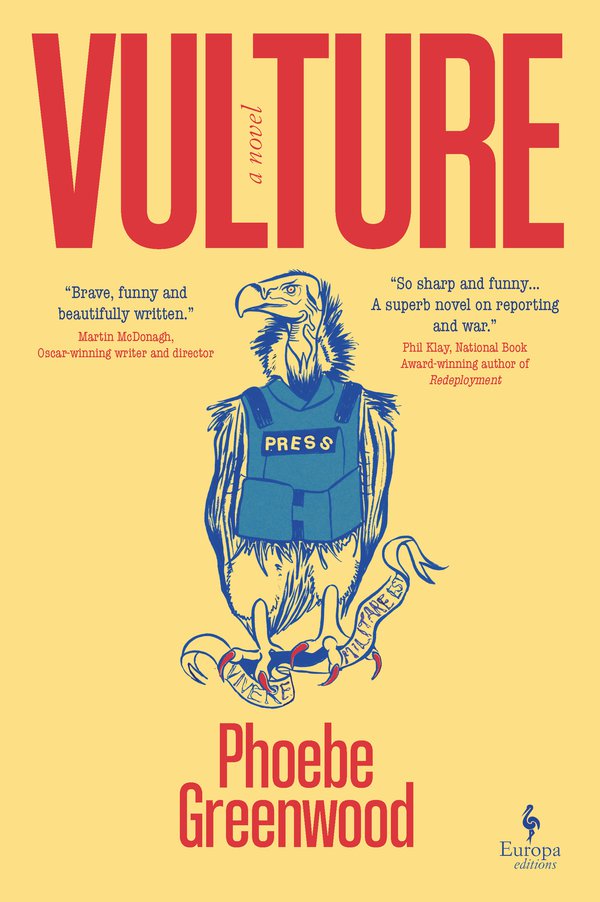
Among so many memoirs by #war correspondents, each more heroic than the last, this novel is the truest of all. As the title says: Vulture. That’s what they are.
Vultures. And in most cases, nothing else.
To non-war correspondents, it will seem a sort of mockery. Snarky and biting. Because a war correspondent cannot be stunned by Prozac and not hear an airstrike outside their window, right? No way. Who would ever take sleeping pills on the frontline? Anyone would be on high alert. And yet, that’s what happened on my first day in Syria.
On my first day in war, actually. The house next door was bombed. And the Canadian TV star I was with to learn the trade didn’t even wake up.
And somehow, I learned: I learned never to learn from others.
I have learned to be the opposite.

Sara Byrne, alter ego of Guardian reporter Phoebe Greenwood, is a British freelancer like many others. Penniless and disorganised. She lives in #Jerusalem. Or more precisely, in the Jerusalem of expats: that bar crawl where you hunt for assignments and opportunities. And so, in 2012, she replaced the Tribune correspondent, who was in #Syria and #Gaza, intending to make the front page and win back her ex. She is booked at the Beach Hotel. Like everyone else. With water, electricity, and chocolates on her pillow. And she looks for the juiciest story, which is, obviously, #Hamas. Even though she knows nothing about Hamas, or Gaza, or the #Middle East#, she knows it would be an exclusive. And when, by chance, she gets in touch with jihadists, her editor in London is thrilled. But only to quickly dismiss her when the #IDF kills the militant who has just left the interview, which she’d arranged in the hotel, not to take the trouble to walk out, and a boy too dies. On every page, really, on every paragraph that might sound like fiction to an outside reader, I thought I might probably know the journalist who had inspired that part of the story.
So many names came to my mind.
And at times, honestly, I thought it was me.
Forget all the epic tales of war correspondents. The books you have read, the movies you have watched. The TEDx talks you have listened to. None of that is true. Sara Byrne stands there, disheartened, before a thousand Mohammeds who answer her questions without ever actually answering, who say what needs to be said, like everyone else, whether it is about Palestinians, Israelis, Syrians, Afghans, what needs to be said, not to have any problem. In any case, she depends completely on her fixer, who is more than a translator, he is, as the term suggests, the one who solves everything for you, organises everything for you, does everything for you, he is the real journalist, because in the end, he also writes for you, in that half hour you have to write: and I swear, it really is like that – on October 7th, I was ordered to file 800 words in ten minutes on the reaction of #Ramallah to the Hamas attack: and I was still at the gate of the flight to Tel Aviv. And your fixer, by the way, is simply someone who speaks English. Sometimes you are lucky, and he is a journalist, but sometimes you are not. Sometimes, he is literally the first English speaker you come across. And he tells you the first things that come to his mind. Then, when an Italian photographer steps on a mine, Sara Byrne is speechless: she never imagined it was possible to die in Gaza because Gaza is dangerous if you are #Palestinian. Only if you are Palestinian. But if you are Italian, or English, or French, Gaza is the easiest and safest of wars, because you are tracked and followed metre by metre by IDF drones. H24. You will never be hit. Never.
You wouldn’t have said it, right?
Because it is something no one says. Otherwise, what kind of heroes would we be?
In the entire book, there’s not a single line about war.
War is merely the backdrop. A glow in the night, a distant roar.
Forget all the epic tales of war correspondents… None of that is true.
Because for many, many journalists, it is like that. For an #Anthony Shadid#, who went embedded with the poorest of the poor, and penned lively pages where everything came to life, you have 99 Sara Byrnes: like the one who, just back from one of the boats that rescue #migrants in the Mediterranean Sea, came over for dinner to my house, and told me only what was that she cooked on board, and how.
She looked like she was just back from an outdoor trip.
She even took a selfie on the bow, wearing shorts, flip-flops, and Ray-Ban glasses.
Sara Byrne only feels the war when she causes the death of a boy. She knocked at his mother’s door to apologise, with sweets, promising to help, and the mother, of course, is just furious: and even this, you will find it hard to believe, is not fiction. I have seen worse. I have seen a journalist not remember the name of the fixer killed because of him.
As if he had never existed.
The journalist, wounded, interviewed like a hero. And the fixer, dead: not even mentioned.
Sooner or later, Israel will reopen the Gaza borders. But will the international press really make a difference? Or will the Sara Byrnes of Western media simply pay Palestinian journalists and turn them into fixers, drivers, and waiters? Erasing them?
As Israel did?