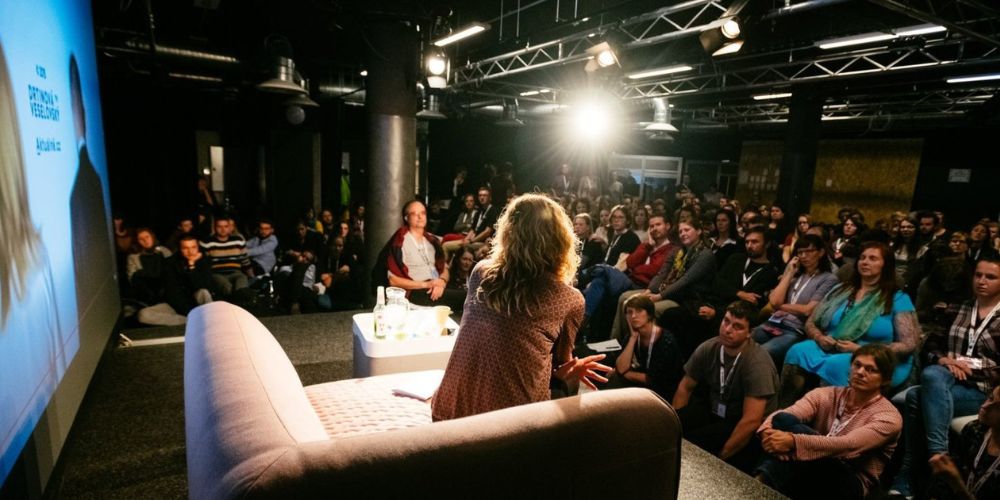
The Inspiration Forum at the 2024 Ji.hlava International Documentary Film Festival lasted five days and featured talks and discussions from the field of ethics. Its goal was to identify deeper transformations in the ecological, political, technological, and social spheres.
 For example, in «Artistic Vision and Accountability: A Central European Perspective on Freedom, Censorship, and Filmmaking Dilemmas», the panellists reflected on their responsibility making films towards the public and institutions. What is creative freedom and responsibility, and what is the possible influence of state or structural (market) censorship on creation? For example, what do you do when you film disabled children who don’t understand what it is to give consent? I asked the filmmaker of such a film – and got the answer that their parents knew what was good enough. She also told us she used days to gain trust before bringing in the camera – while another filmmaker said he always used his camera from the start without any problems. And ask yourself, where is the limit of what you should do when you use a camera – in the privacy of a woman’s home birth?
These reflective forums at Ji.hlava are welcomed. Another one had «technology» as the focus – and not only #Artificial Intelligence# (AI). Talks and lectures with titles like «Future of Free Time?» And «Less Work, More Life» debated the distribution of time between work and leisure. In one forum, I asked about using AI from a photo of a little girl in the ruins of #Gaza to make a video sequence with her ‘crying’. Would that be crossing an ethical line, about reality – although crying happens all the time? One answer was to blur that created sequence or make it into animation – to let the audience understand fake from reality.
Nature
Another topic in the Inspirational Forum was nature: For example, «All for the Forest and the Forest for All» discussed issues of #logging, protection zones, and our relationship with #nature as the basis for its protection. Another was «Forest as a Source of Life and Politics», which discussed #indigenous peoples’ victorious political and activist struggles for the right to natural resources.
When we talk about ethics, look at our reviews of four films on nature in this issue of Modern Times Review: A Call from the Wild; Plastic People; Documerica, Self-Portrait of a Nation on the Brink; and Valentina and the MUOSters – from protecting woods, looking at #microplastic, environmental crises, or radiation from a military station. They all have content that raises moral questions regarding our relation to nature.
The world is getting more violent and militarised
Warfare
Contemporary warfare and its transformations were also a recurrent topic in Ji.hlava, with lectures and panels like «War Without Rules» (on the changing world order), emotional messages directly from the war zones in Gaza and #Sudan in the «Women Behind the Frontline», and «War in the Archives» illustrating not only the brutality of recent decades but also the transformation of our perception of the media’s images of war (see below on Heidegger).
 Here another interesting panel was called «The Future of War and Peace,» where we heard that last year (2023), the world had 59 armed conflicts, the highest number of state-based conflicts since the Second World War. In the same year, 1200 million people lived within 50 kilometres of a conflict, up from 600 million in 1990. The world is getting more violent and militarised. And let me add, since we are talking about ethics here: Recently 300,000 people were killed over two years in #Ethiopia, roughly the same number as in Gaza and #Ukraine together. Have we heard much about this African country in media or documentaries?
But the panel was mainly about the role of women, so I raised the issue of whether there is a difference between men and women conducting killings as soldiers: Would a female soldier in the Israeli #IDF be more ‘caring’ than their fellow male soldiers? Or what about #Kurdish female freedom fighters in #Iraq and #Turkey, who operate in a more anarchistic way, where the group have a man and woman leading together? Think for yourself, as it was hard to get a clear answer from the researcher.
What is ethics, really?
Key ethical principles are fundamental guidelines that inform moral reasoning and behaviour across diverse fields, including #philosophy, #healthcare, #business, and personal conduct, but also as you document the world through film.
Let me list some topics: Autonomy – respect for individuals’ right to make their own decisions; beneficence – the obligation to act in ways that promote the well-being of others; nonmaleficence – the duty to avoid causing harm; justice – fairness in the distribution of benefits, risks, and resources; veracity – the duty to tell the truth and avoid deception, which supports transparency, honesty, and the informed consent process in relationships and professional practices; respect – recognising the inherent dignity and worth of every individual; and integrity – adherence to moral and ethical principles even when challenged, meaning consistency in values, honesty, and moral courage. These principles are often used in combination to address complex ethical dilemmas – and some more important than others, as you make a film about reality.
The world as picture
The philosopher Robert Sinnebrink’s held a lecture titled «Ethics and Accountability in Documentary Filmmaking: Creation, Argumentation, and Impact on Public Debate». He explored the ethical dimensions of documentary filmmaking from various perspectives: creators, documentary subjects, and viewers.
 Sinnebrink is also known for his book Cinematic Ethics: Exploring Ethical Experience through Film (2016). At Ji.hlava, he introduced the concept of «cinematic ethics,» in which a documentary film serves as a form of ethical understanding and political persuasion. And what about ethical accountability when using documentary rhetoric, which aims to educate, challenge, and influence societal and cultural-political debates?
This brings us to an important topic for me, about how we create our world and its values. As I asked and discussed with Sinnebrink, since he touched on ‘representation’ and media, I reminded him about the German philosopher #Martin Heidegger# (1889–1976), who I knew he had read. What about Heidegger’s essay The Age of the World Picture (1938)? Sinnebrink nodded and underlined how important this 86-year-old essay still is, as it talked about how we all are being formed or how we influence our reality. This is a reflection on the transformation of humanity’s relationship with the world, knowledge, and being – and so also for directors of documentaries.
The world becomes something to be mastered, measured, and systematised.
So let me end here, dear reader, with how Heidegger criticised our #modernity, saying that the world ends up as pictures.
Heidegger argues that the modern age is characterised by the concept «world picture», meaning that the world is conceived and represented as an object of human knowledge and control. This transformation is not merely about creating representations of the world (as in films, maps, or models) but reflects a fundamental shift in how humans relate to Being or existence itself. The world becomes something to be mastered, measured, and systematised. And modern science exemplifies this transformation by treating nature as something to be investigated, quantified, and manipulated according to human will. Reality is though increasingly reduced to calculable entities, losing its deeper existential and metaphysical dimensions. This new worldview frames the world as a calculable and exploitable resource.
Humanity also according to Heidegger now positions itself as the measure of all things, with the world existing as an ‘object’ for human representation. This contrasts with earlier epochs where humans saw themselves as integrated into a broader, divine, or cosmic order. This ‘anthropocentric’ orientation can be criticised for reducing Being to what is present-at-hand, stripping it of its mystery and richness. This happened during the #Renaissance and Enlightenment when human reason and autonomy became paramount. The emergence of the «world picture» culminates in a technical and instrumental mode of existence.
 Heidegger’s concept of «enframing» (‘Gestell’) – a word also Sinnebrink was clearly aware of from his German studies – refers to the framework or ‘ordering’ mode of revealing the world, which characterises the modern technological age. In this mode, the world and everything in it, including humans, are seen as resources (‘Bestand’) to be organised, calculated, and exploited for human purposes. ‘Enframing’ is not a tool or technology itself, but a mindset or an orientation toward Being or existence itself. It dictates how the world appears to us and how we interact with it. Also a danger for filmmakers, as they communicate the world through representations and pictures.
For Heidegger, the danger lies in humanity’s forgetfulness of Being (‘Seinsvergessenheit’), as the focus shifts entirely to controlling and manipulating entities. Therefore, the task in art, film, and philosophy is to have the potential to counteract the reductionism of the «world picture» by fostering a more poetic and contemplative engagement with Being – reminding humanity of dimensions of existence that lie beyond calculation and utility.
So, what should we, filmmakers, artists, and philosophers, do against a modern worldview emphasising representation, #control, and objectification? Unfortunately, this worldview today is all over, used in wars, modern technology, and the misuse of nature. How can many of us be inspired to find ways of being – that are deeper and with a more thoughtful engagement?